
Beyond Text: Leveraging Social Ties to Predict and Visualize Consumer Sentiments
Predicting and Visualizing Consumer Sentiments in Online Social Media
This paper introduces a social media analytics framework built on Apache Spark to predict and visualize consumer sentiments on Sina Weibo. It leverages Collective Classification (CC) algorithms, specifically a Gibbs sampling-based approach, to infer the opinion orientations of "neutral" users by analyzing both their local content features and their relational ties within the social network.
TL;DR
Most sentiment analysis tools focus solely on what a user says. This research shifts the focus to who a user is connected to. By using a framework built on Apache Spark and Collective Classification (CC) algorithms, the authors can predict the hidden sentiments of neutral users with over 80% accuracy by analyzing their social circles and network influence.
Problem & Motivation: The "Neutral" Majority
For brands, the most valuable social media users aren't just the loud fans or the vocal critics; they are the "Neutral" (Group U) users. These users often represent the largest segment of a social network and are the most susceptible to being influenced by their peers.
Traditional supervised learning (like SVM or simple CNNs) struggles here because:
- Semantic Complexity: Chinese text on platforms like Sina Weibo is idiomatic and hard to parse.
- Incomplete Data: Most users don't post enough clear, opinionated content to be accurately labeled by text alone.
- Relational Neglect: Standard methods ignore the "Social" in social media, missing the fact that opinions often flow through follower/friend connections.
The authors' insight is simple but powerful: If you know the opinions of a user's friends and the user's position in the network, you can predict their likely sentiment even if they haven't spoken up yet.
Methodology: The Collective Classification Engine
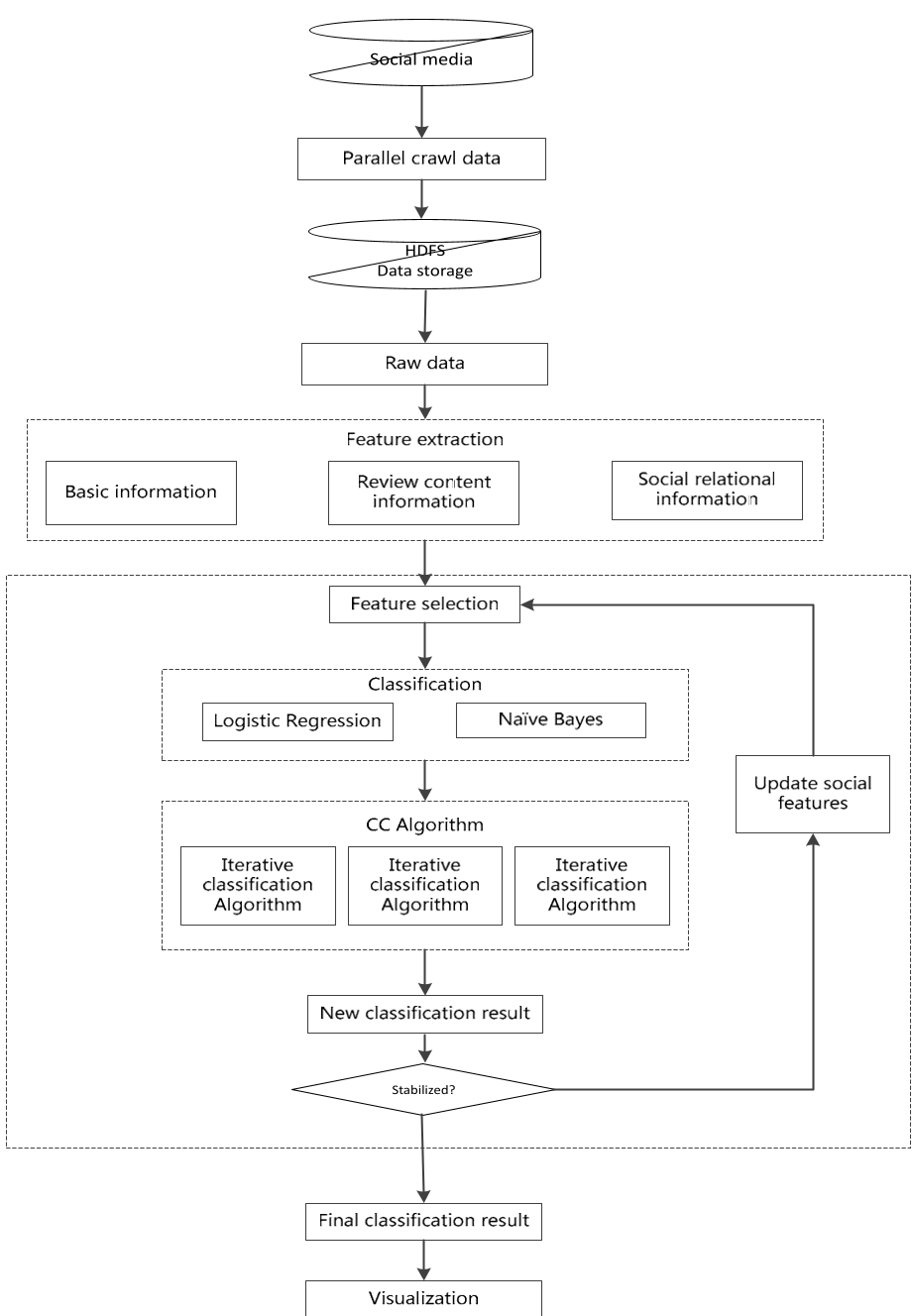
The framework starts by crawling data via Spark and cleaning it (removing "noise" like advertisements and redundant @-shares). The heart of the system is the Collective Classification process.
1. Relational Feature Extraction
Instead of just looking at word counts, the model extracts:
- Neighbor Sentiment: How many people this user follows are Positive vs. Negative?
- User Influence: A PageRank-based score to see how much weight a user carries.
- Closeness Centrality: Measuring how "central" a user is to the information flow.
2. The Feedback Loop: ICA vs. Gibbs Sampling
The paper compares two sophisticated iterative methods:
- Iterative Classification Algorithm (ICA): A local classifier labels unknown nodes, then updates all relational features, and repeats until the labels "stabilize."
- Gibbs Sampling (GS): Unlike ICA, which picks the best label at each step, Gibbs Sampling maintains a probability distribution and samples labels over hundreds of iterations (e.g., 600 times). The final label is determined by the frequency of the results, which prevents the model from getting stuck in "occasional" errors.
Experiments & Results
The authors tested their framework using data from Sina Weibo regarding Meizu smartphones (1,022 nodes, 4,696 edges).
Key Findings:
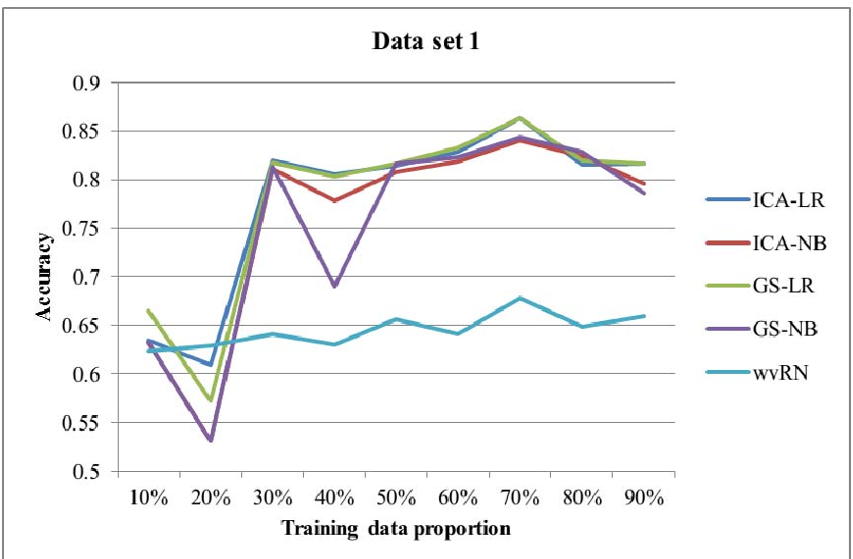
- The 30% Threshold: Accuracy stays low (below 70%) if less than 20% of the network is labeled. However, once 30% of the nodes are known, accuracy surges to over 80%.
- The Gold Standard: Gibbs Sampling with Logistic Regression (GS-LR) emerged as the winner, consistently outperforming the baseline wvRN (Relational features only) by nearly 20% in accuracy.
- Visual Insight: Using an "OpinionRing" visualization, managers can see at a glance that Positive users (red) tend to praise the OS (Flyme), while Negative users (blue) concentrate on hardware issues like battery life and broken screens.
Critical Analysis & Conclusion
Takeaway
This work proves that social networks are not just communication channels but information manifolds. By capturing the structural dependencies between users, we can fill in the "blanks" of consumer sentiment that text analysis alone misses.
Limitations & Future Work
While the Gibbs sampling approach is robust, the paper relies on a manual filtering process for noisy content and a predefined lexicon for Chinese NLP. Future iterations could benefit from:
- Automatic Noise Removal: Using deep learning to filter spam.
- Dynamic Networks: Social networks change; the model should ideally update sentiments in real-time as relationships shift.
- Multi-level Visualization: Handling "Big Data" scales where millions of nodes might clutter a single OpinionRing.
For marketing managers, this is a roadmap: stop looking at comments in a vacuum and start looking at the influence maps.