
RMTL: Decoding Personality on Social Media via Robust Multi-Task Learning
Predicting Big-Five Personality for Micro-blog Based on Robust Multi-task Learning
This paper introduces a Robust Multi-Task Learning (RMTL) framework for predicting the Big-Five personality traits (Neuroticism, Agreeableness, Extraversion, Conscientiousness, Openness) using Sina Micro-blog data. By decomposing the parameter matrix into low-rank and group-sparse components, the method outperforms traditional single-task and standard multi-task learning models.
Executive Summary
TL;DR: This research addresses the challenge of predicting the Big-Five personality traits from Sina Micro-blog behavior by moving beyond independent classification tasks. By introducing a Robust Multi-Task Learning (RMTL) approach, the authors successfully exploit the latent correlations between personality traits (e.g., the link between Agreeableness and Conscientiousness) while identifying and isolating irrelevant task associations that would otherwise degrade model performance.
Positioning: This work bridges the gap between psychometric modeling and machine learning, specifically improving upon the "one-size-fits-all" assumption in multi-task learning for small-scale datasets typical in social psychology.
Problem & Motivation: The "Small Data" and "Mixed Relatedness" Dilemma
In the realm of social media mining, obtaining high-quality ground-truth labels for personality traits requires users to complete lengthy psychological questionnaires (like the BFI-44). Consequently, researchers often face two major hurdles:
- Overfitting: Small training sets lead to poor generalization when using single-task models like Random Forest or SVM.
- Task Heterogeneity: The Big-Five traits are not a monolithic block. While some traits share psychological drivers, others—like Agreeableness and Openness—show no statistical correlation. Traditional MTL forces all tasks to share information, which introduces "negative transfer" from irrelevant tasks.
Methodology: Synergy through Decomposition
The core innovation lies in the decomposition of the weight matrix , which maps user features to personality scores. The authors define as the sum of two distinct structures:
1. The Low-Rank Component ()
The matrix captures the shared information between correlated personality traits. By applying a trace-norm (the sum of singular values), the model is forced to find a low-dimensional subspace that explains multiple traits simultaneously, effectively reducing the risk of overfitting.
2. The Group-Sparse Component ()
The matrix acts as a "buffer" for irrelevant tasks. By using the norm, the model can identify features or tasks that do not fit the shared structure, preventing unrelated traits from polluting the learning process of others.
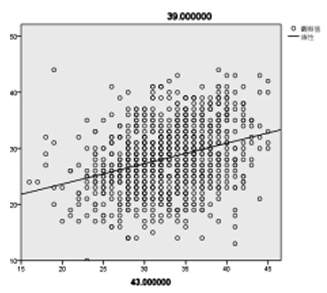 The relationship mapping: Correlated traits (Agreeableness and Conscientiousness) share information, while Openness is isolated as an outlier.
The Optimization Loop
The authors utilize an Accelerated Proximal Gradient method to solve the objective function. This ensures that the model converges quickly () despite the complex mixed-norm constraints.
Experiments & Results: Robustness Validated
The study utilized a dataset of 994 active Sina Micro-blog users, extracting 114 features (12 profile characteristics and 102 linguistic features via TextMind).
Comparison with Baselines
The RMTL method was pitted against:
- Single-Task Methods: Naive Bayesian (NB), Logistic Regression (LR), Random Forest (RF), and RepTree.
- Standard MTL: Simple Multi-task learning assuming total relevance.
Key Findings
- Higher Precision & Recall: Across all five traits, RMTL consistently showed higher F1-values than single-task models.
- Elimination of Negative Transfer: RMTL outperformed standard MTL, proving that identifying "irrelevant tasks" is crucial when traits are not universally correlated.
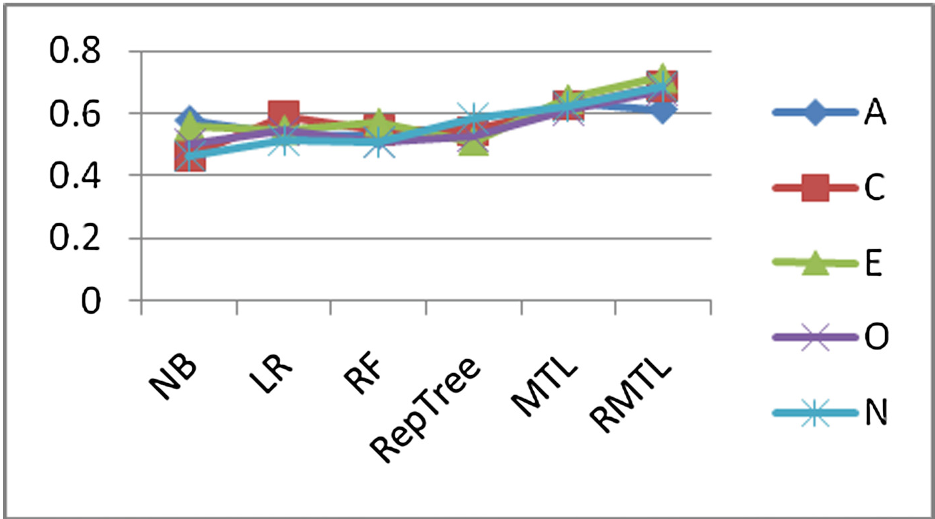 Comparative performance across Naive Bayesian, Logistic Regression, Random Forest, RepTree, MTL, and the proposed RMTL.
Critical Analysis & Conclusion
Takeaway
The RMTL framework successfully mitigates the "data scarcity" problem in social media psychology. By recognizing that tasks can be "partially related," it reflects the reality of human personality more accurately than traditional algorithms.
Limitations & Future Work
- Scalability: While 994 users is sufficient for a study, "Big Data" contexts involving millions of users might require more efficient stochastic optimization versions of RMTL.
- Feature Evolution: The reliance on manual linguistic features (TextMind) could be supplemented by Deep Learning embeddings (e.g., BERT or RoBERTa) to capture more nuanced semantic context in micro-blogs.
Ultimately, this work serves as a robust foundation for building more nuanced, psychologically-aware AI systems.