
The Social Signal: Predicting Build Failures via Developer Communication Networks
Predicting build failures using social network analysis on developer communication
This paper presents a predictive model for software integration build failures by applying Social Network Analysis (SNA) to developer communication patterns. By analyzing IBM's Jazz project, the authors demonstrate that while individual metrics like density or centrality cannot predict failures, a combination of these communication structural measures achieves SOTA-level predictive performance for build outcomes.
TL;DR
Can the way developers talk to each other predict whether their code will actually work together? This paper argues yes. By analyzing the communication networks surrounding IBM's Jazz project, researchers found that while individual "social" metrics aren't enough, a holistic view of a team's communication structure can predict integration failures with high precision (up to 76%), often weeks before the actual build takes place.
Background: Beyond the Codebase
In large-scale software engineering, the bottleneck is rarely just the code; it’s the coordination. When developers are distributed across different time zones and sub-systems, communication breakdowns lead to integration "hell." Historically, we've tried to predict bugs by looking at "code churn" or "complexity." This paper shifts the lens toward the Social Topology—the invisible web of comments, mentions, and subscriptions that link developers.
The Problem: The Subjectivity Gap
Prior research on team coordination has been largely qualitative, relying on interviews or subjective project reviews. Furthermore, most studies look at the project as a whole, missing the granular, day-to-day failures that happen during continuous integration. The authors identify a "missing link": objective evidence connecting communication structures to specific, measurable integration outcomes (the "Build Result").
Methodology: Mapping the Developer Web
The researchers utilized data from IBM’s Jazz project, a platform that tightly integrates task management with communication.
1. Constructing the Network
They didn't just look at who emailed whom. They built a directed graph where:
- Nodes: Developers involved in a build.
- Edges: Communication flow (e.g., Developer A comments on a Work Item, and Developer B is subscribed to it).
2. Social Network Measures (SNA)
The model extracts several sophisticated metrics to characterize the "shape" of the team:
- Density: How well is everyone connected?
- Centrality (Degree & Betweenness): Are there "gatekeepers" or "information bottlenecks"?
- Structural Holes: Is the information flow redundant or diverse?
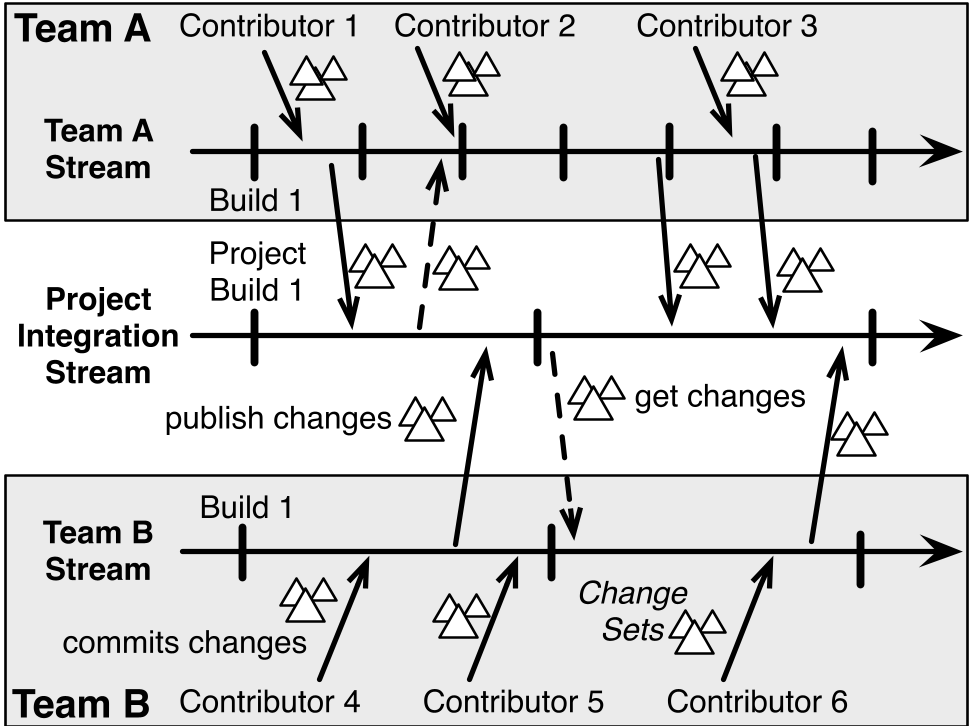 Figure 1: The flow from individual team streams into the project integration stream—the "Integration Build" being the ultimate test of coordination.
Why It Works: The "Combined" Insight
A key finding of the paper is that no single metric is a silver bullet. You cannot look at "Density" alone and say a build will fail. However, when these metrics are combined into a Bayesian classifier, a pattern emerges. The "Social Signal" becomes clear only when you look at the entire structural context of how information is moving (or failing to move) through the group.
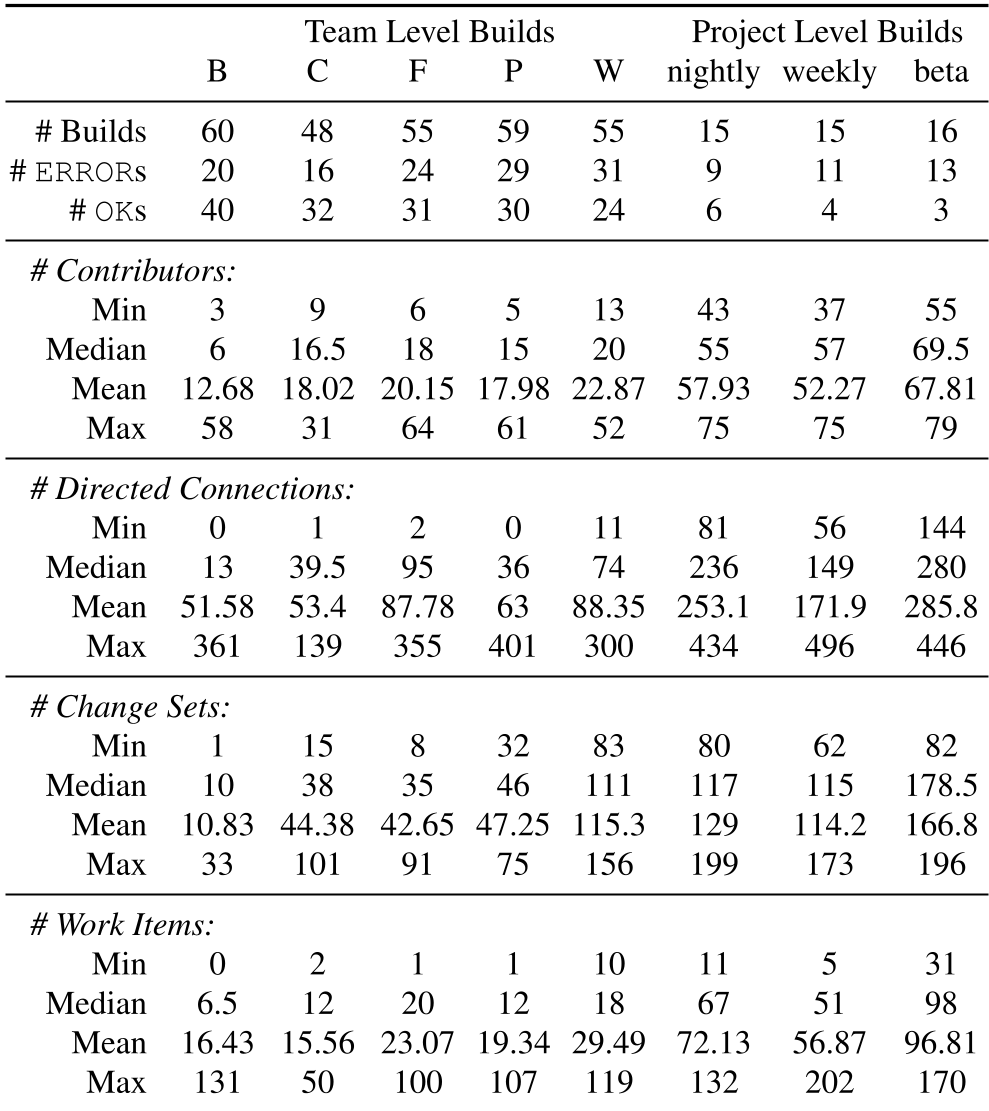 Table 1: Descriptive statistics of the five teams and three project-level integrations studied.
Key Results & Performance
The predictive model was validated using "leave-one-out" cross-validation. The results were striking:
- Recall: 55% - 75% for team builds.
- Precision: 50% - 76% for team builds.
- Project-Level Success: For nightly and weekly builds, the model was even more accurate, with Error Recall surpassing 89%.
Crucially, the authors tested the model using only the first 25% of the communication time interval. Even with this limited data, the predictive power remained high. This means the model acts as an early warning system, giving teams time to fix coordination issues before they waste resources on a failed build.
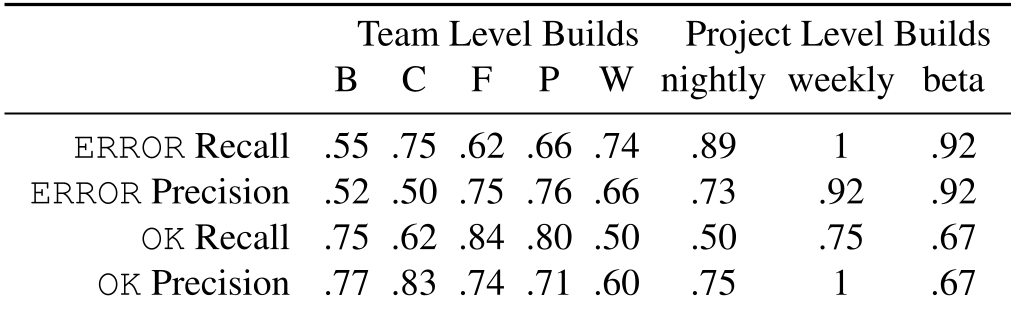 Table 2: Precision and Recall values across different teams, showing the model consistently beats "random guessing."
Critical Analysis & Future Outlook
Takeaway: This work validates the idea that software development is as much a social endeavor as a technical one. The communication patterns are not "noise"—they are leading indicators of technical success.
Limitations:
- Platform Specificity: The study is tied to the IBM Jazz environment and its specific "Work Item" commenting culture.
- Missing Channels: It does not account for "water cooler" conversations or private Slack/Instant Messaging, which are harder to mine but equally critical.
Future Work: The authors suggest integrating these models directly into IDEs. Imagine a dashboard in VS Code or IntelliJ that warns a manager: "Team coordination looks fragmented; there is a 70% chance the Friday integration build will fail."
Conclusion
By treating developer communication as a formal network structure, we can move from "guessing" why integrations fail to "predicting" them. This paper paves the way for a new generation of Socially-Aware Development Tools that prioritize human coordination as much as code quality.