
Who Will Trade With Whom? Bridging Social Graphs and E-Commerce via Second Life
Who will trade with whom?: Predicting buyer-seller interactions in online trading platforms through social networks
This paper explores the predictability of buyer-seller interactions in online marketplaces by leveraging external online social network (OSN) data. Using a large-scale dataset from Second Life, the authors demonstrate that social network features can significantly improve link prediction performance, achieving an AUC of 0.641.
TL;DR
Can your social circle predict your shopping habits? This study investigates whether links in an online social network (OSN) can predict future transactions in a marketplace. By analyzing data from the virtual world Second Life, the researchers find that social signals provide a 28% boost in predictive accuracy over random chance, offering a lifeline for "cold-start" recommendation scenarios.
Background: The Interplay of Social and Commercial Networks
In the digital economy, we are nodes in multiple overlapping networks: we follow friends on social media and buy from vendors on trading platforms. While these worlds seem distinct, human behavior suggests they are deeply intertwined. However, most prior work in link prediction has focused on single-source data. This paper addresses the gap by asking: If I know who you talk to, can I guess who you will buy from?
The Challenge of Data Silos
Predicting buyer-seller interactions is notoriously difficult because:
- Data Scarcity: New users have no trading history (the Cold-Start Problem).
- Structural Differences: Social networks are often unipartite (user-to-user), whereas trading networks are bipartite (buyer-to-seller).
- Data Access: Crawling large-scale, matched data between a social site (like Facebook) and a commerce site (like Amazon) is nearly impossible due to privacy and platform silos.
The authors circumvented this by using Second Life (SL), a virtual world where social interactions (MySecondLife) and commercial trades (SL Marketplace) are publicly accessible and intrinsically linked.
Methodology: Feature Engineering the Virtual World
The researchers extracted 35 distinct features categorized into Network-oriented (the structure of the graph) and Content-oriented (user metadata).
1. Network Features
They applied classic link prediction metrics:
- Adamic Adar & Common Neighbors: Measuring the overlap in friend circles.
- Preferential Attachment: The "rich-get-richer" logic—do popular socialites become popular sellers?
2. Content Features
They looked for homophily:
- Shared interests, common groups, and frequently visited virtual regions.
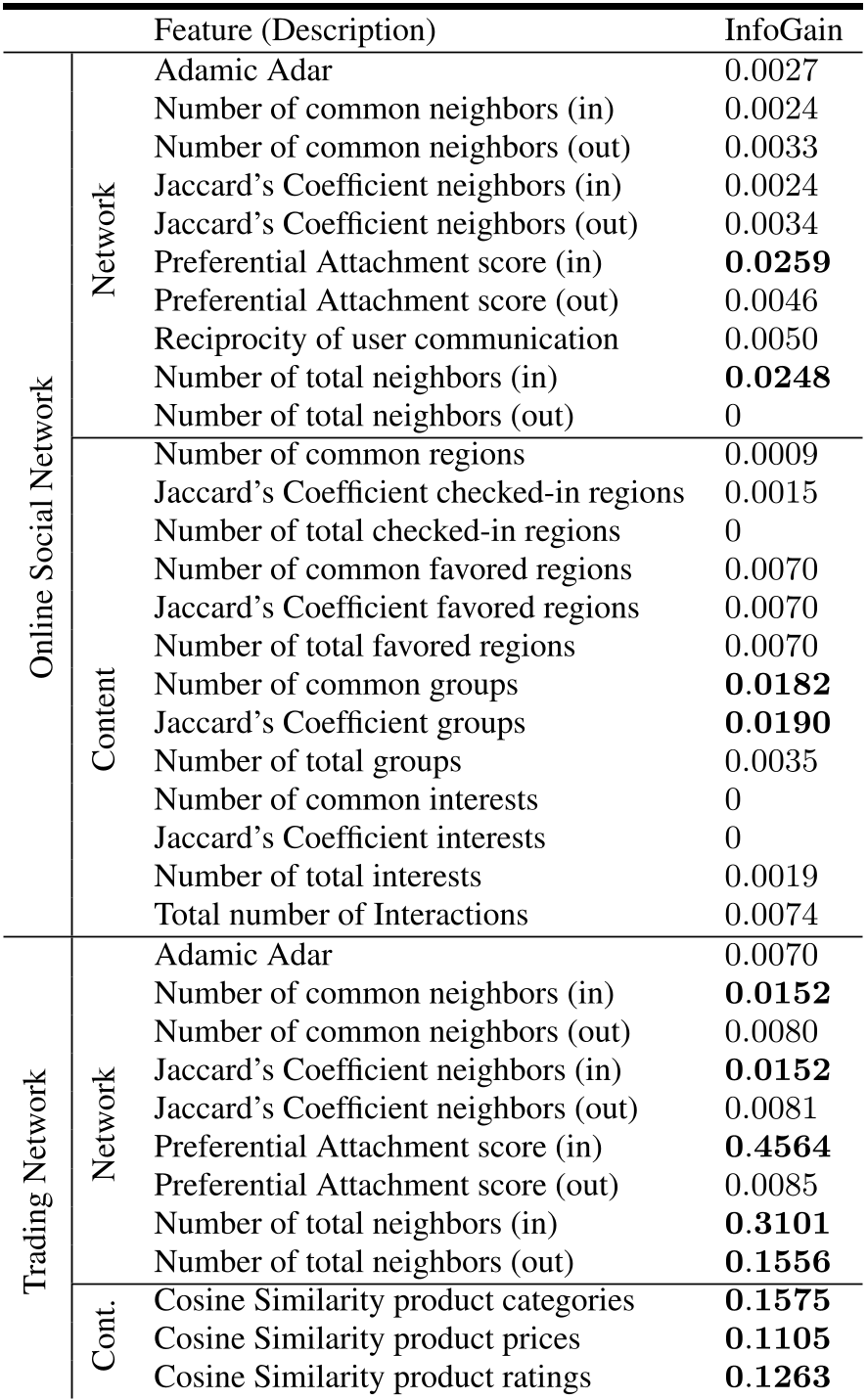 Note: Table 1 shows the InfoGain of various features. Note the high predictive power of 'Preferential Attachment' in both networks.
Key Findings: Social Signals Carry Weight
The researchers tested three classifiers: J48 (Decision Trees), Logistic Regression, and SVM.
- Social Media as a Proxy: Using only social network data, Logistic Regression achieved an AUC of 0.641. While not as high as trading-data models (0.899), it is significantly better than the 0.500 random baseline.
- Network > Content: In both social and trading datasets, the structural "Network" features (how you are connected) were more predictive than "Content" features (what you say you like).
- The Cold-Start Solution: The most critical takeaway is that social data works even when trading data is missing.
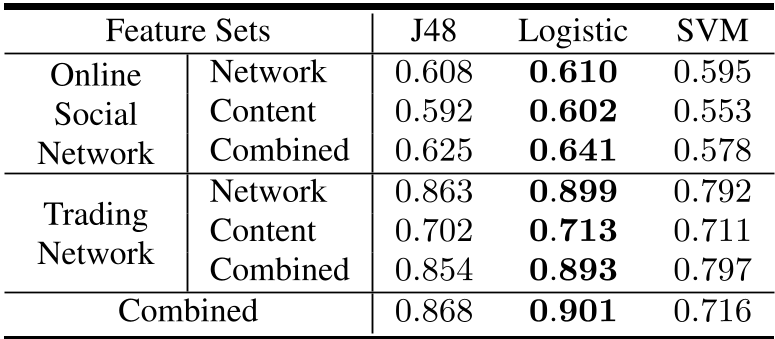 Table 2: Comparison of different feature sets. The combination of Social and Trading data offers the highest overall performance (0.901 AUC).
Critical Insight & Conclusion
Why does this work? The high value for Preferential Attachment suggests that visibility in a social network correlates with trust and status in the marketplace. If a user is a central "hub" in a social circle, they are more likely to be discovered as a seller.
Limitations
The study is conducted within a virtual world (Second Life). While SL mimics real-world dynamics, the behavior of avatars may differ from real-world consumers. Additionally, the study found that combining social and trading data only slightly improved the trade-only model, suggesting that social data is a secondary signal—vital for new users, but redundant for established ones.
Final Takeaway
For product managers and AI engineers, this paper validates the strategy of Social Commerce. Integrating "Login with Facebook/Twitter" isn't just for ease of access; it provides a high-value data stream to jumpstart personalized recommendations before the user even makes their first click in your store.