
What is My Next Job: Predicting the Company Size and Position in Career Changes
What Is My Next Job: Predicting the Company Size and Position in Career Changes
This paper introduces a predictive framework for job mobility, specifically targeting company size and position levels in the ICT industry. Leveraging large-scale career history data from LinkedIn, the authors propose a multi-feature model that achieves 72.1% accuracy for next company size and 73.9% for position prediction.
TL;DR
Predicting career moves is no longer just for HR headhunters. This research utilizes LinkedIn's massive career trajectory data to predict where (company size) and what level (position) an ICT professional will land next. By blending temporal facts (duration) with spatial status (rank and scale), the model hits a SOTA-level accuracy of ~74%, proving that our career jumps are far more predictable than they feel.
Problem & Motivation
The "Boundaryless Career" has replaced the gold-watch-at-retirement era. In the ICT sector, job hopping is the norm, yet analyzing this has historically been a qualitative mess of surveys and "gut feelings."
The authors identify a critical gap: while we know when people leave (temporal), we lack robust models to predict the destination (spatial attributes). The challenge lies in the noise of professional titles—where a "Lead" in a startup might be an "Engineer" at Google. We need a way to normalize these transitions.
Methodology: The Core
The researchers moved beyond simple counts. They formalize job mobility as a transition between career segments.
1. Feature Engineering
The secret sauce lies in two "Accumulated" features that reflect the intensity of experience:
- Accumulated Company Value (): . This gauges if a user is "climbing" to larger ecosystems or drifting.
- Accumulated Position Value (): . This measures the "density" of promotion history.
2. Normalization of Tiers
To handle data sparsity, the authors mapped the messy reality of LinkedIn into discrete buckets:
- Company Size: Large (>5000), Middle (500–5000), Small (≤500).
- Position Grade: Management, Senior, Ordinary, Internship.
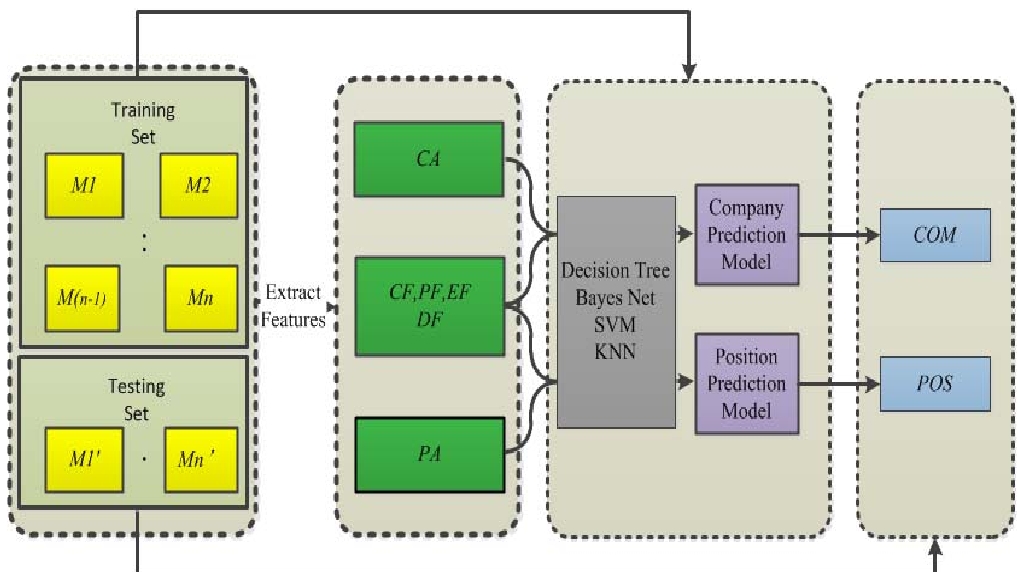 The multi-task and multi-feature prediction model adopts various classifiers like SVM and Decision Trees to process spatio-temporal inputs.
Observations from the Data
The study reveals striking patterns in the ICT labor market:
- The 12-Month Itch: Resignations peak at multiples of 12 months (annual cycles), usually following graduation months (May/June).
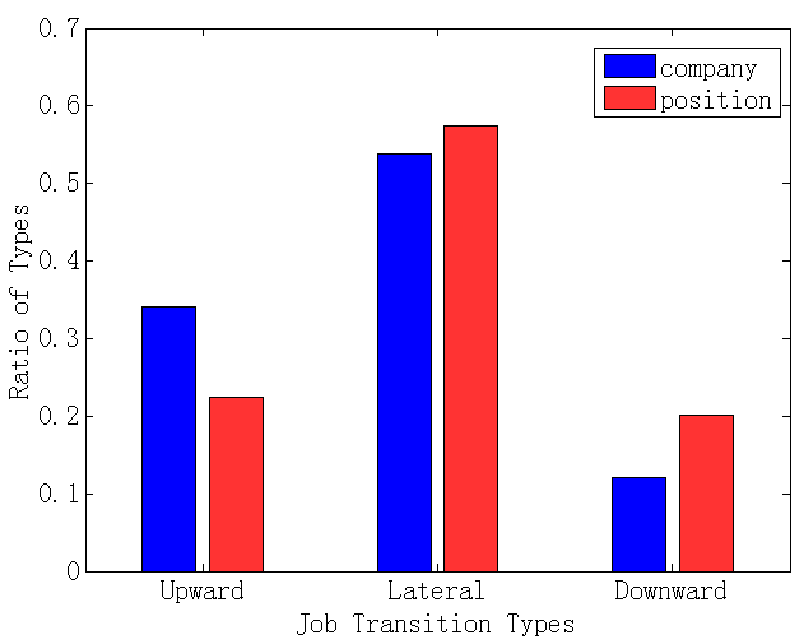
- Lateral Dominance: Over 50% of moves are "lateral" (same level, different company), though position "downgrades" are surprisingly common when individuals jump to significantly larger companies.
Experiments & Results
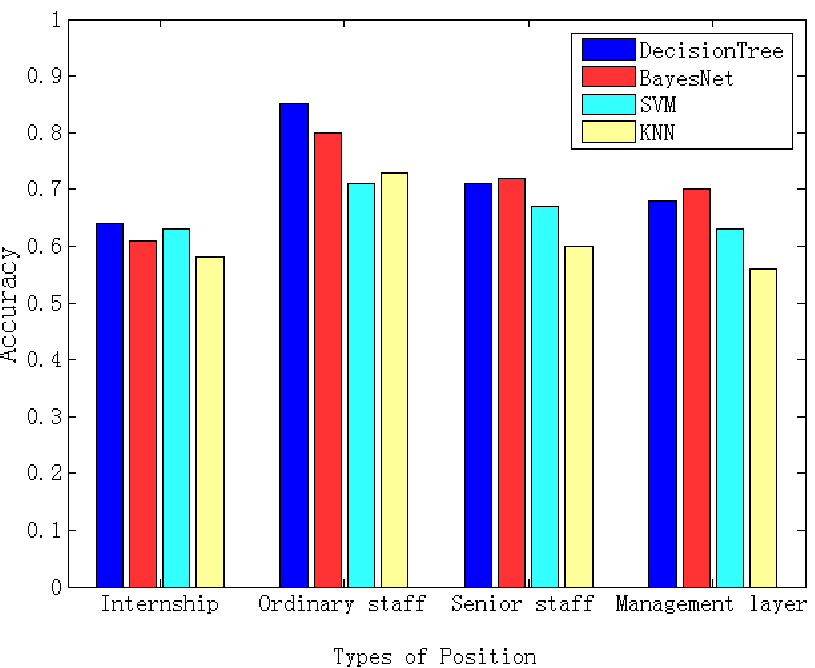
The researchers tested four main algorithms: Decision Tree (J48), Bayes Net, SVM, and KNN.
- Company Size Prediction: SVM emerged as the winner with 72.1% accuracy. Small companies were the easiest to predict due to their high frequency in the dataset.
- Position Prediction: Decision Trees outperformed others with 73.9% accuracy, likely because career progression often follows logical "if-then" hierarchical steps that trees model efficiently.
Critical Analysis & Conclusion
Takeaway
This work translates "career intuition" into a quantifiable feature space. The high accuracy suggests that academic credentials and recent job duration are the strongest predictors of the next step.
Limitations
- Granularity: The model uses broad categories (e.g., "ICT"). A developer's move from AI to Cybersecurity might look different than a move within Web Dev.
- Sentiment: The model lacks "desire" metrics. LinkedIn data shows what happened, not the emotional burnout or ambition that caused it.
Future Outlook
The logical next step involves LLM-based semantic analysis of job descriptions and Graph Neural Networks to model the implicit "prestige network" of companies. This isn't just a paper; it's a blueprint for the next generation of AI-driven job recommendation engines.