
MAG: Unlocking Customer Value through the Lens of Social Subgraphs
Predicting Customer Value with Social Relationships via Motif-based Graph Attention Networks
This paper introduces MAG (Motif-based Multi-view Graph Attention Networks), a novel framework for predicting customer value by integrating social relationship data with demographic and behavioral features. By leveraging higher-order network motifs and a gated fusion mechanism, MAG achieves state-of-the-art performance on large-scale e-commerce and review datasets, reducing MAE by up to 7.3%.
TL;DR
Classic marketing models like RFM (Recency, Frequency, Monetary) are hitting a ceiling because they treat customers as isolated islands. Researchers from Tsinghua University have introduced MAG, a Motif-based Graph Attention Network that proves your social circle is as predictive of your value as your credit card history. By analyzing "higher-order" structures—small patterns of friendship and trust—MAG outperforms traditional AI models by substantial margins.
Background: Beyond the Individual
In the world of Customer Relationship Management (CRM), the "Holy Grail" is predicting a customer's future value. Traditionally, if you bought a lot last month, you're "high value." But this ignores Social Influence. If your three best friends are "power shoppers," you are statistically more likely to become one too.
The problem is that standard Graph Neural Networks (GNNs) are "blunt instruments." They look at your direct neighbors but often fail to see the shape of those connections. Are you part of a tight-knit clique, or just a random follower in a massive broadcast chain? The shape (motif) matters.
The "Shape" of Money: Motif-based Methodology
The core innovation of MAG is the Motif-based Multi-view Graph Attention (MMA). Instead of looking at the social network as one giant mess of links, the authors break it down into 13 specific "triplets" (motifs).
1. Multi-view Graph Construction
The model creates different "views" of the network. One view might only show people in a perfect triangle; another might only show a "broker" connecting two others.
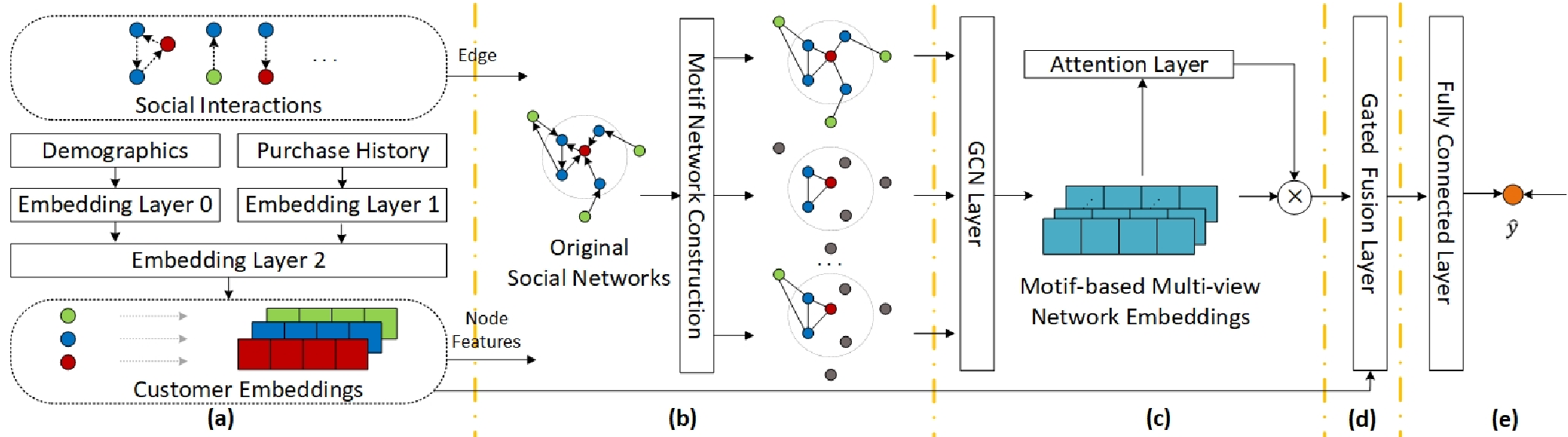
2. Gated Fusion (The Human Element)
Not everyone is equally influenced by their friends. MAG uses a Gated Fusion (GF) layer with two specific gates:
- Susceptibility Gate: Does this customer follow the crowd or stick to their own habits?
- Dependency Gate: How much does the final value prediction rely on social data vs. personal history?
Crucial Insights: Not All Friends are Equal
The most fascinating part of the study is the "Motif Analysis." The authors discovered that simply adding more motifs doesn't help—some are actually "noise."
- Informative Motifs: The "Fully-Connected" (t12) motif is a high-value signal. If you and two friends all know each other, you form a "high-value corp" that reinforces spending behavior.
- The Marketing Signal (t8): The "Down-linked mutual dyad" often represents professional recommendation behaviors. It reveals the "invisible hand" of marketing within a social circle.
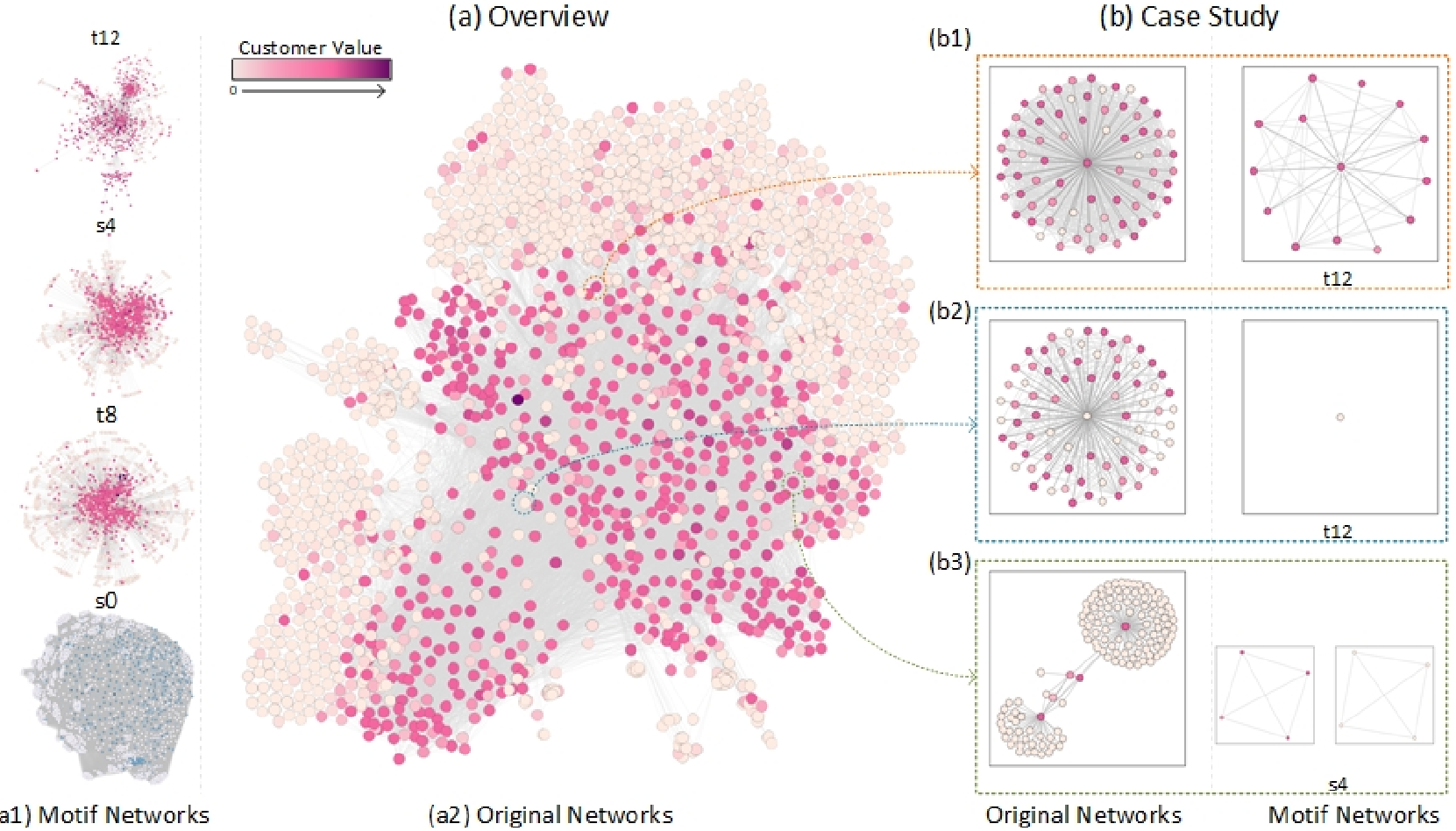
Performance & Results
The model was tested on Beidian (a social e-commerce giant) and Epinions.
- Accuracy: MAG beat standard GCNs and GATs consistently.
- Efficiency: By using motifs to "filter" the network, the model avoids the over-smoothing and noise issues that plague deep GNNs.
| Model | MAE (Lower is better) | Improvement |
|---|---|---|
| RF (Baseline) | 38.02 | - |
| GCN | 24.25 | ~36% |
| MAG (Ours) | 20.57 | ~46% |
Critical Perspective
While MAG is a breakthrough, it has a notable limitation: Computational Complexity. Finding motifs in a graph with millions of nodes is expensive. The authors used 3-node motifs to keep it manageable, but 4-node or 5-node motifs remain a "frontier" that is currently too heavy for real-time production systems.
Conclusion
MAG proves that Socio-Economic Embeddedness is real. If you want to find your most valuable customers, don't just look at what they buy—look at the geometry of who they know. The "clique" is the most profitable unit in the modern social economy.