
Beyond the Face: Decoding Depression and Culture through Linguistics and Non-Verbal Cues
Predicting Depression and Emotions in the Cross-roads of Cultures, Para-linguistics, and Non-linguistics
This paper presents a multimodal approach for the AVEC 2019 Challenge, focusing on two tasks: Detecting Depression with AI (DDS) and Cross-cultural Emotion Recognition (CES). The authors introduce linguistic and word-duration features from ASR transcripts that significantly outperform standard audiovisual baselines, while employing unsupervised feature adaptation (PCA/CCA) for cross-language emotion modeling.
TL;DR
Predicting mental health states like depression and cross-cultural emotions remains a "Holy Grail" in affective computing. This paper by Kaya et al. proves that sometimes, what we say and how long we pause is a far more powerful predictor of depression than complex deep learning models of facial expressions. By leveraging simple ASR (Automatic Speech Recognition) transcripts and unsupervised domain adaptation, the team crushed the AVEC 2019 baseline by nearly 3x in depression detection.
Problem & Motivation: The Generalization Gap
Most AI systems for depression detection fail when moving from the laboratory to the real world. This is primarily due to:
- Modality Fragility: Deep visual features (like ResNet) are sensitive to lighting and camera angles.
- Cultural Variance: Emotions aren't expressed the same way in Germany as they are in China.
- The "Wizard-of-Oz" Effect: Models trained on human-led interviews often fail when the interviewer is replaced by an autonomous AI system.
The authors' insight was that depressed speech has a rhythm. Patterns of silence, word repetition, and speech rate are more stable "biomarkers" for mental health than the high-dimensional noise found in raw video pixels.
Methodology: The Power of KELM and ASR
The research tackles two distinct problems using two specialized pipelines.
1. Depression Severity (DDS)
Instead of relying solely on the provided Deep Spectrum (VGG-16) audio features, the authors extracted ASR-based Low-Level Descriptors (LLDs):
- Word count and duration.
- Words per second (speaking rate).
- Inter-turn duration (the "gap" between the AI's question and the patient's answer).
These features were processed through Kernel Extreme Learning Machines (KELM). KELM is a fast, non-backpropagation learning strategy that uses a "kernel trick" to map features into a high-dimensional space, solving the regression task analytically.
 The study utilized the DAIC-WOZ corpus, involving interactions between human subjects and virtual agents.
2. Cross-Cultural Emotion (CES)
To tackle the cross-cultural gap, the authors used Unsupervised Feature Adaptation. Since Chinese data wasn't in the training set, they used PCA and Canonical Correlation Analysis (CCA) to align German and Hungarian features with the Chinese target domain. They also implemented a Gated Recurrent Unit (GRU) network with a "bottleneck" architecture to capture the temporal flow of emotions.
Experiments & Results: A Triple Threat
The results were eye-opening. While deep visual features (ResNet) performed beautifully on the development set, they crashed on the test set (overfitting). In contrast, the lingusitic features were incredibly robust.
- Depression (DDS): The fusion of ASR word-duration and Bag-of-Words features hit a 0.344 CCC, compared to the challenge baseline of 0.120.
- Emotion (CES): The system improved Arousal prediction by 31.3% and Valence by 6.6% on the Chinese dataset compared to the baseline.
The "Silence" Metric
The authors attempted to segment "Non-Linguistic Vocalizations" (NLV) like breathing and laughter. While difficult to automate, they found that combining even basic silence duration with word metrics pushed the performance further.
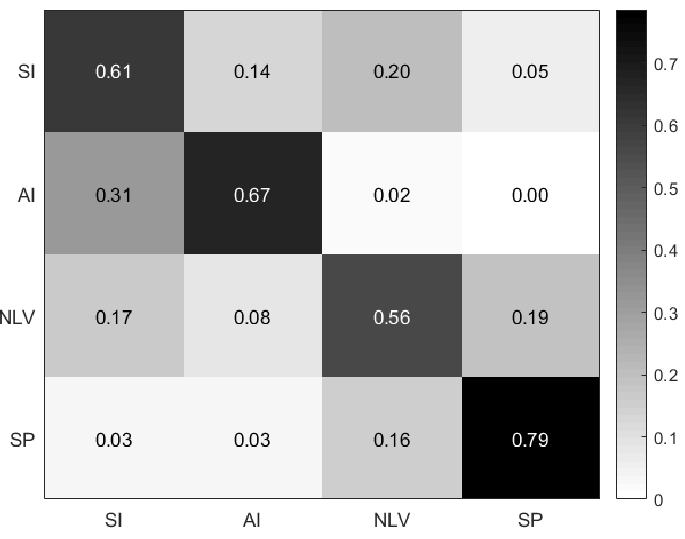 The confusion matrix shows the difficulty in distinguishing between silence (SI) and the virtual agent (AI), highlighting room for improvement in automated segmentation.
Critical Insight: Why Traditional DL Failed
The paper highlights a critical lesson for AI researchers: Correlation is not Generalization. The deep representations extracted from VGG and ResNet often captured features specific to the interviewer or the room, whereas the temporal spacing of words (ASR features) captured the pathology of depression itself.
Limitations
- Liking Dimension: The system failed to predict "Liking" (how much a subject liked a commercial). The authors admit that without deep textual sentiment analysis, audio and video alone are insufficient for abstract preferences.
- Segmentation Error: Automatically detecting "breathing" vs. "silence" remains computationally difficult in noisy environments.
Conclusion
This work underscores a pivot in affective computing: moving away from "Black Box" deep learning toward interpretable behavioral cues. By focusing on the temporal structural of dialogue and cultural domain adaptation, we can build mental health AI that actually works outside the lab.