
Mining the Digital Soul: Predicting Depression through Social Media Analytics
Predicting Depression Levels Using Social Media Posts
The paper presents a system for predicting depression levels by mining User Generated Content (UGC) from Social Network Sites (SNS) such as Twitter, Facebook, and LiveJournal. Using text classification techniques including Support Vector Machine (SVM) and Naïve Bayes, the model categorizes posts based on the nine clinical symptoms defined by the DSM-IV to identify mental health risks.
TL;DR
This study explores the potential of using Social Network Sites (SNS) as a continuous screening tool for mental health. By applying Support Vector Machines (SVM) and Naïve Bayes classifiers to user-generated content, the researchers built a system capable of identifying depressive symptoms across multiple platforms, achieving an impressive 100% precision with the Naïve Bayes model, albeit with challenges in general recall.
Context & Motivation: Why SNS?
Traditional clinical diagnosis is often a "snapshot"—a moment in time captured during a bi-weekly therapy session. However, depression is a persistent shadow that manifests in daily routines, sleep patterns, and language. With over 2 billion people expressing their raw emotions on social media, platforms like Twitter and Facebook have become "digital phenotyping" labs.
The authors argue that the current medical science is not 100% precise in diagnosing depression because it relies on patient memory. By mining User Generated Content (UGC), we can capture a person’s mood, thinking style, and social interactions in real-time, providing a more objective dataset than traditional self-reporting.
Methodology: From Raw Posts to Clinical Insights
The researchers utilized RapidMiner to construct a robust text-processing pipeline. The core of the approach lies in how the data is handled:
1. The Preprocessing Pipeline
To convert messy social media text into a format machines can understand, the system employs four critical steps:
- Tokenization: Breaking sentences into individual words.
- Stop-word Filtering: Removing noise like "the" or "is".
- Case Transformation: Standardizing text (lower case).
- Porter Stemming: Reducing words to their root form (e.g., "depressed" to "depress").
2. Theoretical Grounding (DSM-IV)
Unlike simple sentiment analysis (identifying "sad" vs "happy"), this work maps text directly to the nine clinical symptoms of Major Depressive Disorder (MDD), including suicidal ideation, loss of energy, and worthlessness.
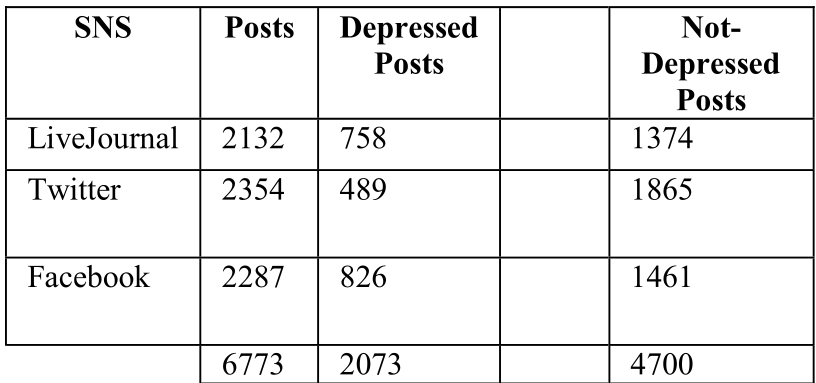 Table 1: Distribution of the manually trained dataset across different SNS platforms.
Experiments & Results: Precision vs. Recall
The performance was evaluated against a ground truth established by the Beck Depression Inventory (BDI-II) questionnaire.
| Metric | SVM Classifier | Naïve Bayes Classifier |
|---|---|---|
| Accuracy | 56.7% | 63.3% |
| Precision | 67% | 100% |
| Recall | 56% | 58% |
The Precision Breakthrough
The most striking result is the 100% precision achieved by Naïve Bayes. This implies that when the model flags a user as depressed, it is highly likely to be correct. However, the Recall (57%) indicates that the model still misses a significant portion of depressed individuals.
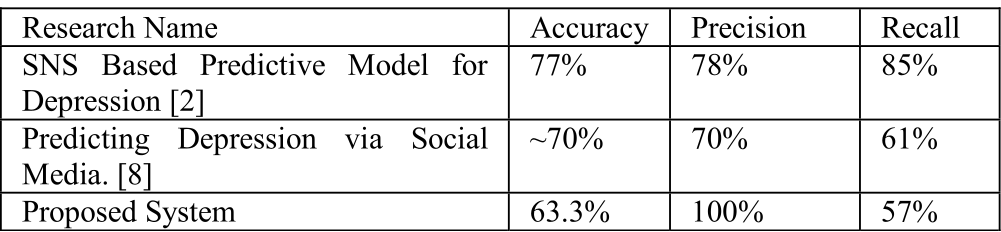 Performance comparison showing the proposed system focuses on high precision relative to prior work.
Critical Insight: The Linguistic Barrier
The authors provide a candid look at the limitations. One of the primary reasons for lower accuracy was the localization of data. Many participants were from Saudi Arabia, posing two major challenges:
- Slang: Sentiment in Arabic slang often carries meanings that standard NLP libraries struggle to parse.
- Activity Levels: Depressed individuals might be less active on certain platforms, making the data sparse.
Conclusion & Perspective
This work represents a vital step toward integrating AI into preventative mental healthcare. By shifting the focus from "reactive treatment" to "proactive screening," such tools could alert family members or psychiatrists before a patient enters a major depressive phase.
Future Outlook: The next frontier for this research involves moving beyond "Bag-of-Words" models toward Contextual Embeddings (like BERT or GPT-based models) that can better navigate local slang and the nuanced cultural expressions of mental distress.