
Bayesian MKL: Bridging the Affective Gap with Multi-View Probabilistic Learning
Predicting Emotional States of Images Using Bayesian Multiple Kernel Learning
The paper introduces a Bayesian Multiple Kernel Learning (MKL) framework for affective image classification. By integrating diverse low-level features (color, shape, texture) and employing a multilabel setup, the model achieves state-of-the-art performance on the IAPS dataset while providing probabilistic intensity distributions for mixed emotions.
TL;DR
Predicting how an image makes a human feel is notoriously difficult due to the "affective gap." This paper presents a Bayesian Multiple Kernel Learning (MKL) approach that doesn't just pick one feature; it learns to fuse color, shape, and texture through a probabilistic lens. By treating emotion as a multi-label distribution rather than a single category, it achieves superior accuracy (0.31 vs. 0.22 for standard SVMs) and reveals which visual elements—like edges and color moments—truly drive our emotional responses.
The "Affective Gap" Problem
In computer vision, we can identify a "dog" in an image with high precision, but predicting if that dog evokes "Awe," "Contentment," or "Fear" is a different beast entirely. Prior research often struggled because:
- Feature Selection Dilemma: It’s unclear which low-level features (e.g., contrast, hue, edge density) correlate with specific emotions.
- Emotional Ambiguity: A single image often evokes mixed feelings (e.g., "Sadness" mixed with "Contentment").
- Hard Labels: Most models force a "hard" classification, ignoring the intensity and distribution of the emotion.
Methodology: The Power of Multiple Kernels
The authors refuse to settle for a single feature view. Instead, they utilize Multiple Kernel Learning (MKL). Imagine each feature type (color layout, edge histogram, etc.) has its own "kernel" or similarity measure. The model learns a weight for each kernel, effectively identifying which features are most "telling" for emotional states.
Architectural Insight
The model is built on a hierarchical Bayesian framework. As seen in the graphical model below, the system shares kernel weights across different labels. This is a crucial design choice: it assumes that if a certain edge feature is important for "Grief," it likely carries information relevant to "Sadness" too.
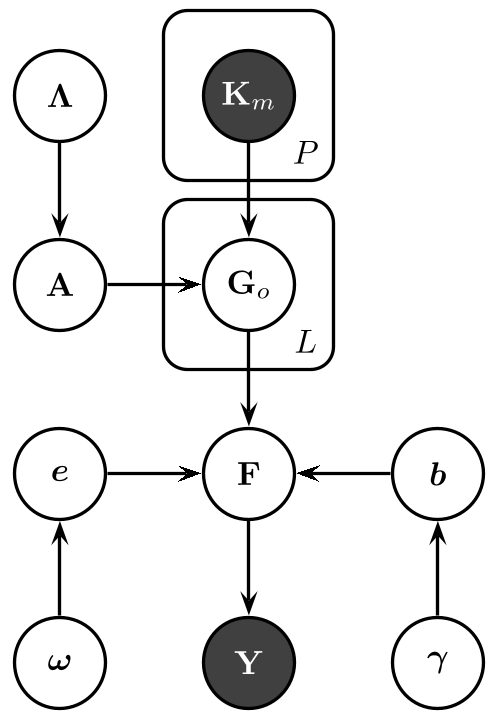
The inference is handled via Variational Approximation, which allows the model to remain computationally tractable while providing a full posterior distribution. This means instead of just saying "This is a Happy image," the model says "There is an 80% probability of Contentment and a 20% probability of Amusement."
Experiments and Results
The researchers tested their approach on the International Affective Picture System (IAPS).
SOTA Comparison
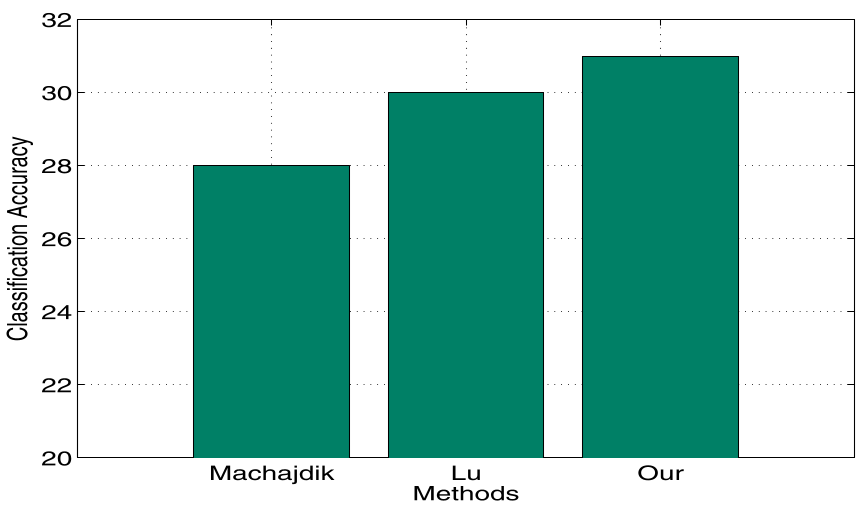
The Bayesian MKL model significantly outperformed traditional SVMs. While the best single-feature SVM (using Dominant Color) managed only 0.22 accuracy, the MKL approach reached approximately 0.31. This 9% jump proves that emotions are multifaceted and require a combination of visual "cues" to be accurately decoded.
Visualizing "What Matters"
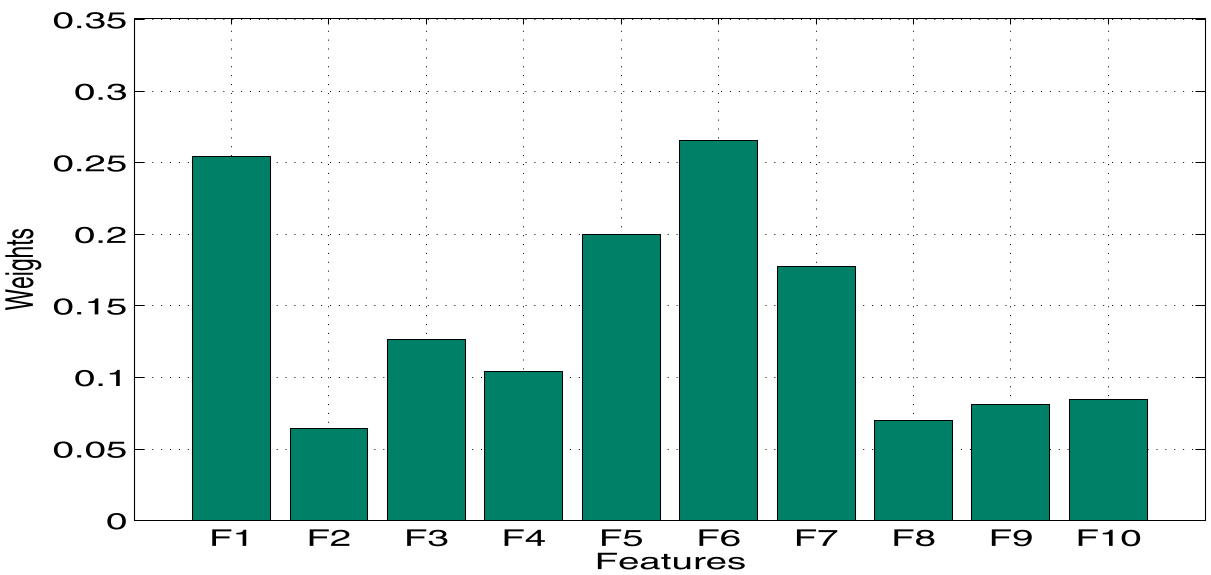
One of the most valuable outputs of this research is the feature ranking. By examining the learned weights, the authors found that Edge Histograms (F6) and Scalable Color (F1) were the most informative. This aligns with psychological theories suggesting that sharp edges and color saturation are primary drivers of human emotional arousal.
Critical Analysis & Conclusion
This paper succeeds by shifting the focus from creating better features to better feature integration. The use of a multi-label setup to capture emotional correlation is a brilliant "Inductive Bias" that mimics human psychology.
Takeaway: If you are dealing with subjective, ambiguous data (like emotion or aesthetics), don't look for a "silver bullet" feature. Instead, use a probabilistic framework that can weigh multiple perspectives simultaneously.
Limitations: The study uses low-level features only. In the modern era of Deep Learning, integrating these Bayesian MKL principles with High-Level Semantic features from CNNs or Transformers would likely push these results even further into the SOTA territory.