
OOD: Predicting the Climax of Social Media Storms Through "Weak Ties" and History Matching
15569_Predicting the Evolution of Hot Topics A Solution Based on the Online Opinion Dynamics Model in Social Network.
This paper introduces the Online Opinion Dynamics (OOD) model to predict the evolution of hot topics in social networks. By integrating unique confidence thresholds, influence radii, and a random interaction mechanism with strangers, the OOD model achieves state-of-the-art performance in both qualitative and quantitative opinion forecasting on the TianYa Forum dataset.
TL;DR
Researchers have developed the Online Opinion Dynamics (OOD) model, a novel framework that predicts not just if a social media topic will reach a consensus, but exactly what that opinion profile will look like at its climax. By combining personalized data inversion (History Matching) with sociological theories of "weak ties," the model outperforms standard physics-based opinion models in quantitative accuracy.
Background: Beyond Theoretical Consensus
In traditional academic studies of opinion dynamics, the goal is often binary: will a group eventually reach a consensus? However, for governments and enterprises, the "eventual" state is less important than the "climax" state. They need to know: How many people actually support us right now?
Prior models like the Hegselmann-Krause (HK) model simplified reality by assuming everyone talks to everyone else or that everyone has the same "open-mindedness." This paper argues that such models are too rigid for the messy reality of social media.
The Core Insight: Peer Pressure + Random Strangers
The OOD model operates on two brilliant intuitions:
- Personalized Parameters: Every user has a unique confidence threshold () and a specific influence radius (). Some people are easily swayed; others are stubborn.
- Weak Ties (The Stranger Effect): In a social network, you are primarily influenced by your "Friends" (). However, online browsing often exposes you to random "Strangers" (). Sociologically, these "weak ties" are often the most effective at injecting new information and changing minds.
Methodology: Parameter Inversion via History Matching
Instead of guessing these parameters, the authors borrowed a technique from oilfield reservoir engineering called History Matching. Using Particle Swarm Optimization (PSO), they looked at how users behaved in past events (e.g., the "Tianjin port explosions") to figure out their underlying social profiles.
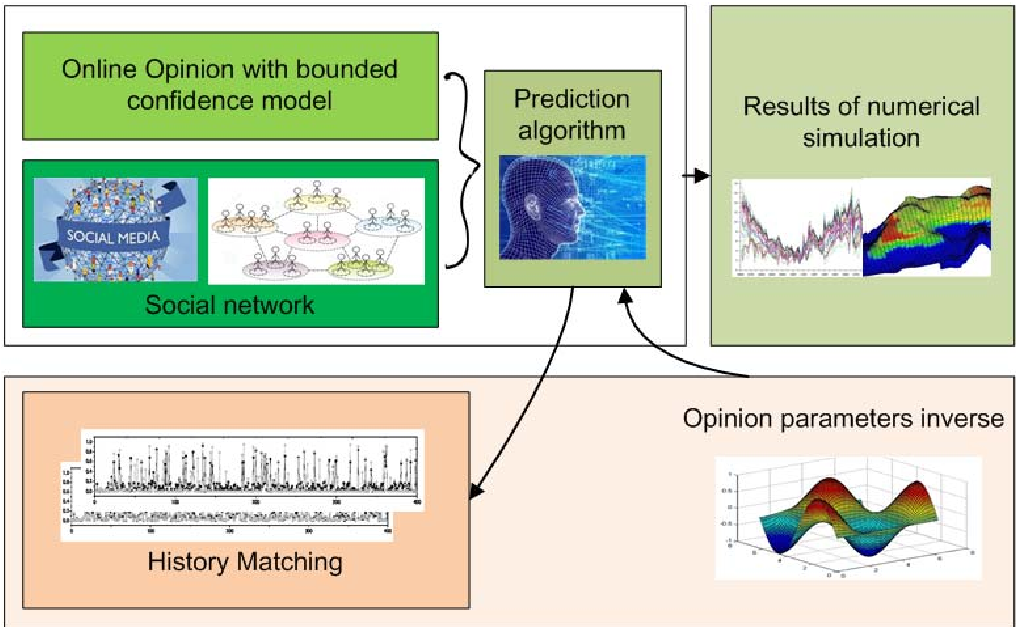 Figure 1: The OOD workflow – from parameter inversion via historical matching to climax prediction.
Experimental Results: Quantitative Breakthrough
The researchers tested OOD against five real-world hot topics from China's TianYa Forum. While previous models (HK-13 and HK-17) were "okay" at predicting the general vibe (Qualitative), they were terrible at predicting actual opinion levels (Quantitative).
| Model | Qualitative Accuracy (Binary) | Quantitative (25% Bias) |
|---|---|---|
| OOD (Proposed) | ~99% | ~60-77% |
| HK-13 | ~95% | ~20-30% |
| HK-17 | ~93% | ~19-22% |
The OOD model's success in quantitative forecasting is a massive leap forward for decision-support systems.
 Figure 2: History matching of predicted vs. real values. OOD (a) shows a much tighter fit to the real data points compared to its predecessors.
Why It Works: The "Strong Ties" Trap
The authors used Granovetter’s Weak Ties Theory to explain why older models failed. Older models are "Strong Tie" models—they assume information only flows in closed loops. This leads to information loss and echo chambers. By including random stranger interactions, OOD avoids this trap, allowing the simulation to "respond" to changes just as real online communities do.
Critical Analysis & Conclusion
Takeaway
The OOD model marks a transition from social physics (studying particles) to social computing (studying people). By recognizing individual heterogeneity and the importance of stranger-to-stranger interaction, it provides a tool that enterprises can actually use for risk management.
Limitations
- The "Closed Community" Requirement: The model works best in relatively closed environments like a BBS forum. On massive, fluid platforms like X (Twitter) or Sina Weibo, tracking the same 400 individuals across multiple events is much harder due to "node churn."
- Computational Cost: Using PSO for inversion across hundreds of thousands of users would be computationally expensive.
Future Work
The next frontier is scaling this model to work in "open" communities where new users are constantly joining and leaving the conversation halfway through an event's evolution.