
Forecasting the Flu: Why Symptoms, Not Search Terms, Are the Future of Epidemic Surveillance
Predicting Flu Epidemics Using Twitter and Historical Data
The paper introduces a flu epidemic prediction model that utilizes Twitter data filtered by symptom-based Boolean queries (ILI-Tweets) and historical epidemiological data. By capturing real-time "current conditions" more accurately than official sources, the system achieves an average correlation of 0.85 over 17 flu seasons.
TL;DR
Predicting flu outbreaks usually relies on historical data and doctor reports, but these are often delayed or revised after the fact. This paper presents a method that mines Twitter focusing on specific combinations of symptoms (e.g., fever AND cough) rather than just keywords. By using these "ILI-Tweets" as a real-time stable proxy for current infections, the researchers can predict seasonal peaks several weeks in advance with high accuracy (0.938 precision), outperforming both Google Flu Trends and complex simulation models.
The Problem: The Volatility of "Ground Truth"
In epidemiology, the current state of an outbreak is surprisingly hard to pin down. Official data from organizations like the CDC (ILICDC) are often unstable; they are updated weekly as more local clinics report in, meaning the "data for this week" might change three weeks from now.
Furthermore, search-based tools like Google Flu Trends (GFT) suffer from "information-seeking bias." If a news report mentions a bird flu outbreak in China, millions of healthy people might search for "flu symptoms" out of curiosity or fear, causing a spike in the data that doesn't correspond to actual sickness.
Methodology: From Medical Terms to Naïve Language
The core innovation of this study is the shift from diagnosis-driven monitoring to symptom-driven monitoring.
1. The Naïve Language Bridge
Doctors use words like "malaise" or "pharyngitis." Patients tweet about "feeling like a train hit me" or "sore throat." The authors developed an algorithm to automatically learn these naïve expressions, expanding a technical medical query into a broad, social-media-friendly net.
2. Boolean Symptom Validation
To filter out "noise" (people mereley talking about the flu), the model uses a Boolean query logic. It doesn't just look for "flu"; it looks for a match in two categories:
- Category A (Systemic): Fever, Chills, Malaise, etc.
- AND Category B (Respiratory): Cough, Sore throat, Dyspnea.
This ensures the tweets actually reflect an Influenza-Like Illness (ILI) case definition.
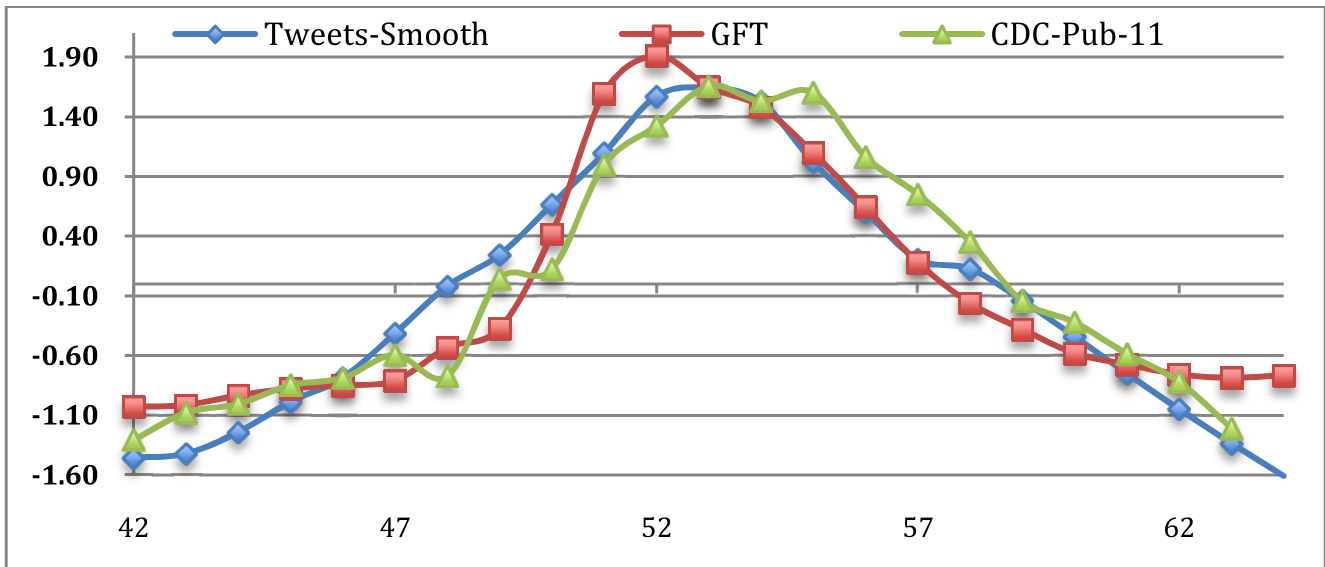 Figure 1: Comparison between ILI-Tweets, GFT, and CDC data. Note how Twitter and GFT lead the CDC actuals by approximately one week.
Prediction via Fusion and Prototypes
Once the real-time "current state" is established via Twitter, the authors use two strategies for prediction:
- The Prototype Model: Uses an "Average ILI Profile" derived from 17 years of data. This is particularly useful for "outlier" seasons that start very early or late.
- The Fusion Model: Compares the current season's early trajectory to past seasons, weights them by similarity, and "fuses" their future paths to predict the current one.
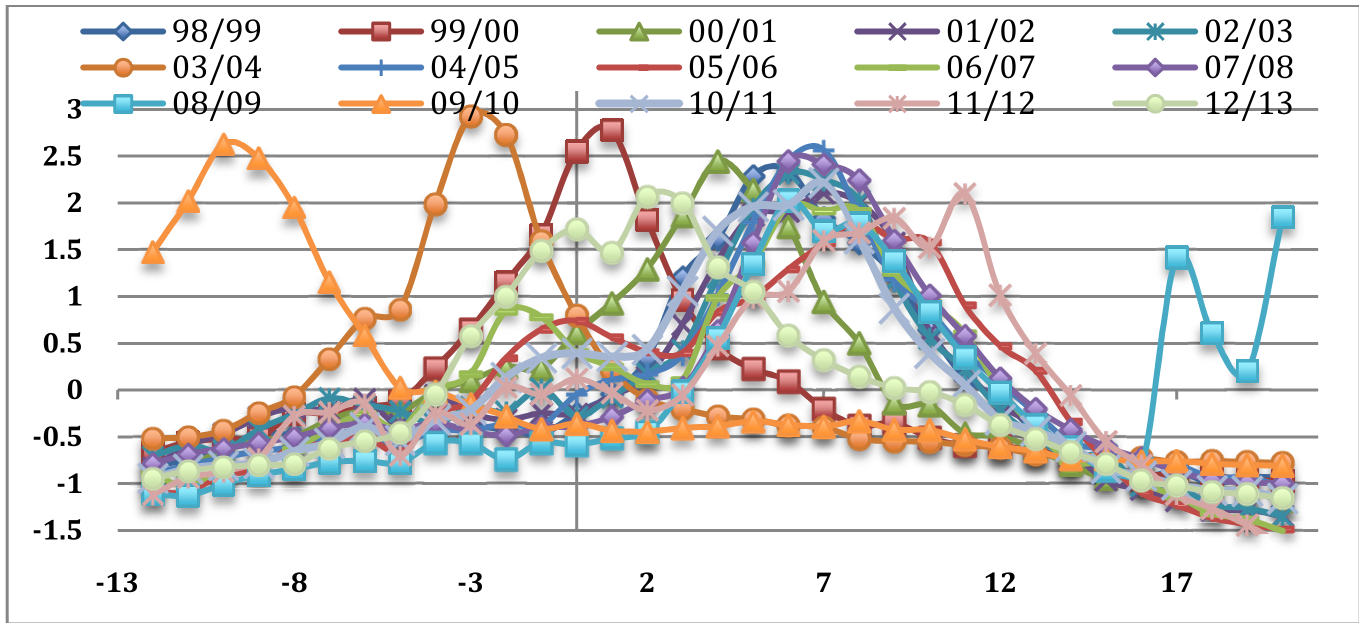 Figure 3: Historical flu season variations (z-normalized), showing the diversity of peak timings and intensities the model must handle.
Experimental Results
The researchers tested their model retrospectively on 17 seasons. The results show that while very early predictions (week 45-48) are challenging, the accuracy improves rapidly as the "early curve" develops.
| Metric | Our Model (Week 1) | Our Model (Week 5) | Prior SOTA (Shaman et al.) |
|---|---|---|---|
| Peak Accuracy (±1 week) | 0.688 | 0.938 | ~0.739 |
| Avg. Correlation | 0.87 | 0.91 | N/A |
The model provides an extra "real-time" value for the current week that official reports lack, effectively buying researchers a 1-2 week head start on identifying the seasonal peak.
Critical Insight & Conclusion
The true value of this work is proving that social data is a more stable sensor for the "now" than official surveillance. While officials are still cleaning their data, Twitter provides a near-perfect reflection of symptoms the moment they occur.
Limitations: The model relies on the assumption that future seasons will somewhat resemble the past 17 seasons. A completely unprecedented "Black Swan" pandemic (like COVID-19 would later become) might require the Prototype model to adapt more dynamically than the current Fusion approach allows.
Takeaway: By combining natural language processing (to bridge the gap between doctor-speak and patient-speak) with simple weighted similarity models, we can create epidemic early-warning systems that are both cheaper and more accurate than complex biological simulations.