
Beyond a Single Truth: Predicting and Managing Foreground Object Ambiguity
Predicting Foreground Object Ambiguity and Efficiently Crowdsourcing the Segmentation(s)
This paper introduces the problem of "Foreground Object Ambiguity," identifying images where multiple annotators naturally perceive different primary objects. The authors present STATIC, a dataset of 14,000 images with ambiguity labels, and a fine-tuned CNN system that predicts ambiguity to optimize crowdsourcing pipelines, achieving significant cost savings.
TL;DR
Researchers have long treated disagreements in image segmentation as "human error." This paper argues that such disagreements often stem from inherent Foreground Object Ambiguity. By introducing the STATIC dataset and a predictive CNN model, the authors demonstrate how to detect which images will split public opinion and use these predictions to slash crowdsourcing costs by up to 47%.
The "One Truth" Fallacy
In the world of computer vision, we are obsessed with "Ground Truth." When we ask five people to segment the "most prominent object" in an image and they give us five different masks, our standard reaction is to average them or pick the majority.
However, as shown in the authors' research, some images—like a single flower—are unambiguous, while others—like a box of разноцветный (multi-colored) crayons—are inherently ambiguous. In the latter case, is the "truth" one crayon, a handful, or the entire box? Existing benchmarks often penalize algorithms that find a valid, but different, object than the one recorded by a single annotator.

Methodology: Can Machines Predict Human Disagreement?
The authors curated STATIC (Segmentation Test for Ambiguous Truth Inferred for the Crowd), a massive dataset covering eight benchmarks, labeled by humans for degree of ambiguity.
The CNN-FT Architecture
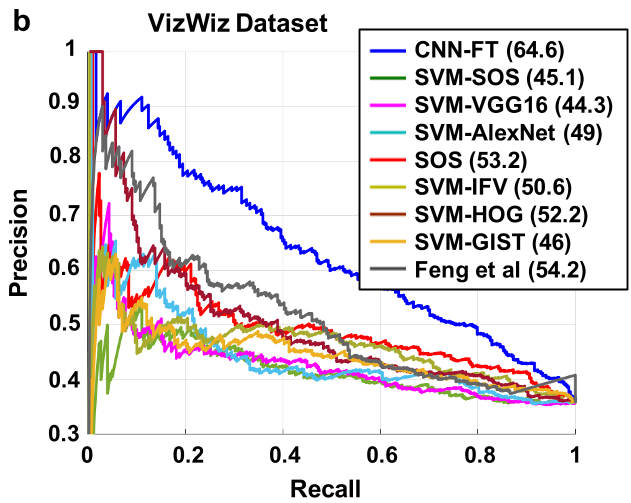
To automate the detection of ambiguity, the team developed CNN-FT. They took a Salient Object Subitizing (SOS) network—originally designed to count objects—and fine-tuned it for a binary classification task: Will humans agree on this image?
They compared this against:
- Traditional Saliency Methods: Checking if there are multiple competing "hotspots."
- Global Descriptors: Using GIST and HOG features via SVMs.
- Deep Features: Using AlexNet and VGG16 as feature extractors.
The Result: CNN-FT achieved the highest Average Precision, proving that the visual context alone (textures, object relations, and layout) contains enough signal to predict if humans will see things differently.
Efficiency: Smart Redundancy Allocation
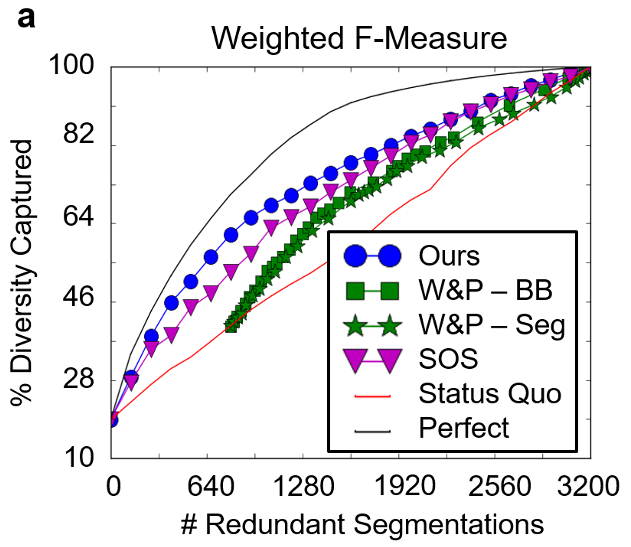
The most practical application of this work is in Crowdsourcing. Currently, researchers either collect one segmentation (missing diversity) or N segmentations for every image (wasting money).
The authors proposed a Redundancy Allocation system:
- Step 1: Collect one segmentation for every image.
- Step 2: Use CNN-FT to rank images by predicted ambiguity.
- Step 3: Spend the remaining budget only on the "Top-X" most ambiguous images to get diverse opinions.
Experimental Results
Using this "Greedy" allocation strategy, they captured the full diversity of human perception while saving 47% of human labor compared to random allocation. In a real-world scenario of 800 images, this translates to saving 8 hours of manual annotation time.
Critical Insight: The Impact on Assistive Tech
The paper highlights a crucial application: Blind Photography. Blind users often take photos to ask, "What is this?" (e.g., using VizWiz). If an image is ambiguous or poorly framed, the system should be able to tell the user before it gets sent to a human or an AI for processing. The authors found that their model performs reasonably well even on the low-quality, blurry images typically captured by blind users, though this remains an area for further improvement.
Conclusion
This work challenges the "one-size-fits-all" approach to image segmentation. By proving that ambiguity is predictable, the authors provide a roadmap for more honest evaluation and more efficient data labeling. Future vision systems should not just aim for "the" truth, but acknowledge the spectrum of valid human interpretations.
Key Takeaways
- Evaluating against a single ground truth is flawed for at least 20-50% of typical vision datasets.
- Ambiguity is a learnable visual feature, distinct from technical difficulty.
- Smart crowdsourcing can cut costs significantly by focusing resources where humans are most likely to disagree.