
Augmented CBR: A Hybrid Approach to Mobile Money Fraud Detection
Predicting Fraud in Mobile Money Transfer Using Case-Based Reasoning
The paper introduces an augmented Case-Based Reasoning (CBR) framework for detecting fraud in Mobile Money Transfer (MMT). By integrating Genetic Algorithms (GA) for feature weighting and automated k-value selection, the system achieves a superior prediction accuracy of up to 0.98% compared to standard CBR baselines.
TL;DR
Researchers have developed a hybrid Case-Based Reasoning (CBR) system specifically designed for Mobile Money Transfer (MMT) environments. By utilizing Genetic Algorithms (GA) to tune feature weights and grouping transaction data into five specific contexts, the model achieves a 98% detection accuracy, successfully identifying fraudulent patterns even in small, imbalanced datasets where traditional deep learning often struggles.
Problem & Motivation: The MMT Security Gap
Mobile Money Transfer (MMT) has become the backbone of financial inclusion in developing nations. However, its rapid growth has outpaced regulatory oversight. Fraudsters exploit this by using prepaid phones and "mule" accounts to hide their identities.
Standard anti-fraud systems face two major hurdles:
- Data Scarcity: Real-world fraud data is rare, sensitive, and expensive to collect.
- Methodological Rigidity: Neural networks are "black boxes" requiring massive data, while rule-based systems are too slow to update as fraud tactics evolve.
The authors argue that Case-Based Reasoning (CBR) is the ideal solution because it mimics human expertise: it solves new problems by retrieving and adapting solutions from similar past cases, providing transparency and the ability to learn from limited experience.
Methodology: Beyond Simple Transaction Analysis
The core innovation lies in how transactions are represented and how similarity is calculated.
1. Contextual Representation
Instead of treating variables like "Amount" or "Time" as isolated data points, the system clusters log information into five strategic contexts:
- Transaction Type: The nature of the operation (e.g., Cash-in vs. Transfer).
- Client: Profile data, including account balance and historical spending habits.
- Interval: Temporal features like the month or day of the week.
- Location: Geospatial data of the transaction.
- Amount: Quantized spending levels relative to daily limits.
2. GA-Enhanced Similarity (FWCBR)
In a standard CBR system, all features are often weighted equally. This paper uses a Genetic Algorithm to evolve the optimal weights () for each context, ensuring that the most "indicative" features have the highest impact on the similarity score.
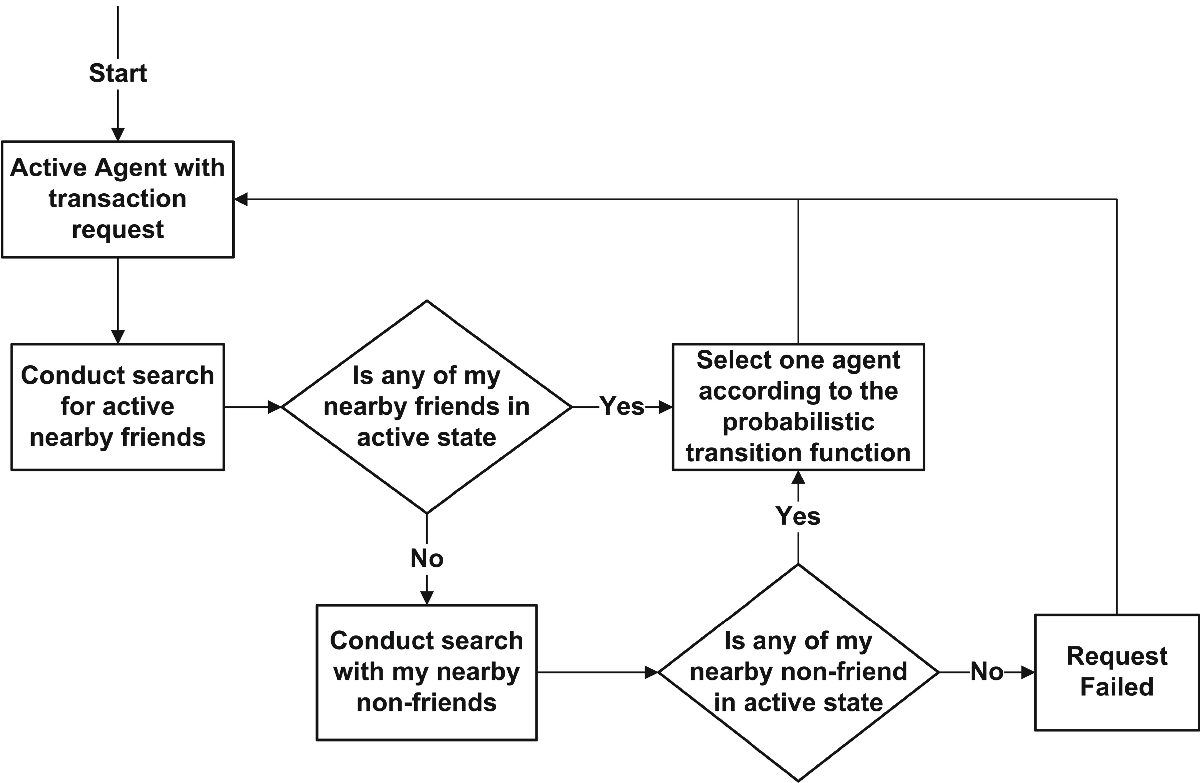 The simulation workflow used to generate agent behavior and legitimate/fraudulent transaction logs.
Experiments & Results
The authors used a Multi-Agent Simulation Toolkit (MASON) to generate 141,556 transactions, mimicking a real-world class imbalance (only 0.2% fraud).
Key Findings:
- Standard CBR (Baseline): While accurate on the majority class, it struggled to "catch" fraud, with a recall as low as 0.46 in individual dimension tests.
- Context-Dimension FWCBR: Achieving the best balance, this model reached a 0.93 Recall and 0.86 Precision specifically for fraud detection.
- Performance Stability: While increasing the value (neighbors) beyond 3 showed diminishing returns, the weighted context approach remained robust.
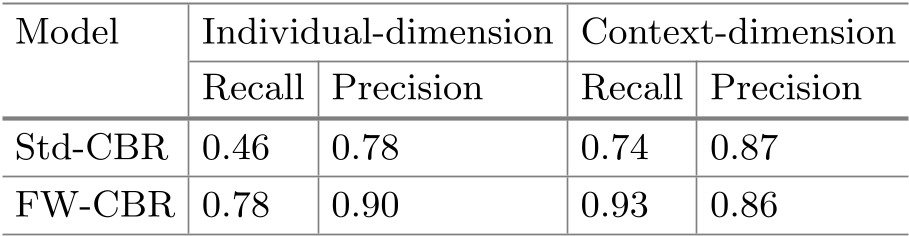 Comparison of Std-CBR and FW-CBR across Individual and Context dimensions.
Critical Analysis & Conclusion
The strength of this work is its transparency. By using CBR, investigators can see which "past cases" triggered the fraud alert, which is far more actionable than a raw probability score from a neural network.
Limitations: The primary bottleneck is the computational cost of the Genetic Algorithm. Evolving populations of weights in real-time for millions of transactions is currently unfeasible for production environments without further optimization or "offline" weight training.
Future Outlook: As MMT continues to expand, localizing these "Contextual Dimensions" to specific regional behaviors (e.g., specific holiday spending patterns) could further refine accuracy. This paper provides a solid blueprint for building "Small Data" AI that outperforms "Big Data" models in niche, high-stakes fields.