
Predicting Healthcare Access: Turning Survey Data into Actionable Insights
Predicting Access to Healthcare Using Data Mining Techniques
This paper utilizes data mining techniques to predict healthcare accessibility using the Behavioral Risk Factor Surveillance System (BRFSS) dataset. By evaluating four classification models—Regression, Neural Networks, Decision Trees, and K-Nearest Neighbor—the study identifies Logistic Regression and Neural Networks as the top performers for predicting individuals' ability to access medical care.
TL;DR
In a world where healthcare is a fundamental right yet remains inaccessible to many, this study leverages the power of data mining to predict who is likely to face barriers. Using the massive BRFSS survey dataset, the researchers found that Logistic Regression and Neural Networks are highly effective at identifying individuals at risk, with insurance status and employment being the most critical predictors.
Background: Beyond Clinical Outcomes
Most AI in healthcare focuses on "what happens inside the hospital"—diagnosis, treatment plans, and fraud detection. This paper shifts the focus to "what happens before the hospital"—the socio-economic and behavioral factors that prevent people from seeking care in the first place. Positioned as a predictive modeling study, it bridges the gap between public health policy and machine learning.
The Problem: The Complexity of Access
The researchers identified a significant gap: traditional statistical methods often struggle with the "messiness" of large-scale survey data. The BRFSS data for Michigan alone involves over 400 variables and significant portions of missing data. Why is this hard? Because healthcare access isn't just about income; it’s a web of education, employment, physical health, and psychological barriers that simple heuristics cannot solve.
Methodology: The SAS Enterprise Miner Workflow
The authors utilized a robust pipeline in SAS Enterprise Miner 7.1. Their approach to "Missing Data Imputation" is particularly noteworthy:
- Categorical Data: Imputed using Decision Trees.
- Interval Variables: Imputed via distribution-based methods to preserve data variance.
- Model Comparison: They didn't just pick one algorithm; they staged a "competition" between Regression, Decision Trees, K-Nearest Neighbor (MBR), and Neural Networks.
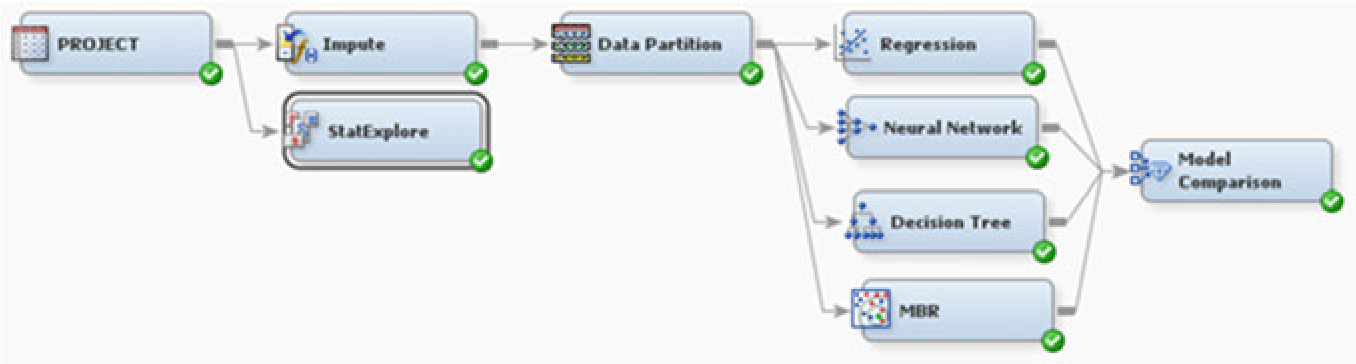 Figure 1: The SAS modeling diagram shows the sequential path from data imputation to multi-model comparison.
Experiments & Results: The Performance Gap
The results were clear: Regression and Neural Networks were the winners.
As shown in the table below, the ROC index (where 1.0 is a perfect model) for Regression surpassed 0.83. This indicates a very high degree of predictive power.
| Model | ROC Index | Misclassification Rate |
|---|---|---|
| Regression | 0.837 | 0.110 |
| Neural Network | 0.829 | 0.110 |
| Decision Tree | 0.675 | 0.113 |
| MBR (k-NN) | 0.603 | 0.140 |
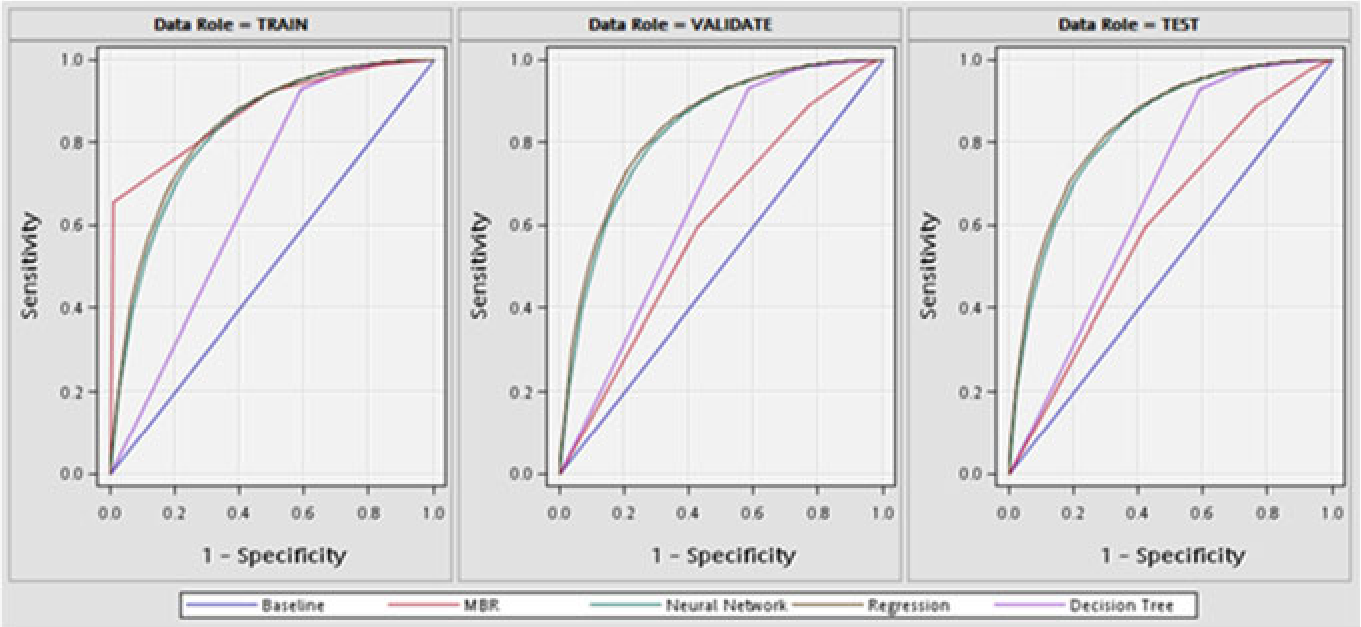 Figure 2: The ROC Curve demonstrates that Regression and Neural Nets (top curves) provide superior predictive accuracy compared to the baseline.
The "Intuitive" vs. "Counter-Intuitive" Findings
Through Logistic Regression estimates, the authors uncovered fascinating insights:
- The Predictable: Lacking health insurance increases the probability of facing access barriers by 110%.
- The Surprising: Men were 24.3% more likely than women to report cost-related access issues.
- The Paradox: Some high-income brackets (>$50,000) showed an increased probability of access limitations, possibly due to higher healthcare consumption or specific insurance coverage gaps.
Critical Insight & Conclusion
This paper demonstrates that while Neural Networks offer high precision as "universal approximators," Logistic Regression remains the "gold standard" for public health due to its interpretability (Odd Ratios).
Takeaway: The study proves that healthcare accessibility is predictable. However, the poor performance of K-NN and Decision Trees suggests that the relationship between socio-economic features and healthcare access is likely linear or highly complex-continuous, rather than based on simple hierarchical rules. Future work could benefit from XGBoost or LightGBM, which often outperform standard Decision Trees on this type of tabular survey data.
Limitations: The study is limited to Michigan data from 2011. The healthcare landscape has shifted dramatically post-ACA (Affordable Care Act), meaning a modern replication of this study is essential to see how these predictors have evolved.