
Decoding the Curious Mind: Predicting Personality from Facebook Digital Footprints
Predicting the Human Curiosity from Users' Profiles on Facebook
The paper introduces a machine learning approach to predict the human curiosity trait using data extracted from Facebook profiles. Utilizing the CEI-II (Curiosity and Exploration Inventory) scale and a J48 decision tree classifier, the authors established a model capable of identifying curiosity levels with 63% accuracy.
TL;DR
Can your Facebook "Likes" and travel history reveal how curious you are? This research demonstrates that by analyzing social media profiles—specifically check-ins and technology interests—machine learning models can predict a user's degree of curiosity with significant accuracy. This paves the way for "Curiosity-Aware" recommendation engines that know exactly when to show you something familiar and when to push you toward the unknown.
Context: Beyond the Questionnaire
In the realm of Information Retrieval and Recommender Systems, we often face a dilemma: Should we recommend what the user already likes (Accuracy) or something entirely new (Serendipity)? The answer lies in Curiosity. However, measuring curiosity usually requires tedious 44-item questionnaires that users rarely finish.
The authors of this study argue that our "Virtual World" behavior on social networks is a mirror of our "Real World" personality. By mining these digital footprints, we can infer psychological traits implicitly and transparently.
The "Curiosity" Signal in Data
The researchers focused on two dimensions of curiosity defined by the CEI-II scale:
- Stretching: The motivation to seek out new knowledge and experiences.
- Embracing: The willingness to tolerate the novel and unpredictable nature of life.
Methodology & Architecture
The team developed a Search System for Social Networks (SSSN) to bridge the gap between psychological ground truth and raw Facebook data.

The core challenge was Data Pre-processing. Facebook "Likes" are often messy and unclassified. The researchers manually categorized these likes using Wikipedia and deductive methods, transforming raw text into meaningful categories like Technology, Politics, and Sports.
Key Insights: What Makes a Person "Curious"?
The study unearthed several fascinating correlations:
- The Tech Factor: There is a strong linear trend between curiosity and interests in technology (). If you "Like" software, programming, and tech brands, you are statistically more likely to be curious.
- The Mobility Marker: The strongest predictor was travel. The number of unique states and countries visited (via check-ins) correlates heavily with a high curiosity score.
- Education: Higher educational levels showed a positive correlation with curiosity, though this might be partially mediated by income levels allowing for more travel.
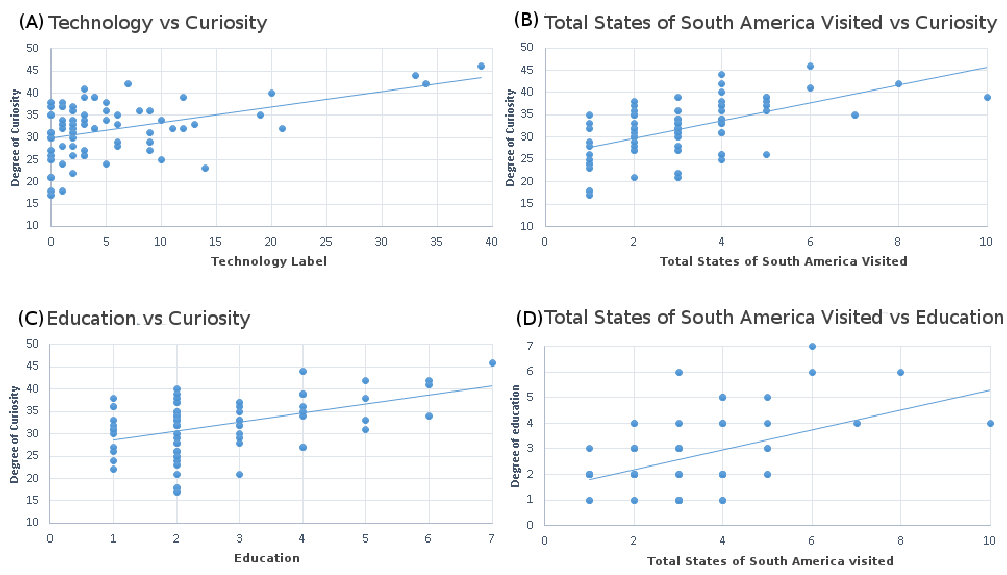 Figure: Linear trends showing the relationship between (A) Technology likes, (B) Education, and (C) Mobility with curiosity levels.
The Prediction Model: Decision Trees
Using the J48 Decision Tree algorithm (a Java implementation of C4.5), the researchers generated a set of human-readable rules.
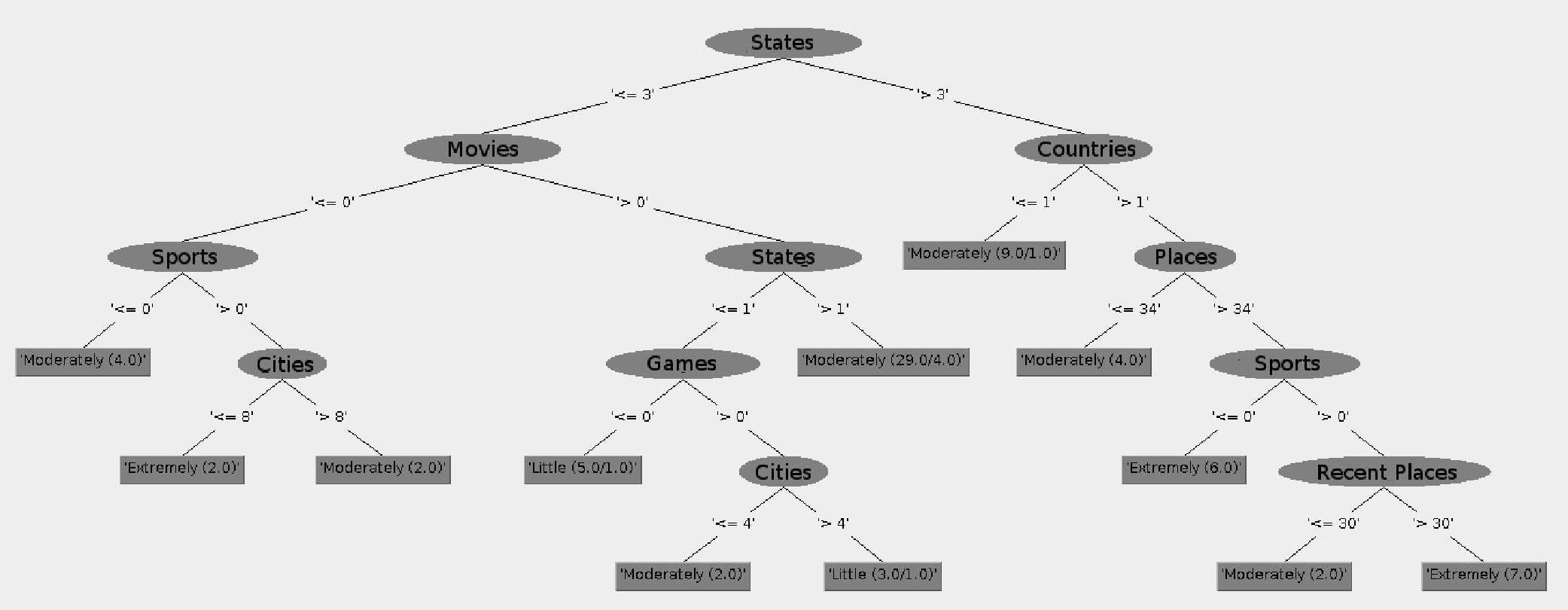
Example Rule: If a user has visited more than 3 states in South America, more than 1 country, and checked into more than 34 unique places, the model classifies them as "Extremely Curious."
Critical Analysis & Conclusion
Why this matters
This work provides a bridge between Psychology and Data Science. For product designers, this means you can segment users not just by "what" they bought, but by "why" they explore. A "High Curiosity" user should be fed a diverse, exploratory feed, while a "Low Curiosity" user might prefer stability and familiar brands.
Limitations
- Cultural Bias: The study was limited to 105 Brazilian users. Curiosity manifests differently across cultures.
- API Restrictions: Since the data was collected, platforms like Facebook and LinkedIn have significantly tightened API access, making this type of "implicit" harvesting much harder for modern researchers.
- Platform Specificity: The model relies on "Check-ins," a feature whose popularity has fluctuated over the years.
Future Outlook
The next frontier is Cross-Platform Profiling. By combining professional data from LinkedIn with personal data from Instagram or X (Twitter), we could build a 360-degree high-fidelity model of user personality, enabling truly "Hyper-Personalized" digital experiences.