
Beyond Link Prediction: Identifying Hidden Entities via Spectral Clustering
1502_Predicting and Identifying Missing Node Information in Social Networks.
The paper introduces MISC (Missing node Identification by Spectral Clustering), an unsupervised framework designed to identify and group placeholders representing the same missing individuals in a social network. By combining Spectral Clustering with proximity measures from link prediction, the authors achieve SOTA performance in reconstructing hidden network structures within real-world Facebook datasets.
TL;DR
While most social network research focuses on predicting who will be friends (Link Prediction), this paper addresses the far more difficult "Missing Node Identification" problem: identifying a person who isn't even in the system yet. By using MISC (Missing node Identification by Spectral Clustering), the researchers can take fragmented "placeholders" of an unknown person and accurately reconstruct their position in the social graph.
The Hidden Entity Problem: Why Link Prediction Isn't Enough
In the world of social graph analysis, we usually assume the "players" (nodes) are known, and we just need to find the "rules" (edges). But in reality, networks are often incomplete. Imagine a security agency tracking a criminal organization or a company trying to map potential customers; they see "placeholders" (e.g., a person mentioned in a text, an unrecognized face in a photo) but don't know if three different placeholders represent one person or three separate individuals.
Prior work like Link Prediction fails here because it cannot merge entities. The authors identify a critical gap: we need a way to cluster these indications based on their shared structural context.
Methodology: The MISC Framework
The core of the paper is the MISC algorithm. It views the problem through the lens of Spectral Clustering.
1. The Affinity Matrix (The Input)
Instead of simple Euclidean distance, the authors use "Affinity Measures" borrowed from link prediction:
- Adamic/Adar: Weighs shared neighbors, giving more importance to "rare" mutual friends.
- Katz Beta: Considers all possible paths between nodes, damped by length.
- Inverse Squared Shortest Path (ISSP): A simple distance-based metric.
2. Spectral Embedding
The algorithm projects these complex graph relationships into a lower-dimensional space using eigenvectors. In this space, placeholders that share a "structural signature" in the known network naturally cluster together.
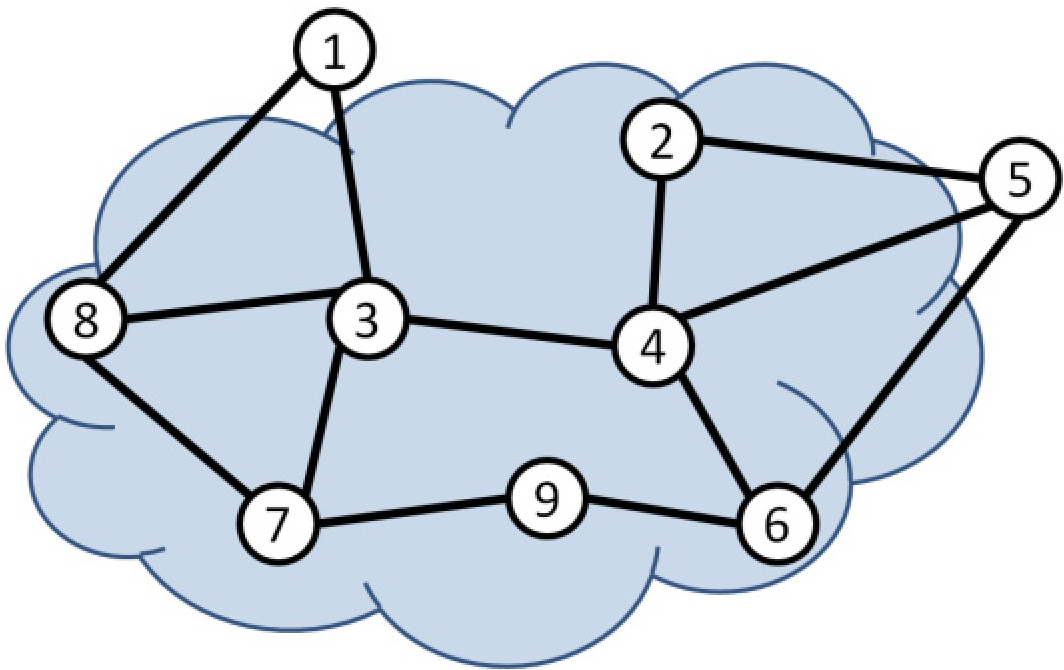 Above: Figure 1 & 2 illustrate how missing nodes are transformed into placeholders connected to the known network.
3. Scaling with R-MISC
Spectral clustering is notoriously . To handle 100,000+ nodes, the authors introduced R-MISC. By removing dimensions representing "distant" nodes that have zero affinity with placeholders, they drastically reduce the matrix size with almost zero loss in accuracy.
Experimental Results: Beating the SOTA
The researchers compared MISC against KronEM, a heavy-duty Kronecker Graph model.
- Accuracy: MISC achieved lower Graph Edit Distance (GED) than KronEM across various missing node percentages (0.5% to 2.5%).
- Robustness: Even when 70% of the placeholders were removed (leaving only 30% of the data), MISC remained as effective as KronEM.
- Noise Tolerance: The algorithm proved surprisingly resilient to "extraneous placeholders" (noise/false alarms), maintaining high Purity scores.
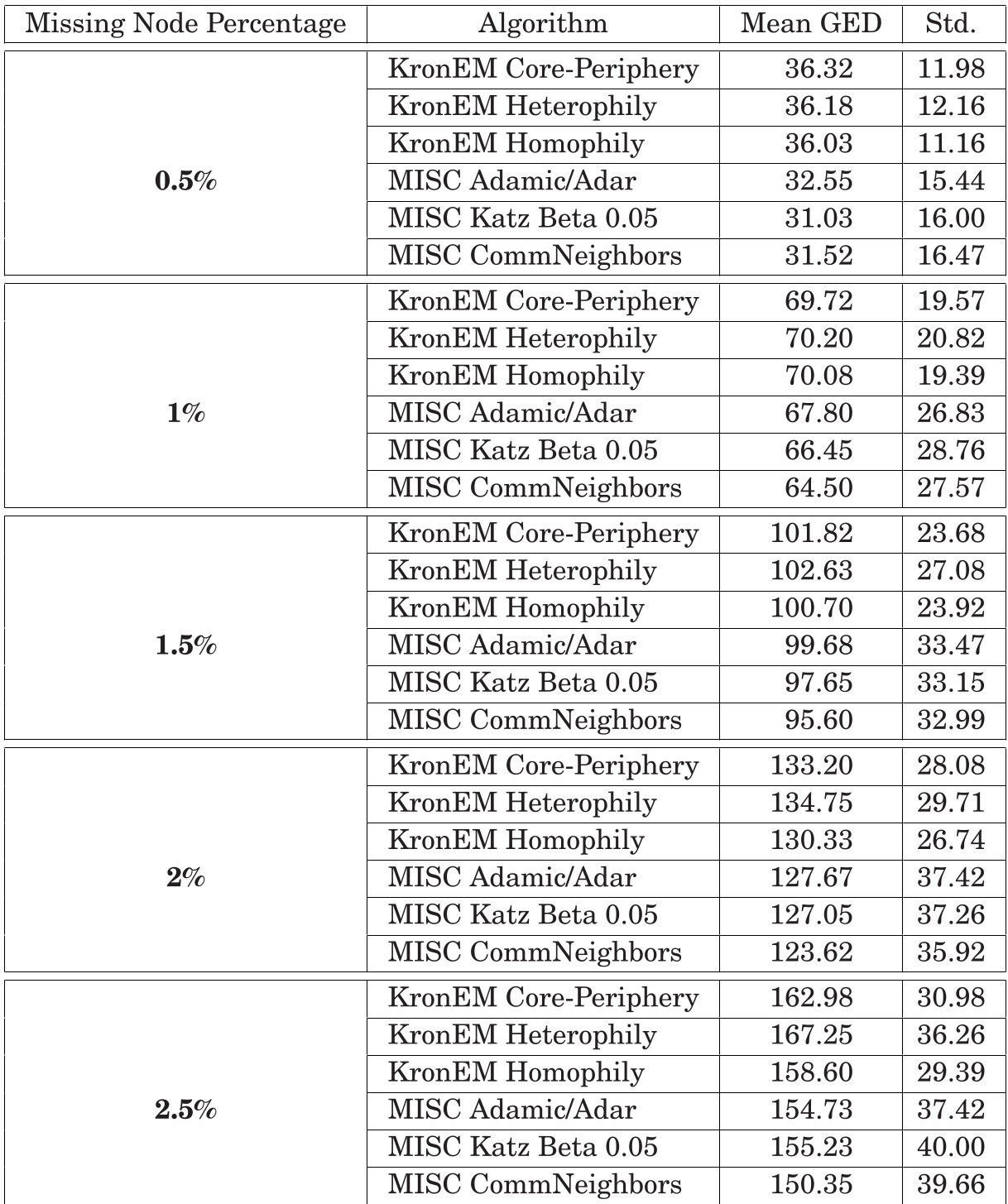 Table 1: Quantifying the superiority of MISC variations over KronEM baselines.
Critical Insight: The "Why"
Why does MISC work? It’s about Structural Localism. Social networks are governed by the principle of Triadic Closure—the idea that friends of friends are likely friends. MISC leverages this by treating the neighborhood of a placeholder as its "fingerprint." If two placeholders share the same fingerprint in the spectral domain, they are almost certainly the same invisible entity.
Conclusion & Future Outlook
MISC provides a powerful tool for deanonymization and network completion. However, the authors admit a current limitation: the model relies purely on structure. The next frontier is Multimodal Fusion—combining this structural spectral clustering with Node Attributes (like age, location, and interests) to create an even more precise "Entity Resolution" engine for social graphs.
For practitioners, the takeaway is clear: when dealing with incomplete data, don't just predict links—cluster the context.