
Twitter as a Sentinel: Enhancing Influenza Prediction with Regularized Regression
Prediction of Infectious Disease Spread Using Twitter: A Case of Influenza
The paper presents a predictive model for influenza outbreaks using Twitter data as a real-time proxy for official CDC Influenza-Like Illness (ILI) reports. By leveraging Natural Language Processing and Ridge Regression, the authors achieved a 25.23% improvement in prediction accuracy over standard un-regularized models.
TL;DR
In the race against epidemics, time is the greatest enemy. Traditional medical reporting (CDC) lags by weeks. This paper demonstrates a robust framework to bridge this gap using Twitter data. By combining Natural Language Processing (NLP) for noise filtering and Ridge Regression for statistical modeling, the researchers achieved a 25% increase in prediction accuracy over baseline methods, effectively turning the "noise" of social media into a reliable early-warning system.
Background & Motivation: The "Reporting Gap"
When an infectious disease spreads, every day counts. However, official data from the CDC (ILINet) relies on clinical reports that take 7-14 days to aggregate. While mathematical models like the SIR (Susceptible-Infectious-Recovered) model provide theoretical projections, they require high-quality initial data which is often missing in the early stages of an outbreak.
The authors argue that Social Network Systems (SNS) like Twitter provide "immediate and prompt" responses. The challenge? Twitter is messy. A user tweeting about "Bieber Fever" or a "cough attack in class" (as a joke) creates statistical noise that can lead to massive overestimations if handled poorly.
Methodology: From Raw Tweets to Refined Signals
1. Document Filtering (The Noise Filter)
The researchers didn't just count keywords. They recognized that a keyword like "cough" can be "positive" (informative) or "negative" (spurious). They used the Mallet Machine Learning Toolkit to train a classifier.
- Positive Sample: "Woke up with a massive headache... the worst sore throat ever."
- Negative Sample: "The awkward moment when you start having a random cough attack in class."
By calculating the probability , they filtered out non-medical mentions, which significantly boosted the correlation between Twitter trends and actual CDC weighted ILI rates (e.g., "cough" correlation rose from 0.43 to 0.55).
2. Model Evolution: Why Simple Linear Regression Fails
A single-keyword model is too fragile. The authors moved to a Multiple Linear Regression Model:
To avoid the trap of Overfitting (where a model performs perfectly on past data but fails in the future), they used AIC (Akaike’s Information Criterion) to select the most vital features: fever, flu, and cough.
The "Secret Sauce": Ridge Regularization
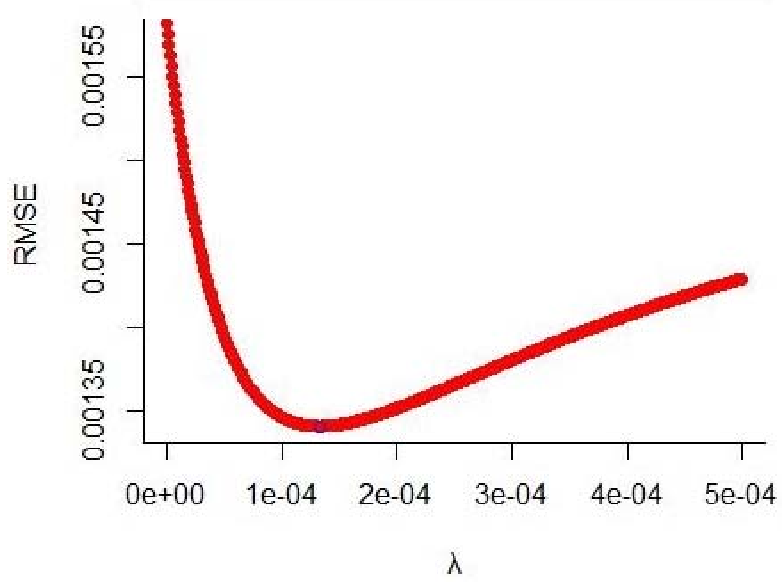
The core contribution of this work lies in applying Ridge Regression. In social media data, keywords often exhibit high multicollinearity (if you have a fever, you're likely to mention a cough too). Standard least-squares methods struggle with this. Ridge adds a penalty term () to the calculation:
This "shrinking" of coefficients prevents the model from being overly sensitive to any single keyword's volatility.
Experiments & Results
The model was trained on 10 weeks of data and tested on 5 weeks. The inclusion of the Ridge penalty resulted in a dramatic reduction in Root Mean Square Error (RMSE).
| Model Type | Improvement with Ridge |
|---|---|
| Weighted ILI | 8.22% |
| Unweighted (with AIC) | 25.23% |
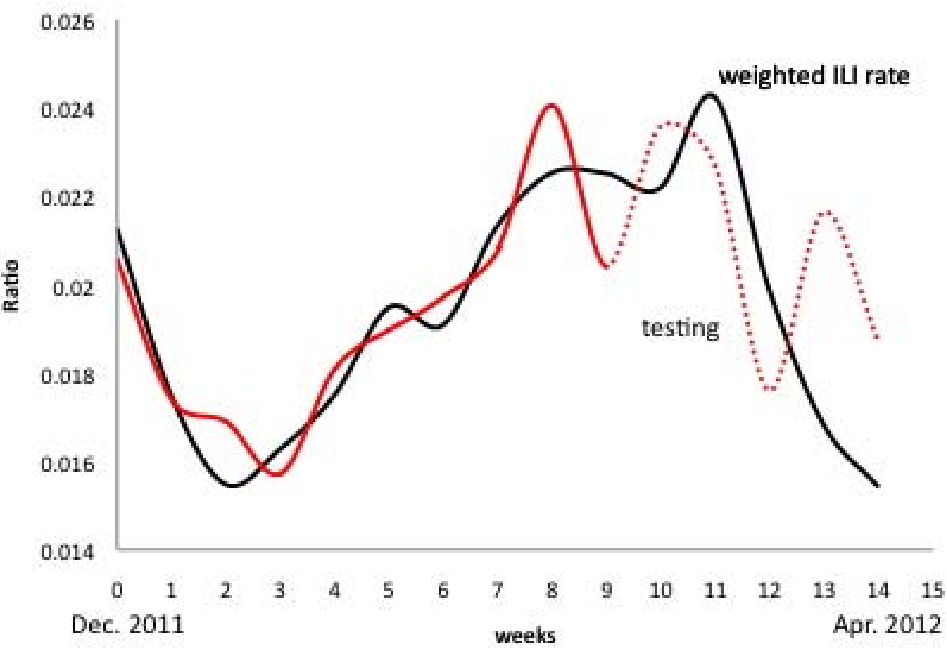 The Ridge Regression model (Dotted Blue) closely tracks the actual CDC data (Solid Red), demonstrating its viability for real-time forecasting.
Critical Insight & Conclusion
This paper serves as a vital case study in Risk Analysis. It proves that quantitative precision doesn't just come from more data, but from better-filtered data. While human behavior on Twitter is chaotic, the application of Ridge Regularization provides a statistical "buffer" that allows for reliable trend prediction.
Limitations: The study primarily focuses on English tweets in the US and does not fully utilize GPS location data (found in only 1.1% of tweets at the time). Future iterations using Deep Learning (like LSTMs or Transformers) could likely further enhance the sentiment-to-disease mapping, but the fundamental logic of regularized regression remains a gold standard for interpretability in public health.