
Predicting Interactions: Using Virtual Footprints to Forecast Social Ties
Predicting Interactions In Online Social Networks: An Experiment in Second Life
This paper investigates the predictability of user interactions (message communication) in online social networks using a combination of social network topology and physical position data. Using the virtual world of Second Life as a proxy for large-scale real-world tracking, the authors compare supervised learning models to determine which features best forecast directed and reciprocal interactions.
TL;DR
Can we predict who you will talk to online by looking at where you've been "physically"? This study uses Second Life as a laboratory to prove that positional data (where you hang out) is actually a better predictor of initial social interaction than your current friend list. However, if you want to know if an interaction will be mutual (reciprocal), the social network's structure still reigns supreme.
Back to the Future: The Social-Spatial Link
In 2013, researchers Steurer and Trattner identified a major bottleneck in social science: it is incredibly hard to track where thousands of people are every minute in the real world while simultaneously reading their private social interactions. To solve this, they turned to Second Life, a virtual world where "in-world bots" can act as automated observers, tracking user coordinates with surgical precision.
The core question was simple: Does hanging out in the same virtual "regions" predict a future message more accurately than having mutual friends or shared interests?
Methodology: Digging into the Data
The researchers constructed two distinct networks:
- The Social Network (): A directed graph where edges represent messages, comments, or "loves" between users.
- The Position Network (): An undirected graph where users are linked if they were seen in the same region concurrently on at least two different days.
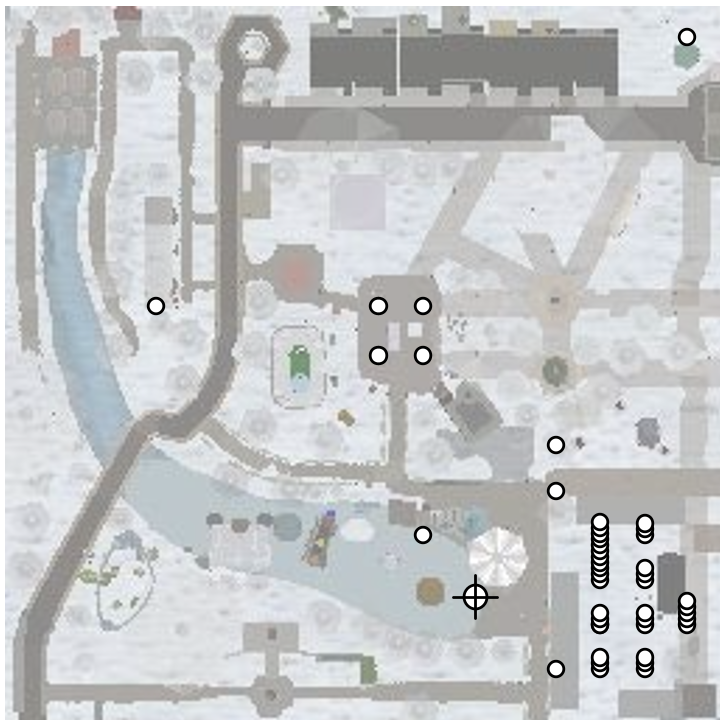 Figure: In-world agents (bots) were used to sample user positions across regions to build a high-fidelity movement dataset.
They extracted several types of features:
- Topological: Common Neighbors, Adamic Adar, and Preferential Attachment.
- Homophilic: Shared groups, shared interests, and physical distance ().
Key Finding 1: Position Trumps Friends for New Connections
The experiment for Predicting Interactions showed a clear winner. Models using positional data achieved an AUC of 0.919, significantly higher than the 0.863 managed by social network features alone.
Within the positional data, "Homophilic" features—specifically the physical distance between avatars and the number of observations together—were the strongest indicators. This suggests that "crossing paths" is the most potent spark for starting a digital conversation.
Key Finding 2: The Reciprocity Paradox
The results took a sharp turn when predicting Reciprocity (whether user A and user B will both message each other).
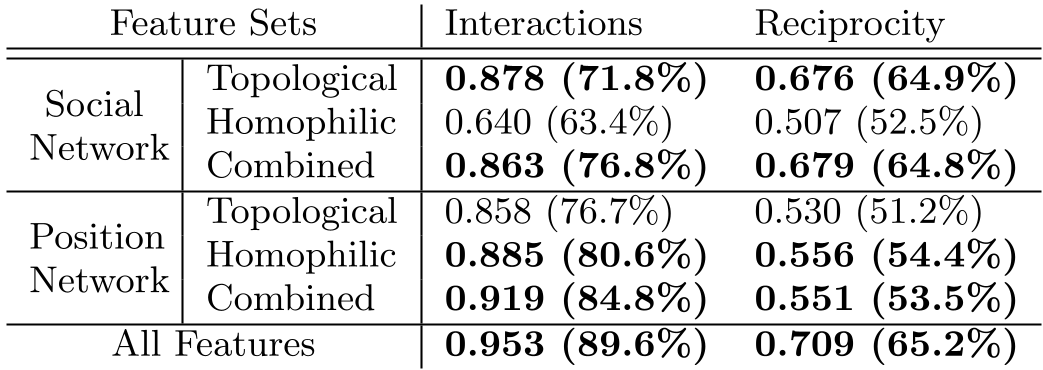 Table: Comparison of Social vs. Position feature sets. Note how Position Network dominance in "Interactions" vanishes in the "Reciprocity" column.
For reciprocity, the social network's topological features (like Jaccard's Coefficient of mutual interaction partners) were the only ones that provided meaningful predictive power (AUC 0.676). Physical location features dropped to near-uselessness (AUC ~0.53-0.55).
The Insight: While being in the same place might make you talk to someone once, the "Structural Balance" of your social circle determines if you will actually form a meaningful, two-way relationship.
Critical Analysis & Takeaways
This paper offers a fascinating look at the propinquity effect—the tendency for people to form friendships with those they encounter often.
- The Strength of Position: In digital environments, proximity acts as a "filter" for interests and context, often more effectively than explicit profile tags.
- The Limit of Spatial Data: Location is a "weak-tie" generator. It explains who we might encounter, but it doesn't explain the depth or direction of the relationship.
- Practical Application: For developers of social platforms or metaverses, these findings suggest that "Discovery" algorithms should prioritize users who frequently occupy the same virtual spaces, but "Relationship" or "Close Friend" suggestions should rely on network transitivity.
Conclusion
Steurer and Trattner's work reminds us that even in virtual worlds, we are bound by spatial logic. We are social animals defined by our geometry. While your "where" defines your "who," your "network" defines your "we."