
Predicting Interests via Social Circles: Does Homophily Hold in Online Networks?
Predicting Interests of People on Online Social Networks
This paper explores predicting user attributes (hobbies) in online social networks using a new dataset from a travel community. It employs Gaussian Field Harmonic Functions (GFHF), a graph transduction algorithm, to leverage mutually self-declared friendship networks for attribute prediction, achieving enhanced accuracy when combined with Support Vector Machines (SVM).
TL;DR
Can your friends' interests reveal your own? This research investigates the homophily assumption within a self-declared travel social network. By applying Gaussian Field Harmonic Functions (GFHF) and hybrid SVM-Graph models, the authors demonstrate that while friendship links are powerful predictors for common interests, their utility diminishes for niche hobbies.
Problem & Motivation: The "Non-Functional" Network Dilemma
In academic citation networks or web-link graphs, edges have a clear "functional" purpose—one paper cites another because they are topically related. However, social networking sites like the one studied here (TravelSite) feature non-functional friendship links. We don't know why two people are friends; it could be an offline connection, a shared photo interest, or a random interaction.
The core question is: Does the homophily principle (similarity breeds connection) actually manifest in these self-declared digital friendships? If so, we can mathematically "propagate" labels from known users to unknown users across the graph.
Methodology: Propagating Interests through Harmonic Functions
The researchers treated the social network as a graph where nodes are people and edges represent mutual friendships.
1. Gaussian Field Harmonic Functions (GFHF)
The primary tool used is GFHF, a semi-supervised learning algorithm. The intuition is to treat the labels (hobbies) as values in a Gaussian field. The algorithm finds a "harmonic solution" where the value of an unlabeled node is the weighted average of its neighbors' values.
This effectively simulates a random walk: if you start at an unknown person and walk to their friends, what is the probability you'll land on someone with a specific hobby?
2. The Hybrid SVM-Dongle Approach
Graph structure alone isn't always enough. The authors introduced "SVM Dongles"—a method to attach external classification nodes to the social graph. These dongles use personal features (age, languages, other countries visited) to give the graph a "nudge" in the right direction.
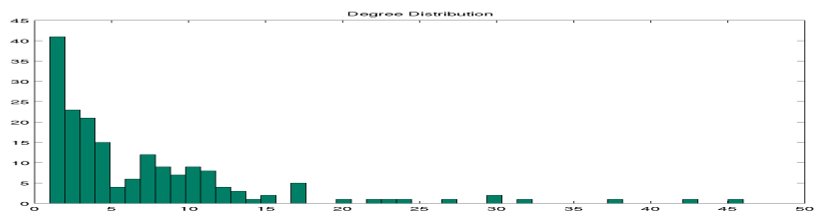 Fig 1: The degree distribution of the TravelSite network, showing a typical power-law social structure.
Experiments & Results: The Incidence Threshold
The study evaluated 26 different hobbies. A fascinating finding emerged: The effectiveness of the friendship network is directly tied to how common the hobby is.
- High Incidence Hobbies: For hobbies shared by >50% of the network, the friendship structure provided massive gains over random baselines (up to 30% accuracy boost).
- Low Incidence Hobbies: For rare interests (niche hobbies), the friendship network was often no better than random guessing.
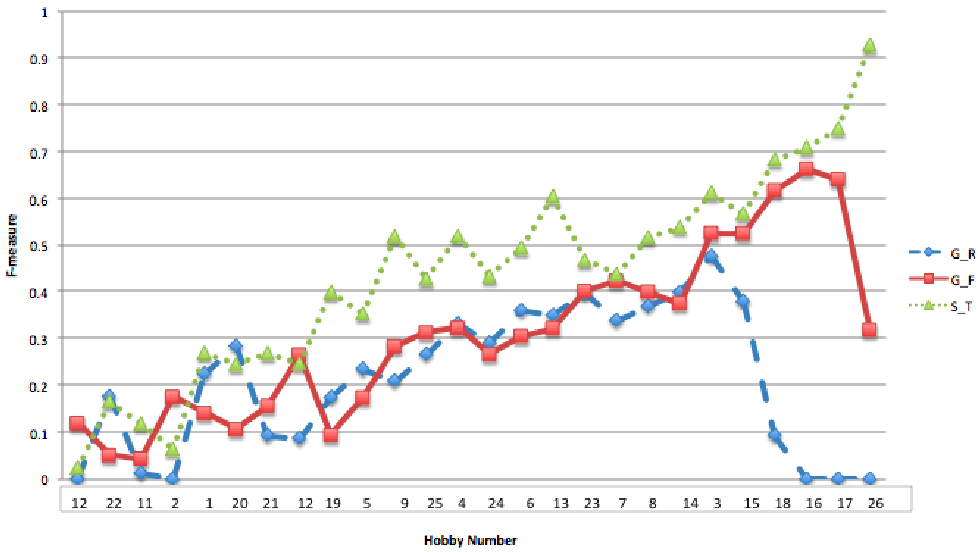 Fig 2: Comparison of Random Matrices (GR), Friendship Networks (GF), and the Hybrid SVM model (ST) using F-measure.
The hybrid model (ST), which combined graph structure with node-specific SVM features, outperformed all other methods. This suggests that while your friends are a good hint, your personal demographics still provide the most stable anchor for prediction.
Critical Analysis & Conclusion
Takeaways
- Homophily is real, but conditioned: In online spaces, people do cluster by interest, but this effect is statistically measurable mostly for "mainstream" interests within that community.
- Hybrid Models are Essential: Graph transduction (GFHF) and supervised learning (SVM) don't just replicate each other; they provide complementary views of the user.
Limitations
The primary limitation of this work is the sparsity of the network. With only 181 active nodes in the core experiment, the results might vary on massive scales where "local clusters" of niche hobbies might become more visible. Furthermore, the "Dongle" parameter () reached a plateau, suggesting that the current way of integrating SVM and GFHF might benefit from more sophisticated fusion techniques like Graph Convolutional Networks (GCNs).
This paper serves as a vital bridge between classical sociology and modern graph-based machine learning, proving that even in the "noisy" world of travel social networks, our friendships remain a mirror of our interests.