
Personalized Pedagogy: Predicting Learner Emotions via Naïve Bayes
Predicting the Learner's Emotional Reaction towards the Tutor's Intervention
This paper presents a predictive modeling approach for Intelligent Tutoring Systems (ITS) to forecast a learner's emotional reaction to pedagogical interventions. Using a Naïve Bayes classifier, the methodology integrates personal traits and situational context to customize feedback delivery.
TL;DR
The effectiveness of a tutor's feedback is not universal—it is filtered through the learner’s personality and current emotional state. This paper introduces a machine learning framework capable of predicting a student's emotional reaction to specific tutor interventions with 62.93% accuracy, paving the way for Intelligent Tutoring Systems (ITS) that adapt to the user's "affective state" in real-time.
Academic Positioning: This work bridges the gap between the OCC (Ortony, Clore, and Collins) cognitive appraisal model and practical, non-intrusive machine learning applications in e-learning environments.
1. The Friction in Affective Computing
Why is predicting emotion so difficult in a learning context? Most existing SOTA solutions lean heavily on biometric sensors—face tracking, heart rate monitors, and skin conductance sensors. While accurate, these introduce a "Hawthorne Effect" where the learner feels monitored and uncomfortable, ultimately skewing the data.
The researchers at the University of Montréal argue that we don't need intrusive hardware if we understand the causal relationship between a learner’s traits (Who they are) and the tutor's actions (What is happening).
2. Methodology: From Appraisal to Probability
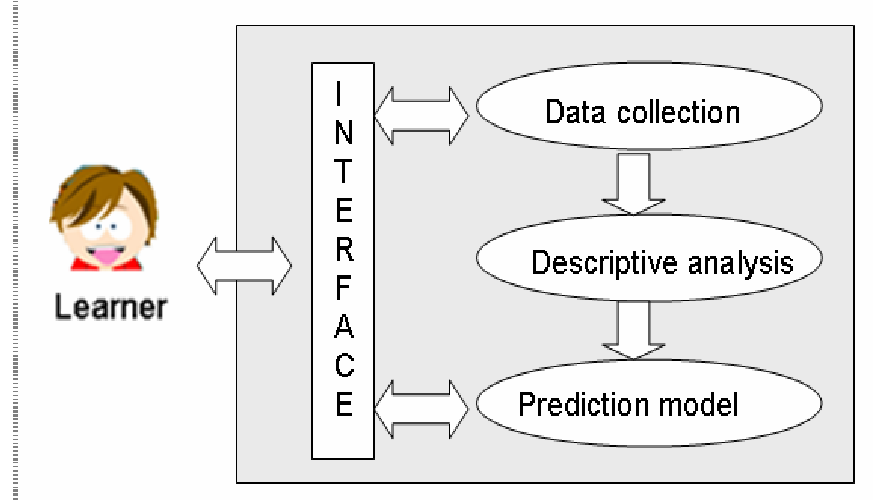
The authors move away from raw signal processing toward a probabilistic inference model. The core of their methodology follows a three-phase pipeline: Data Collection, Descriptive Analysis (via Mutual Information), and Emotion Prediction.
The Bayesian Intuition
The core of the system is a Naïve Bayes Classifier. In an uncertain environment like distance learning, where data is often sparse or "noisy" (small datasets), Naïve Bayes serves as an ideal inductive bias. It assumes that the presence of a particular feature in a class is unrelated to the presence of any other feature.
Specifically, the model calculates the probability of a resulting emotion given the set of attributes (initial emotion, personality, and intervention type):
3. Architecture of an Affective Model
The model is structured as a two-layer Bayesian network. The output variable (Final Emotion) acts as the root node, while inputs like Personality, Motivation, and Feedback Type serve as the leaf nodes.
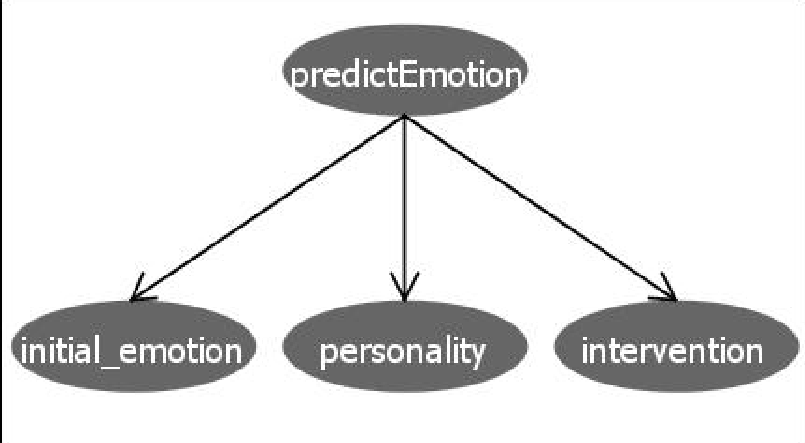
This structure acknowledges a critical psychological insight: Emotions are mood-congruent. A student who starts a session in a negative state is statistically more likely to react poorly to "stern" feedback than a student who is highly motivated and starting from a neutral emotional baseline.
4. Experimental Results & Insights
Using data from 116 learners via a web-based experiment, the model achieved an accuracy of 62.93%. While this figure may seem lower than modern deep learning benchmarks in image recognition, it is a significant achievement for purely text-based, non-intrusive behavioral prediction in a high-entropy domain like human emotion.
Key Findings:
- Personality matters: Traits significantly influence how feedback is cognitively appraised.
- Intervention Specificity: The manner of giving feedback (encouragement vs. correction) is just as important as the content of the feedback.
5. Critical Analysis & Future Outlook
The primary strength of this work is its pragmatism. By relying on categorical variables (Sex, Personality, Intervention Type) rather than continuous video streams, the system remains lightweight and privacy-preserving.
Limitations
- Sample Size: With only 116 tuples after data cleaning, the model's ability to generalize to a global, diverse student population is limited.
- Assumption of Independence: The "Naïve" assumption that personal traits and motivation are independent may not hold true in real-world psychology.
Conclusion
This paper provides a foundational framework for "Affective Tutoring." By transforming the tutor from a static information-dispenser into an emotionally-aware agent, we can create learning experiences that are not just technically efficient, but psychologically supportive.
References
- [1] Damasio, A.R. Descartes’ Error: Emotion, Reason, and the Human Brain. 1994.
- [2] Ortony et al. The Cognitive Structure of Emotions. 1988.