
LSTM-SLN: Cracking the Code of Dynamic Learner Interactions in MOOCs
Predicting Learner Interactions in Social Learning Networks
This paper introduces a time-series methodology for link prediction in Social Learning Networks (SLN), specifically targeting learner interactions in MOOC forums. Using an LSTM-based Recurrent Neural Network architecture, the authors achieve SOTA results, with AUCs typically exceeding 0.75 and reaching up to 0.97 by modeling the temporal evolution of network states.
TL;DR
Predicting how students will interact in online forums is a "moving target" problem. This paper presents a time-series approach using Long Short-Term Memory (LSTM) networks to predict link formation in Social Learning Networks (SLN). By combining network topology with latent topic analysis, the model achieves up to 0.97 AUC, significantly outperforming static Bayesian models and paving the way for smarter educational recommendation systems.
Context: The Challenge of Social Learning Networks
In Massive Open Online Courses (MOOCs), the instructor-to-student ratio is often abysmal. Forums are the lifeblood of these platforms, but they suffer from "cold start" problems (no network exists on Day 1) and high volatility as course topics shift. Unlike a Facebook friend request, an SLN link is emergent and ephemeral—it forms when two people interact within a specific thread. Predicting these links is vital for encouraging early group formation and ensuring students get high-quality help quickly.
Methodology: Beyond Static Snapshots
The core insight of the authors is that an SLN is not a static graph but a process.
1. Feature Engineering: The Three Pillars
The researchers extracted three categories of features for every learner pair:
- Neighborhood-based (Nei): Using metrics like the Adamic-Adar index and Resource Allocation, which reward learners who share "exclusive" (low-degree) common neighbors.
- Path-based (Path): Measuring the shortest path distance and the number of redundant paths between users.
- Post-based (Post): Utilizing Latent Dirichlet Allocation (LDA) to calculate topic similarity between learners' posts.
2. The LSTM Architecture
While prior SOTA utilized Bayesian Networks, they lacked the "memory" needed for evolving networks. The authors utilized an LSTM-RNN to maintain a latent state that is updated at each interval.
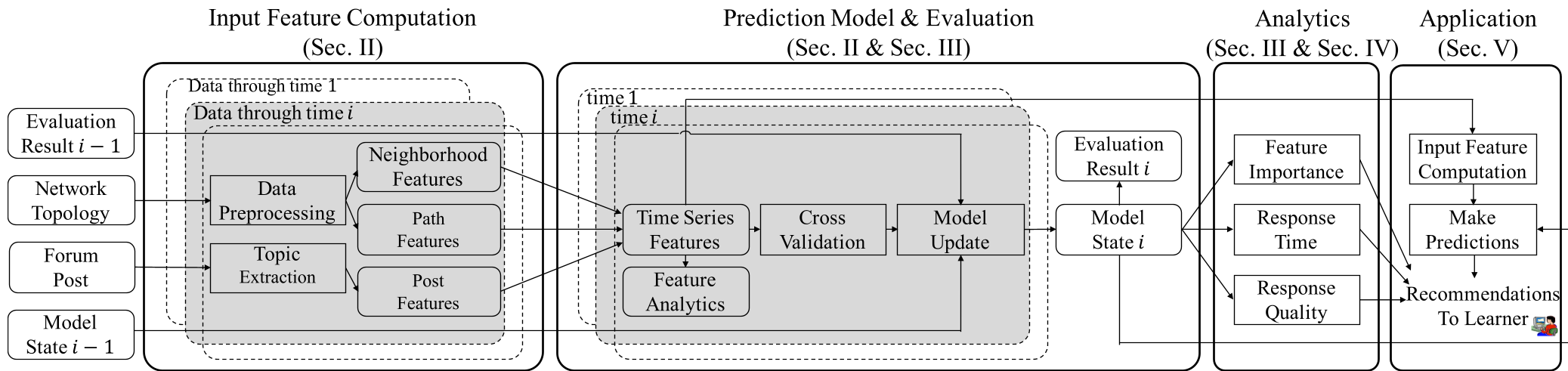 Figure 1: The proposed workflow—from forum scraping and feature engineering to LSTM-based prediction and learner analytics.
The LSTM’s fading gate () is particularly important here, as it determines how much of the previous network state should be "forgotten" when a course enters a new module or topic.
Experiments and Discoveries
The model was tested on four diverse datasets ranging from "Machine Learning" (quantitative) to "Shakespeare in Community" (humanities).
SOTA Performance
The Neural Network (NNet) architecture consistently beat the Bayesian (BNet) approach, especially in Accuracy (ACC).
 Table IV: Comparison of NNet vs BNet. The NNet's ability to handle temporal state leads to superior Accuracy.
Key Insight: The Topic-Timing Connection
The authors found a fascinating nuance: while neighborhood features tell you if a link might form, topic similarity (Post-based) is the "trigger" that predicts when it will form. As topics shift in the syllabus, learners with overlapping interests are suddenly pulled together into the same threads.
The "Speed vs. Quality" Paradox
In a critical analysis of post quality (measured by up-votes and length), the authors discovered a troubling trade-off. Some features that predict fast interaction (like high Jaccard coefficients) actually correlate with lower-quality replies.
This suggests that while we can predict who will talk, a simple recommendation engine might accidentally encourage a "race to the bottom" where students provide quick but shallow responses.
Critical Analysis & Conclusion
Takeaway
This work successfully transitions link prediction from a static structural problem to a dynamic time-series challenge. The high AUCs across disparate subjects (0.75-0.97) prove that SLNs, despite their complexity, follow discoverable social patterns.
Limitations & Future Work
- Cold Start: The model still relies on some initial connectivity. Predicting links for students who haven't posted yet remains a hurdle.
- Quality Modeling: The current model optimizes for connection probability. Future iterations must integrate the "Quality" metrics directly into the loss function to ensure recommendations lead to meaningful learning outcomes.
Ultimately, this research provides the mathematical foundation for the next generation of "AI Teaching Assistants" that can facilitate the right conversation at the right time.