
Deciphering Social Sentiments: Beyond Structural Balance in Signed Networks
Predicting Link Sign in Online Social Networks based on Social Psychology Theory and Machine Learning Techniques
This paper introduces a multi-theoretical framework for link sign prediction in social networks, integrating classical structural theories with Emotional Information Theory. By combining node degrees, triad motifs, and measures of optimism/pessimism, the authors achieve SOTA-level accuracy using Logistic Regression and Neural Networks on Slashdot and Epinions datasets.
TL;DR
Link sign prediction—determining if a relationship is "positive" (friend) or "negative" (foe)—is a critical task in social network analysis. This paper moves beyond traditional structural theories by integrating Emotional Information Theory. By defining and calculating node-level Optimism and Pessimism, the authors significantly improved the accuracy of sign prediction on major social datasets like Epinions and Slashdot, reaching up to 95.7% accuracy.
The Motivation: Why Balance Theory Isn't Enough
For decades, social scientists relied on Balance Theory ("the enemy of my enemy is my friend") and Status Theory to explain signed links. However, these are strictly structural. They assume nodes are blank slates reacting only to their neighbors.
The authors argue that individuals have inherent "emotional personalities." Some users are inherently more likely to trust (Optimism), while others are prone to skepticism (Pessimism). Capturing this "internal state" of a node is the key to unlocking better predictive performance.
Methodology: The Three Pillars of Feature Engineering
The researchers extracted three distinct categories of features to train their models:
- Local Degree Dynamics: Analyzing in-degrees and out-degrees of positive vs. negative links.
- Structural Triads: Categorizing the 16 possible directed triad configurations (e.g., three friends vs. two enemies and a mediator).
- Emotional Intelligence Features:
- Optimism (): A node is optimistic if it forms positive links with others who generally receive more negative sentiment than the network average.
- Pessimism (): A node is pessimistic if it forms negative links with others who generally receive positive sentiment.
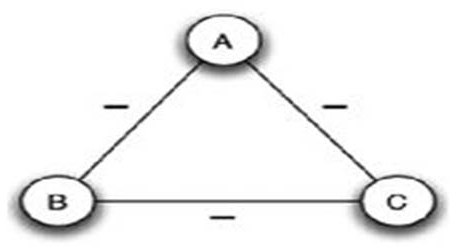 Figure 1: Examples of balanced and unbalanced triads used in structural feature extraction.
Experiments and Results
The study utilized two high-stakes datasets: Slashdot (technology news) and Epinions (product reviews). The authors tested two primary architectures: Logistic Regression and Artificial Neural Networks (ANN).
The Impact of Embeddedness
One of the most striking findings was the correlation between Embeddedness (the number of common neighbors between two nodes) and prediction accuracy. As commonality increases, the social "context" becomes clearer, allowing the model to hit higher precision.
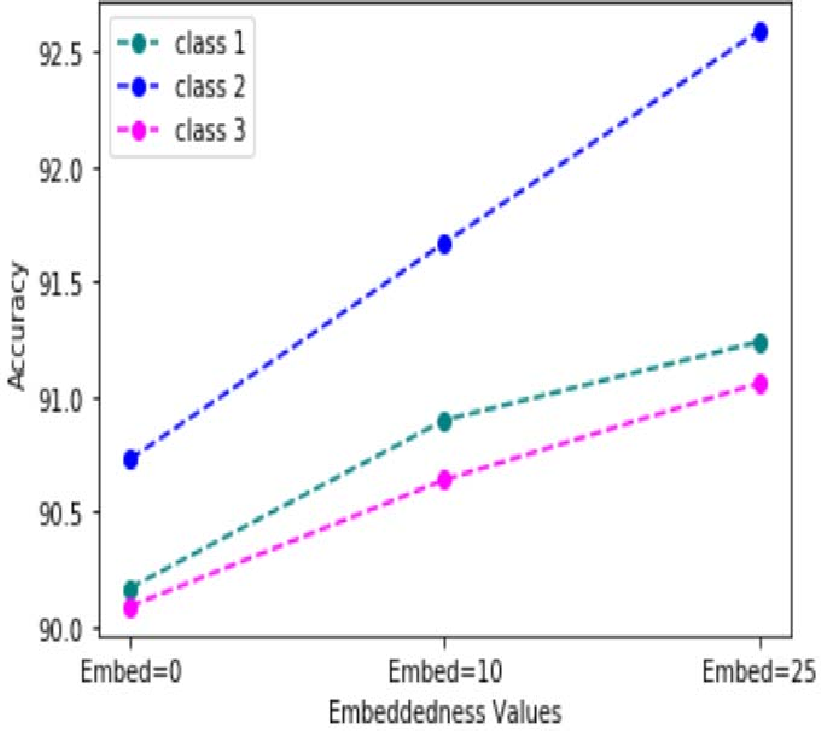 Figure 2: Performance comparison across different feature classes on the Epinions dataset.
Key Quantitative Outcomes:
- Epinions Performance: Reached 95.7% accuracy with Integrated Features (Class 1+2+3) using Logistic Regression.
- Slashdot Performance: Significant gains from 85% to 88.9% after integrating Emotional Information Theory.
- Ablation Insight: While ANNs provided a high baseline, Logistic Regression showed the most significant improvement when emotional features were added, suggesting these features have high linear separability.
Critical Analysis & Conclusion
The core contribution of this work is the validation that social psychology theories can be quantified and computationally applied at scale.
Takeaways:
- Context is King: Prediction accuracy scales with structural embeddedness.
- Personality Matters: A node's bias (optimism/pessimism) is a highly discriminative feature for predicting future edge signs.
Limitations: The current approach relies on static snapshots. Future work should investigate how "optimism" scores evolve over time as a user's experience within a network changes. Furthermore, applying this to heterogeneous graphs (where nodes represent different types of entities) could provide broader utility in recommendation systems.