
Detecting the Silent Crisis: A Multi-Dimensional Neural Approach to Student Mental Health
Predicting Mental Health Problems with Personality, Behavior, and Social Networks
This paper introduces a neural network-based cross-dimensional prediction model for mental health issues among college students. By integrating "Big Five" personality traits, online behavioral records from smart cards, and multi-dimensional social network structures, the model achieves SOTA performance in predicting specific conditions like delusion and suicidal intention.
TL;DR
Researchers have developed a sophisticated neural network model that predicts college students' mental health problems—such as suicidal intention and delusion—by looking at three specific dimensions: Who they are (Personality), What they do (Behavior), and Who they know (Social Networks). By combining these cross-dimensional "digital biomarkers," the model significantly outperforms traditional clinical screening and standard machine learning methods.
Contextualizing the Mental Health Gap
Mental health issues among college students are a growing global concern, yet the tools we use to detect them are often reactive rather than proactive. Most existing research looks at variables in a vacuum—analyzing personality or social media usage or academic stress.
The core insight of this study is that mental health is an emergent property of a complex system. A student's internal personality (Big Five) influences their external behavior (gaming/video consumption), which in turn dictates their position within a social network (trust/leadership). This paper attempts to map that entire ecosystem.
Methodology: The Fusion of Psychology and Graph Theory
The researchers recruited 490 students and gathered data across four distinct datasets:
- Psychology: Big Five personality scores (Neuroticism, Extroversion, etc.).
- Behavior: Real-world smart-card logs tracking internet usage (Games, Social Media, Videos).
- Social Networks: 11 layers of social relationships ranging from "friendship" to "who do you share bad news with?"
- Mental Health: Labels derived from the SCL-90-R psychiatric checklist.
Architectural Innovation
The technical "secret sauce" lies in how the authors quantified social influence. They used Google’s PageRank algorithm on 11 different social network graphs to assign a "rank" to each student. A student who is a hub for "study advice" but isolated in the "good news" network presents a specific structural signature that the neural network can learn.
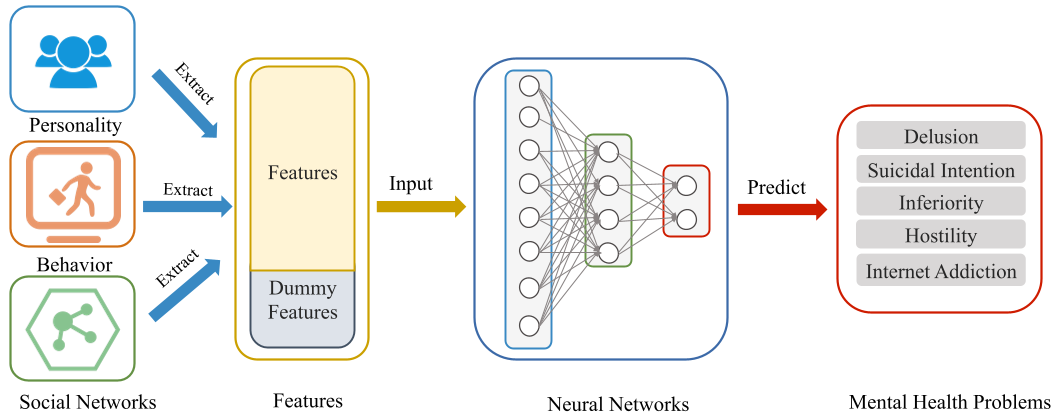
To address the "needle in a haystack" problem—where only a few students have severe symptoms—the team utilized SMOTE (Synthetic Minority Oversampling Technique). This allowed the model to learn from a balanced dataset even when positive cases (e.g., hostility) were rare.
Key Insights and Results
The experimental results validate the "Multi-Dimensional" hypothesis:
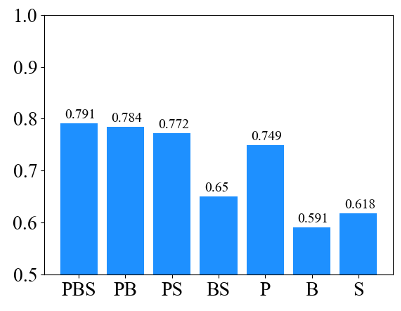
- The Power of Trio (PBS): Combining Personality (P), Behavior (B), and Social Networks (S) consistently yielded the highest accuracy across all five mental health categories.
- Gaming & Inferiority: A specific correlation was found between high game time and feelings of inferiority (), suggesting that digital isolation often precedes or mirrors psychological struggle.
- The Best Predictor: When used alone, Personality was the strongest single predictor, but Social Networks provided structural clues that personality tests often miss.
As shown in the comparison table below, the neural network approach achieves massive gains over traditional models like Logistic Regression or Naive Bayes, particularly in complex categories like Internet Addiction (+28.7%).

Critical Analysis: Why This Matters
This work shifts the paradigm from self-reporting to passive observation. Personality traits are static, but behavior and social network positions are dynamic. By monitoring changes in how a student navigates their social and digital life, we can move toward an "Early Warning System" for mental health crises.
Limitations: The study is currently localized to a specific demographic (freshmen in a Chinese software engineering college). The "Big Five" and smart-card behaviors may manifest differently across different cultures or age groups.
Conclusion
This study proves that mental health is not just "in our heads" but reflected in our social ties and digital footprints. The integration of PageRank-based social features into a neural network provides a robust, non-linear pathway to early detection, offering university administrators a data-driven tool to support student well-being before a crisis occurs.