
Decoding the Digital Mind: Automated Mental Health Prediction via Microblogging
Predicting Mental Health Status on Social Media - A Preliminary Study on Microblog
This paper presents a preliminary study on predicting mental health status using Sina Weibo data. The authors developed two models—a "bootstrap" Naive Bayes classifier and a multi-feature linear regression model—to identify mental health dimensions defined by the SCL-90-R scale, achieving a classification accuracy of 72% for depression.
TL;DR
Researchers from the Chinese Academy of Sciences have tapped into the vast data of Sina Weibo to predict mental health status. By correlating online linguistic patterns and social behaviors with the clinical SCL-90-R scale, they achieved a 72% accuracy in identifying depression, marking a significant step toward automated, real-time psychological monitoring.
Context: Beyond Personality Traits
While previous "cyber-psychology" research successfully mapped social media usage to the "Big Five" personality traits, mental health presents a different challenge. Unlike personality, which remains relatively static, mental health is fluid—shifting with external pressures and internal states. This paper explores whether microblogs can serve as a proxy for the SCL-90-R, a 90-item clinical instrument covering dimensions like anxiety, depression, and hostility.
The Problem: The Clinical Gap
Traditional psychotherapy is often a reactive process: a patient feels unwell and seeks a therapist. However, many suffer in silence due to the stigma or lack of resources. The authors argue that since SNS (Social Networking Services) are now an integral part of life, they provide a non-intrusive stream of data that can flag mental health risks before they escalate into crises.
Methodology: Human-in-the-Loop vs. Automated Lexicons
The authors explored two distinct paths for feature extraction:
1. The "Bootstrap" Method (Model 1)
This model identifies "predisposition words" without prior psychological knowledge. Using a Naive Bayes principle, it discovers terms used more frequently by users with poor mental health scores.
- Insight: It creates an automated lexicon where words like "pain," "insomnia," and "sorry" carry high weights in predicting depression.
2. The Integrated Feature Method (Model 2)
This approach combines three pillars of data:
- Linguistic (LIWC): Categorizing words into psychological domains (e.g., swear words, family, body).
- Emotional Ontology: Mapping text to specific emotions like "angry" or "disappointed."
- Behavioral Metrics: Analyzing SNS activity intensity, such as follower/following ratios and posting frequency.
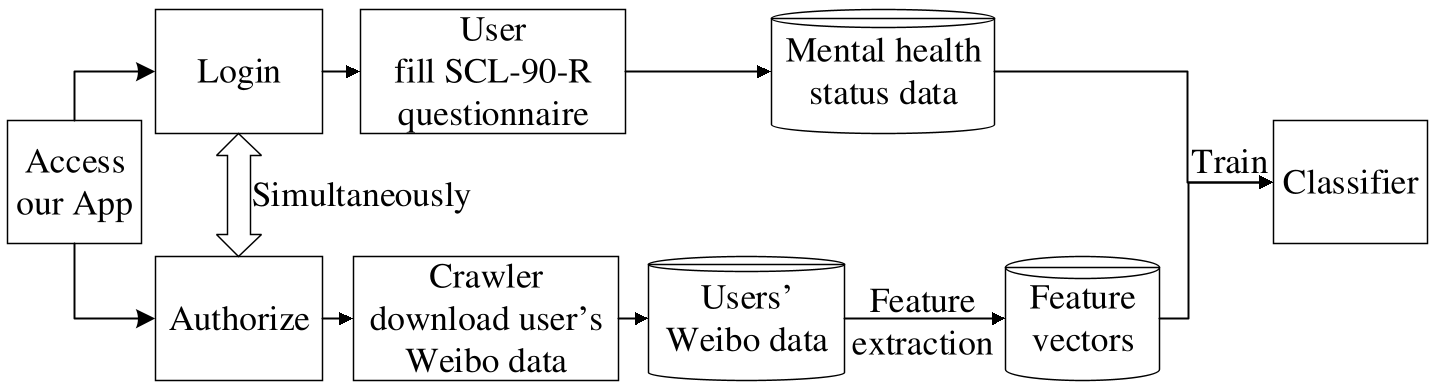 Figure 1: The workflow from Weibo crawling to SCL-90-R prediction.
Interpretable AI over Black Boxes
In a notable departure from the trend of using complex Neural Networks, this study utilizes Linear Regression and Pace Regression. The rationale is purely psychological: to understand why a user is flagged. A linear model provides explicit coefficients, showing exactly how a behavior (like frequent late-night posting) correlates with a specific mental state (like Anxiety).
Key Results & Evidence
The models were tested against 448 volunteers who completed the SCL-90-R.
- Depression Classification: Model 1 achieved a robust 72% accuracy.
- Continuous Prediction: For dimensions like Anxiety (AN) and Hostility (HO), the correlation reached 0.33, which is considered a significant "weak-to-moderate" correlation in psychological sciences.
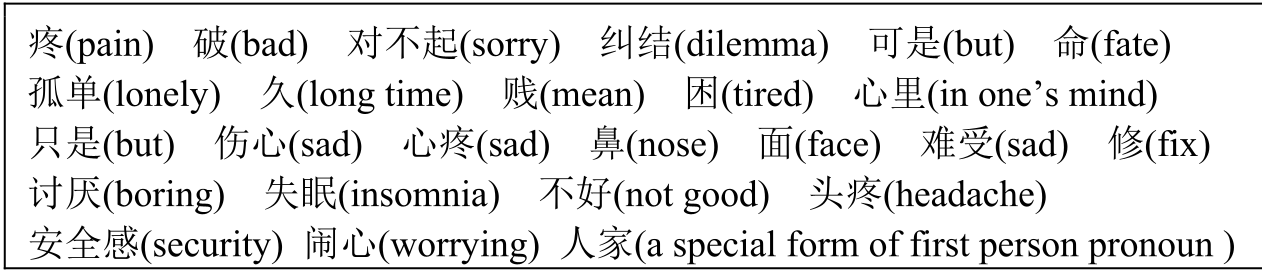 Table 1: Top terms extracted from the depression lexicon—note the semantic links to sadness and physical ailments.
Critical Analysis: The Temporal Missing Link
One primary limitation acknowledged by the authors is the static nature of their current analysis. Mental health is a time-varying signal, yet the model aggregates all of a user's historical posts into a single snapshot. A user might have been depressed two years ago but is healthy now; the current model struggles to distinguish between these states.
Conclusion & Future Outlook
This study serves as a proof-of-concept that the "Cyber-space" is indeed a mirror of our psychological reality. By refining these models to include temporal patterns—how behavior changes over weeks or months—we could move toward "Digital Bio-markers" that provide life-saving early warnings for those struggling with mental illness.