
Beyond the Algorithm: Predict Movie Tastes through Personality and Values
Predicting Users’ Movie Preference and Rating Behavior from Personality and Values
This research develops psycholinguistic models to predict movie genre preferences and rating behaviors by fusing Twitter and IMDb data. Using IBM Watson Personality Insights, the authors map Big5 personality traits and Schwartz values to user choices, achieving an average AUC of 69.4% for genre prediction and a 73% adjusted R2 for rating behavior.
TL;DR
Can your tweets predict whether you'll love a Sci-Fi epic or a gritty Drama? This research proves that they can. By linking Twitter activity with IMDb ratings, researchers have built a model that maps Big5 Personality Traits and Schwartz Values to movie preferences, solving the "cold-start" problem and outperforming traditional Collaborative Filtering by a wide margin.
Background Positioning: This work bridges the gap between Psycholinguistics and Information Retrieval, shifting movie recommendation from "what others liked" to "who you are."
The "Cold-Start" Pain Point
Traditional Recommender Systems (RS) like Netflix or Amazon are reactive. They need you to rate items before they know what you like. When a new user joins, the system is blind—a phenomenon known as the Cold-Start problem.
The authors argue that choice is an extension of the self. If a system can understand your psychological DNA—your level of Openness or your focus on Self-transcendence—it shouldn't need your rating history to know you'll likely rate a psychological thriller highly.
Methodology: The Psycholinguistic Bridge
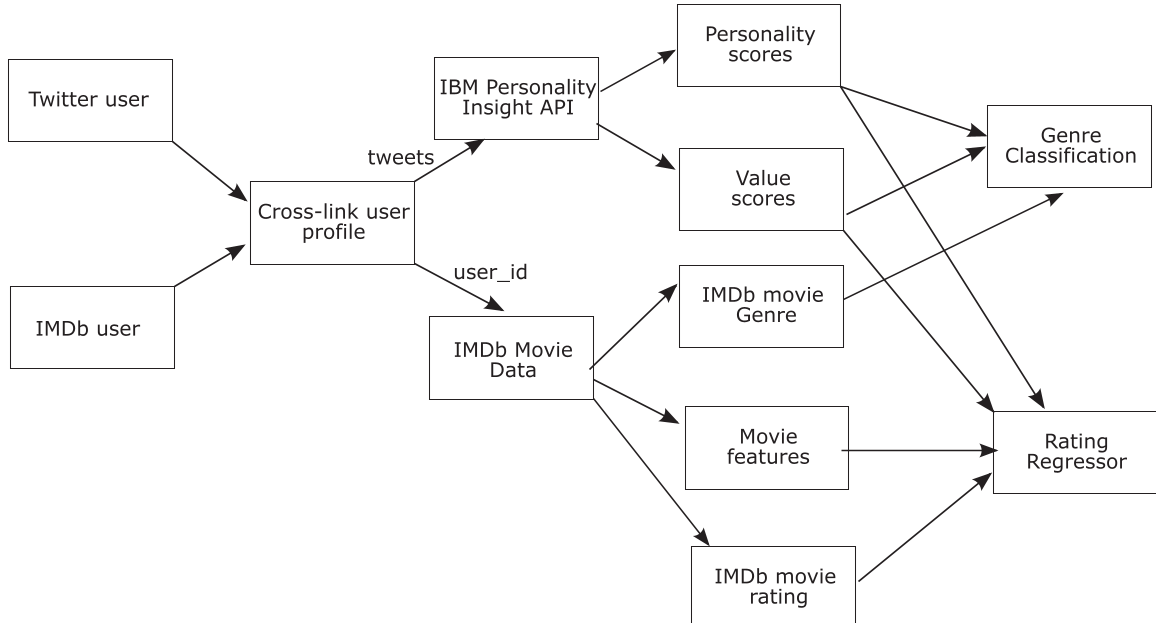
The researchers developed a dual-module framework:
1. Genre Preference Classification
The model extracts traits from tweets and maps them to six popular genres.
- The Insight: People high in Openness gravitate toward Comedy (unpredictable content), while Neurotic individuals show a preference for Drama.
- The Architecture: Instead of relying on a single classifier, they used a Weighted Linear Ensemble combining personality-based and value-based models.
2. Rating Prediction Regression
To predict a specific 1-10 rating, the researchers looked at:
- User Side: Big5 Traits + Schwartz Values.
- Movie Side: Genre + Storyline (analyzed via LIWC for emotional categories like 'Anxiety' or 'Work').
- Interaction: Jaccard similarity between the user's past review topics and the movie’s plot.
Experimental Results: Crushing the Baselines
The results were striking when compared to traditional RecSys techniques like SVD (Singular Value Decomposition) and Memory-based Collaborative Filtering.
| Technique | RMSE (Lower is better) | MAE |
|---|---|---|
| SVD (Traditional Model-based) | 2.6037 | 2.2353 |
| User-Item CF (Traditional Memory-based) | 2.6630 | 2.2748 |
| Personality-Value Ensemble (Proposed) | 1.095 | 1.027 |

The Sci-Fi genre saw the highest prediction accuracy (AUC 0.943), suggesting that the psychological profile of a Sci-Fi fan is particularly distinct and consistently measurable through social media usage.
Deep Insight: Why Personality Matters
The study reveals a fascinating correlation: Openness to Experience and Extraversion are often negatively correlated with movie ratings. High-openness individuals are harder to please; they seek novelty and often view traditional tropes with a critical eye, leading them to give lower average scores even if they "liked" the film.
Critical Analysis & Future Outlook
While the study is a breakthrough in cross-platform data fusion, it has limitations:
- Dataset Size: The manual linking of Twitter to IMDb capped the dataset at 330 users. Scalability remains a question.
- Lexical Limits: The LIWC tool uses a closed vocabulary. Modern LLMs (like GPT-4 or Llama 3) could likely extract even more nuanced "slang" and "subtext" from storylines to improve accuracy further.
The Takeaway: The future of recommendation isn't just tracking what you click; it's understanding why your personality makes you click it. Marketers and developers who integrate psychological profiling will be the ones to solve the cold-start problem for good.