
NELPT: Bridging Knowledge Base Gaps with Twitter’s Spatial Intelligence
Predicting Named Entity Location Using Twitter
The paper introduces NELPT, the first unsupervised framework for Predicting Named Entity city-level Locations using Twitter. It utilizes a Linear Neural Network to aggregate geographical signals from tweet contents, user profiles, and GPS metadata to resolve entity-level location incomplete in Knowledge Bases (KBs).
TL;DR
Knowledge Bases (KBs) are the backbone of modern AI, yet they remain perpetually incomplete as new entities emerge. NELPT (Named Entity Location Prediction using Twitter) is a pioneering unsupervised framework that turns Twitter’s noisy stream into a high-precision sensor for city-level entity locations. By combining neural networks with spatial clustering and EM-based learning, it achieves a 71% accuracy rate without a single manual label.
Problem & Motivation: The "Static" Knowledge Base vs. The "Dynamic" World
Traditional Knowledge Bases like Freebase or YAGO struggles to keep pace with reality. An entity like the "LEO Zoological Conservation Center" might exist in the database, but its specific "where" is often missing.
While previous efforts (like the AP model) tried to extract these locations from web pages, social media presents a more "real-time" but "messier" alternative. The challenges are three-fold:
- Data Imbalance: Some entities have 2300 tweets; others have 20.
- Language Noise: Professional NER tools often fail on 140-character slang.
- Profile Deception: Users often list "My Home" or "Mars" as their location.
The authors' core insight: Even if individual markers (GPS, Profile, or Mentions) are noisy, their Global Distribution forms clusters around the truth.
Methodology: The NELPT Architecture
NELPT doesn't just look at word counts; it looks at "Spatial Architecture."
1. Feature Engineering: Beyond Keywords
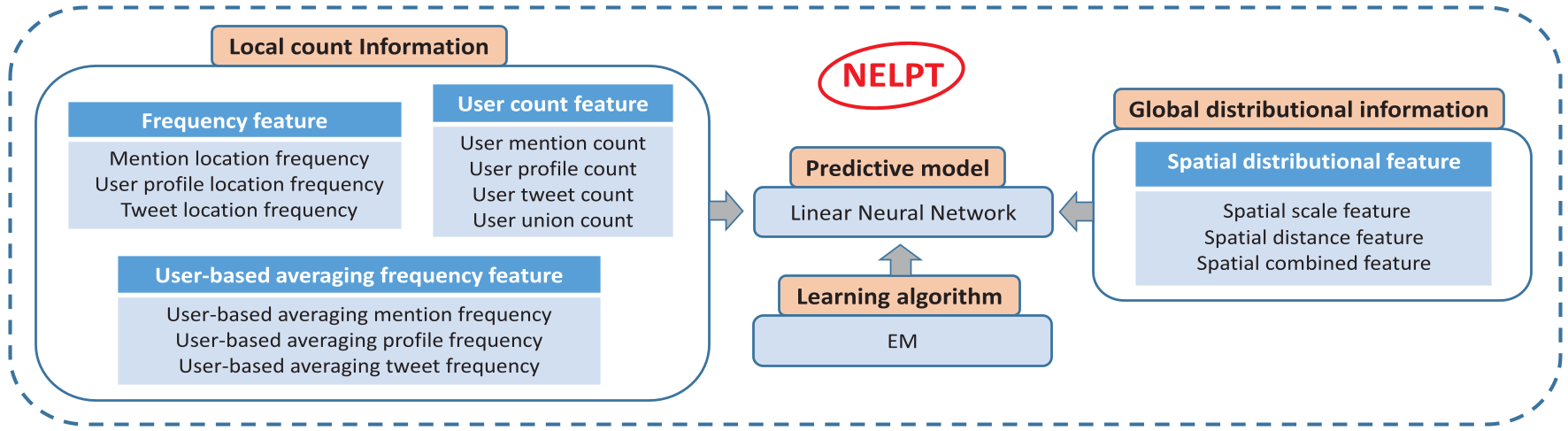
The framework extracts three categories of local count information:
- Frequency Features: How often is the city mentioned with the entity?
- User Counts: Are many different people talking about it, or just one spammer?
- Averaging Metrics: Normalizing popularity by user volume to prevent individual bias.
2. Global Distributional Insight
This is where the framework shines. NELPT assumes that while people tweet about an entity from everywhere, the highest density of tweets (weighted by type—GPS being the strongest signal) will cluster at the entity's true location.
3. Unsupervised EM Learning
How do you train a Neural Network without labels? NELPT treats the "True Location" as a hidden random variable.
- E-Step: Use current weights to predict the most likely city.
- M-Step: Use Gradient Descent to update weights so that the model's confidence in that predicted "truth" is maximized (minimizing Cross-Entropy).
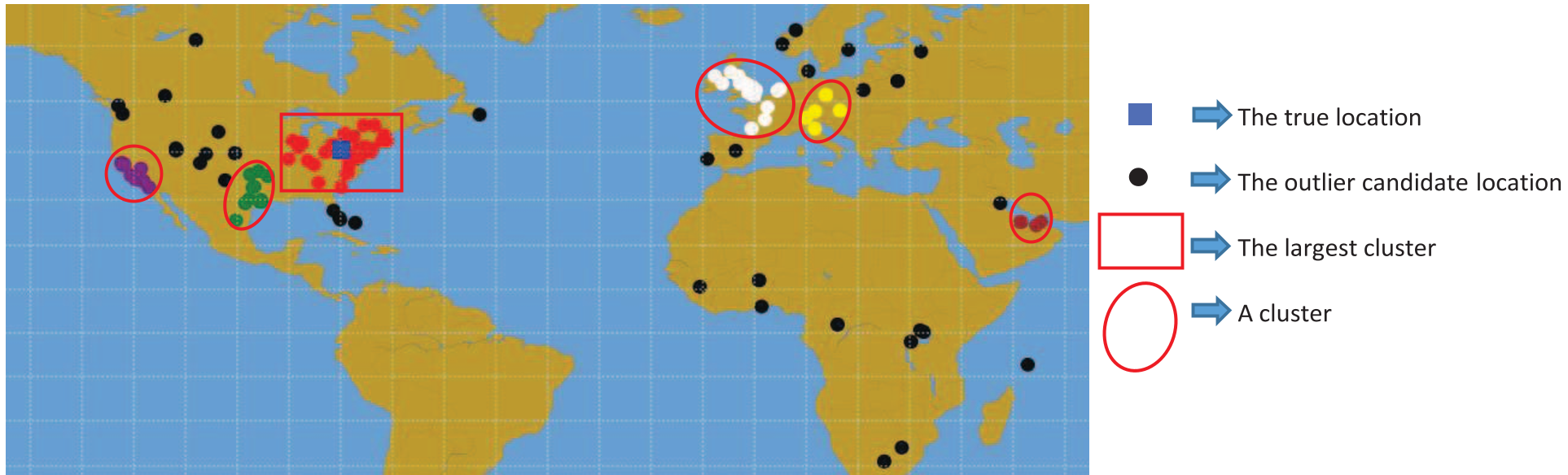 Fig: Candidate locations for "Carnegie Mellon University" clustering heavily in Pittsburgh despite global noise.
Experiments & Results: SOTA Performance
The researchers tested NELPT against 441 entities across Museums, Theaters, Universities, and Corporate Headquarters.
Key Findings:
- Accuracy: NELPT reached 71.0%, beating the best text-only baseline (APset) by 23.4%.
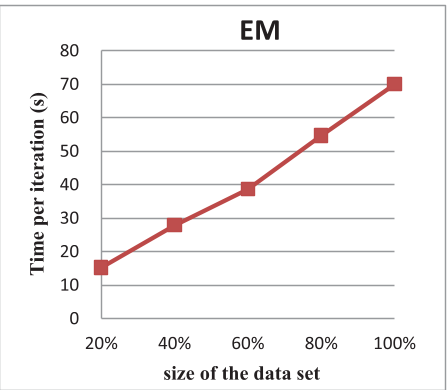
- Scalability: The learning time scales linearly with the number of entities, making it viable for massive KB enrichment.
- Ablation Power: Using all features (Frequency + User + Spatial) was significantly better than using any single group, proving that spatial clustering (DBSCAN) is the "secret sauce."
Critical Analysis & Takeaways
Why does it work? NELPT succeeds because it filters the "spatial influence scope." For a university, the influence is "broad" but the cluster center is precise. For companies (the hardest category at 37.7% accuracy), the model still struggles because branches and headquarters create competing "true" clusters.
Future Outlook:
- Finer Granularity: Moving from city-level to specific street addresses.
- Temporal Dynamics: Predicting the location of "Events" (e.g., festivals) where the location changes over time.
- Sparse Data: Improving performance for entities with fewer than 20 total mentions.
In conclusion, NELPT proves that the collective intelligence of Twitter users—when filtered through a rigorous neural-spatial framework—can serve as a reliable, automated map for the world's knowledge.