
Beyond Static Snapshots: Harnessing Temporal Dynamics for Friendship Prediction
Predicting New Friendships in Social Networks
This paper introduces a supervised learning framework for temporal link prediction in social networks, utilizing J48 decision trees and feed-forward neural networks. By incorporating time-sensitive features like recency and moving averages into a Facebook dataset (New Orleans), the authors achieves a significant performance boost over traditional static-feature baselines.
TL;DR
Predicting who will become friends next on platforms like Facebook is more than just a game of "common friends." This paper demonstrates that how recently and how consistently users interact are far more powerful predictors than simple network topology. By feeding temporal features into J48 Decision Trees and Neural Networks, the researchers achieved significant gains in Precision and AUC over traditional static models.
The "Static" Blind Spot
Most link prediction research treats a social network as a frozen image. In reality, networks are living organisms that pulse with activity. If Alice and Bob have ten common friends but haven't interacted in three years, are they really likely to connect? Static metrics like Common Neighbors (CN) or Jaccard's Coefficient would say "Yes," but the temporal reality screams "No." The authors identify that neglecting the temporal evolution—the past interactions and their timing—is the primary bottleneck in modern link prediction.
Methodology: Fusing Time and Topology
The study utilizes a supervised learning approach. The core innovation lies in the feature engineering, categorizing predictors into two buckets:
1. The Static Baseline
These are the "Old Guard" of network analysis:
- Common Neighbors (CN): Simple count of mutual friends.
- Adamic/Adar (AA): Weighting common neighbors by how "exclusive" they are.
- Preferential Attachment (PA): The "rich get richer" logic based on node degrees.
2. The Temporal Multipliers
This is where the magic happens:
- Recency: Utilizing timestamped Facebook wall posts to see when a node was last active.
- Moving Averages: Computing static features over the last 2, 5, or 10 snapshots to capture trends rather than just current states.
- Link Delay (LD): Measuring the lag between when a connection could have formed and when it actually did.
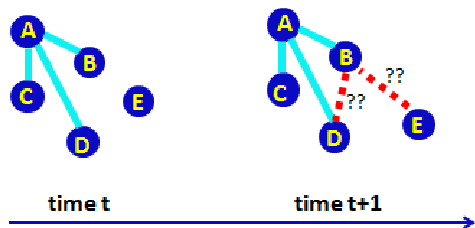 Figure 1: The evolution of links across time-steps, illustrating the transition from potential to actual edges.
Experimental Battleground: Facebook New Orleans
The researchers tested their hypothesis on an anonymized dataset of New Orleans Facebook users spanning 28 months. They specifically focused on "Hard Negatives"—pairs of users who are two hops away (friends of friends) but haven't connected yet. This is a much tougher and more realistic test than comparing random strangers.
Key Findings:
- Temporal Superiority: In nearly every test scenario, models using temporal features (TempRec, AllTemp) outperformed the static baseline.
- Precision vs. Recall: While Recency (TempRec) was excellent for maximizing Recall (finding as many future friends as possible), the AllTemp combination (including Moving Averages) provided the best Precision and AUC ROC.
- Neural Nets vs. Decision Trees: Both models reached similar conclusions, reinforcing that the value lies in the data features rather than just the classifier architecture.
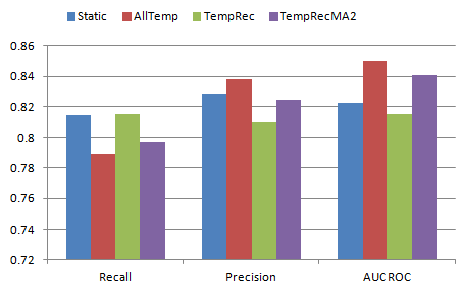 Figure 2: J48 Decision Tree performance comparing Static features against various Temporal combinations. Note the consistent lead of temporal models.
Critical Insight: The "Eagerness" of Users
The study highlights an intuitive but often ignored truth: social structures are built at different speeds. By measuring Link Delay, the models capture the "eagerness" of users. Some users act immediately upon meeting a friend-of-a-friend; others wait months. Capturing this behavioral "velocity" allows the machine learning model to distinguish between a "stale" potential link and a "hot" one.
Future Outlook and Limitations
While the paper proves the efficacy of temporal features, it barely scratches the surface of Deep Learning on Graphs. Modern architectures like Temporal Graph Networks (TGNs) could potentially automate this feature extraction. However, the simplicity of the authors' approach—using interpretable features like Moving Averages—makes it highly practical for deployment in real-world systems where "Why did you suggest this friend?" is a necessary question to answer.
Conclusion
This work serves as a definitive argument for Time-Awareness in social network analysis. For researchers and engineers, the message is clear: if you aren't looking at the timestamps of your interactions, you're only seeing half the picture.