
Predictive Surveillance: Utilizing LBSNs and Neural Networks for Forensic Location Prediction
Predicting Next Location of Twitter Users for Surveillance
This paper proposes a region-based next-location prediction framework specifically designed for technical surveillance and digital forensics. It leverages Foursquare check-in data scraped from Twitter and utilizes Artificial Neural Networks (ANN) to achieve a state-of-the-art error rate of 3% in predicting a suspect's future geographical zone.
TL;DR
Law enforcement agencies face a daunting challenge: tracking suspects across vast urban landscapes with limited resources. This paper presents an intelligent system that mines Foursquare check-ins from Twitter to predict a user's next location. By employing an optimized Artificial Neural Network (ANN), the researchers achieved a 97% accuracy rate in predicting the geographical region a suspect will visit next, potentially revolutionizing digital forensics and technical surveillance.
The Motivation: From Manual Tracking to Digital Intelligence
The core problem in tech-surveillance is the "search-area dilemma." If investigators don't know where a suspect is headed, they must monitor a wide perimeter, which drains budgets and manpower. While most people view social media "check-ins" as harmless social sharing, this paper identifies them as a structured mobility signal.
The authors argue that human behavior is not random but follows routine patterns. By capturing these patterns from Location-Based Social Networks (LBSNs), we can shift surveillance from reactive (where were they?) to proactive (where will they be?).
Methodology: The Architecture of Prediction
The proposed methodology follows a sophisticated pipeline: data harvesting, feature extraction, and regional classification.
1. Data Harvesting & Feature Engineering
The system extracts four primary features from a suspect's Foursquare/Twitter history:
- Spatial Traits: Latitude and Longitude of past check-ins.
- Temporal Traits: The specific Month and Day of the activity.
2. Regional Zoning
Instead of attempting to predict an exact GPS coordinate (which is prone to high variance), the authors partitioned the map of Turkey into a 6x19 grid. This transforms the task into a Region-Based Classification problem, making the model more robust to minor deviations in user behavior.
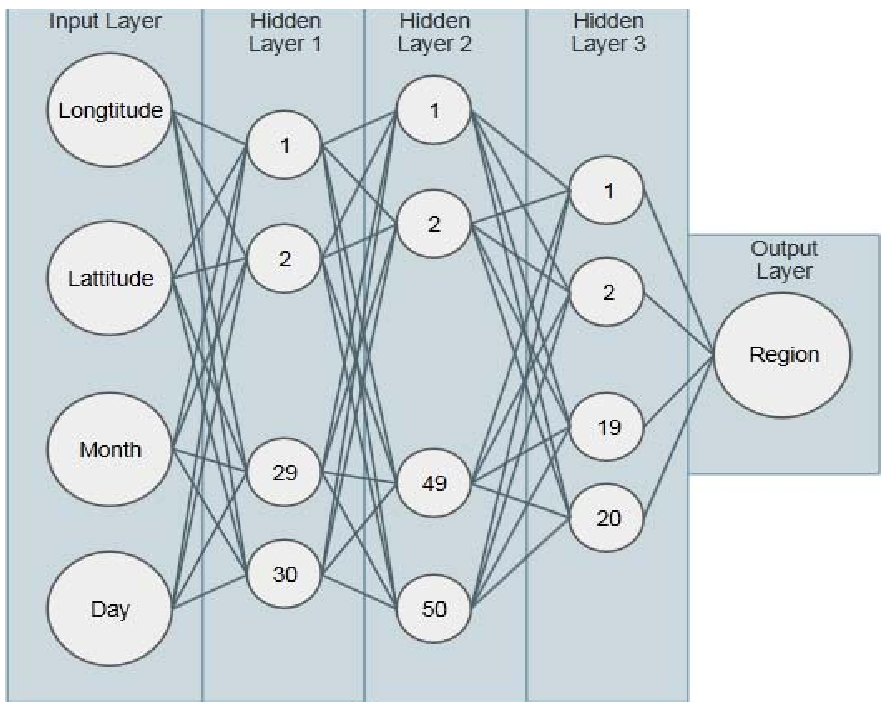 Fig. 1: The optimized ANN structure featuring input layers for spatio-temporal data and specialized hidden layers for pattern recognition.
3. Neural Architecture Optimization
The researchers conducted an extensive ablation study on ANN architectures. They discovered that a Multi-layered Perceptron (MLP) using the Scaled Conjugate Gradient (SCG) algorithm provided the best convergence. The top-performing model utilized three hidden layers with a (30, 50, 20) neuron distribution.
Experimental Results: Precision in Practice
The results validate the transition from coordinate-based tracking to regional-based prediction.
| Model ID | Hidden Layers | Algorithm | Error Rate |
|---|---|---|---|
| Model 2 | 3 (30,50,20) | SCG | 3.25% |
| Model 4 | 3 (30,50,20) | LM | 8.45% |
| Model 1 | 2 (20,40) | SCG | 5.53% |
By utilizing the Percentage Error formula between Predicted Regions (PR) and Real Regions (RR), the study confirmed that the SCG-trained neural network is exceptionally reliable for surveillance tasks.
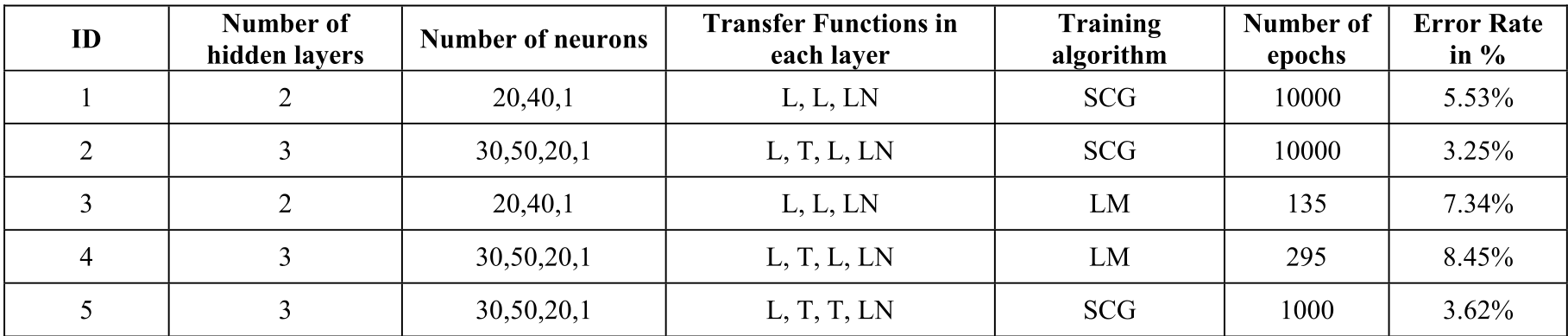 Fig. 2: Comparison of different ANN configurations and their corresponding error rates.
Critical Insights & Future Outlook
The "3% Error Rate" is more than just a statistic; it represents a functional tool for investigators. However, there are inherent limitations:
- Data Density: The model requires at least 40-50 past check-ins to train effectively. Suspects with high "privacy awareness" who don't post locations would be immune to this specific method.
- Granularity: While regional prediction is highly accurate, narrowing the search area from "zones" to "specific venues" (meters instead of kilometers) is the next logical frontier.
Conclusion
This research proves that the digital breadcrumbs we leave in the "Latent Space" of social media can be reconstructed into a physical trajectory. For law enforcement, it offers a way to work smarter; for the general public, it serves as a stark reminder of the privacy implications inherent in the "Check-in" culture.
Takeaway for the Industry: Future forensic tools will likely integrate this type of ANN-based mobility prediction with real-time API streaming to provide live "Heat Maps" of suspect probability.