
Beyond Demographics: Leveraging Social Ties to Predict E-Commerce Acceptance
Predicting online channel acceptance with social network data
This paper introduces a novel application of social network analysis to predict consumer e-commerce acceptance across various product categories. By employing network-based classifiers like the Weighted-Vote Relational Neighbor (wvRN), the study demonstrates that local social ties significantly influence channel choice, especially for high-durability goods and niche services.
TL;DR
Predicting who will buy online usually involves prying into age, income, and PC habits. This research flips the script: by looking at who your friends are, companies can predict your online channel acceptance more accurately than traditional methods. This is especially true for niche services and high-end durable goods where social trust matters most.
The "Data Privacy" Wall in E-Commerce
For decades, marketers have chased the "perfect customer profile" using demographic variables. However, we are hitting a wall. Customers are increasingly protective of their personal data, and acquiring granular information (like one's "attitude towards the internet") is expensive and intrusive.
The authors of this study recognized a massive, untapped goldmine: Public Social Ties. Whether it's a member list of a sports club or a public Facebook friend list, these connections are often visible. The core insight? Birds of a feather shop together. If we know even a small fraction of a network's behavior, we can infer the rest through Homophily (like-minded people associate) and Social Contagion (people influence their peers).
Methodology: The Power of Relational Classifiers
Instead of building a model that asks "How old is User X?", the authors used Relational Classifiers.
The wvRN Algorithm
The primary weapon was the Weighted-Vote Relational Neighbor (wvRN) classifier. It calculates the probability of a node adopting a behavior based on the weighted sum of its neighbors’ probabilities.
This formula essentially says: Your likelihood of thinking "buying a car online is okay" is the average opinion of your closest friends.
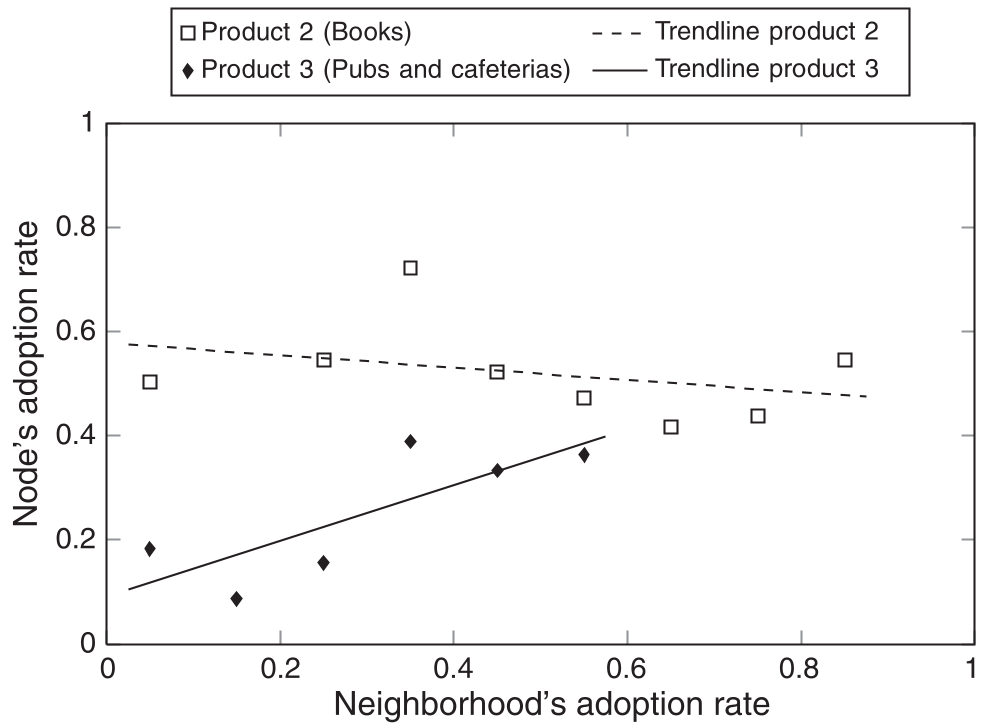
The researchers used Relaxation Labeling to handle the "cold start" problem—where you have a network but don't know the labels for most people. The system iteratively updates its guesses until the whole network's "vibe" stabilizes.
Experimental Insights: Where Networks Shine
The study tested 11 product types, from books to 2nd-hand cars. The results revealed a fascinating pattern: Network data is most valuable when the behavior is rare.
1. The Inverse Correlation
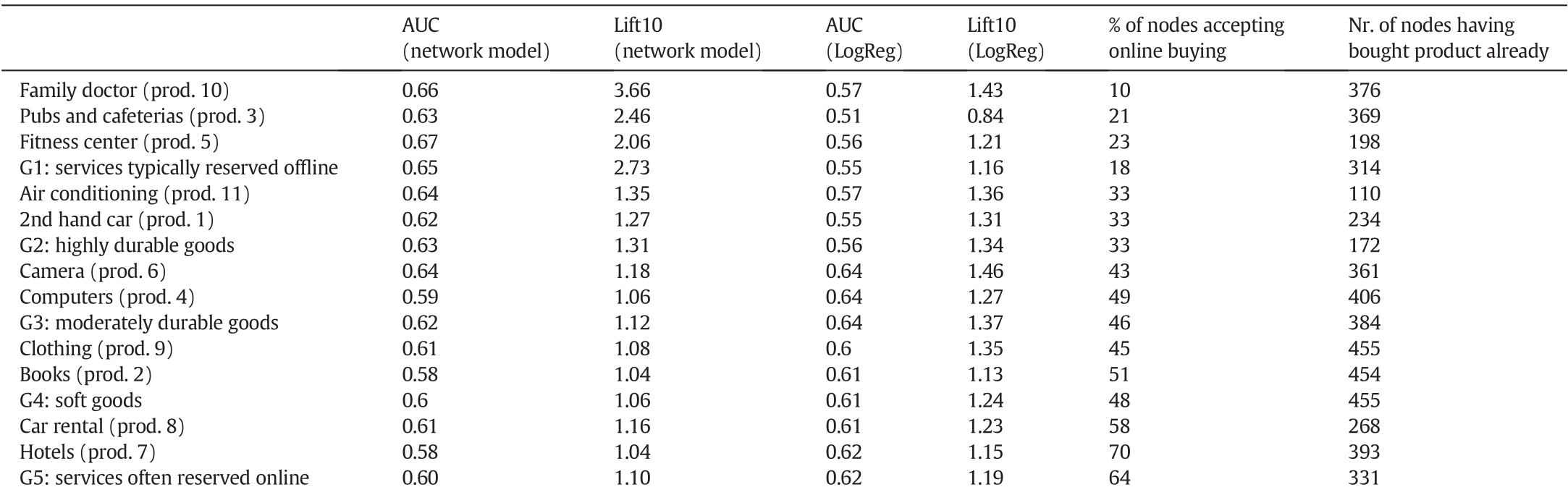
The model's performance (measured by Lift10) was negatively correlated (-0.83) with the base adoption rate.
- Common behaviors (like booking a hotel): Traditional models work fine because everyone does it.
- Rare behaviors (like booking a family doctor online): Social networks are the only reliable signal. Here, the network model was 3.6 times better than random guessing.
2. Weight doesn't matter as much as presence
One of the most practical findings was that knowing the intensity of a friendship (e.g., "we talk daily" vs. "we talk weekly") didn't significantly improve the model. Simply knowing that a connection exists (binary link) was enough to yield high predictive power.
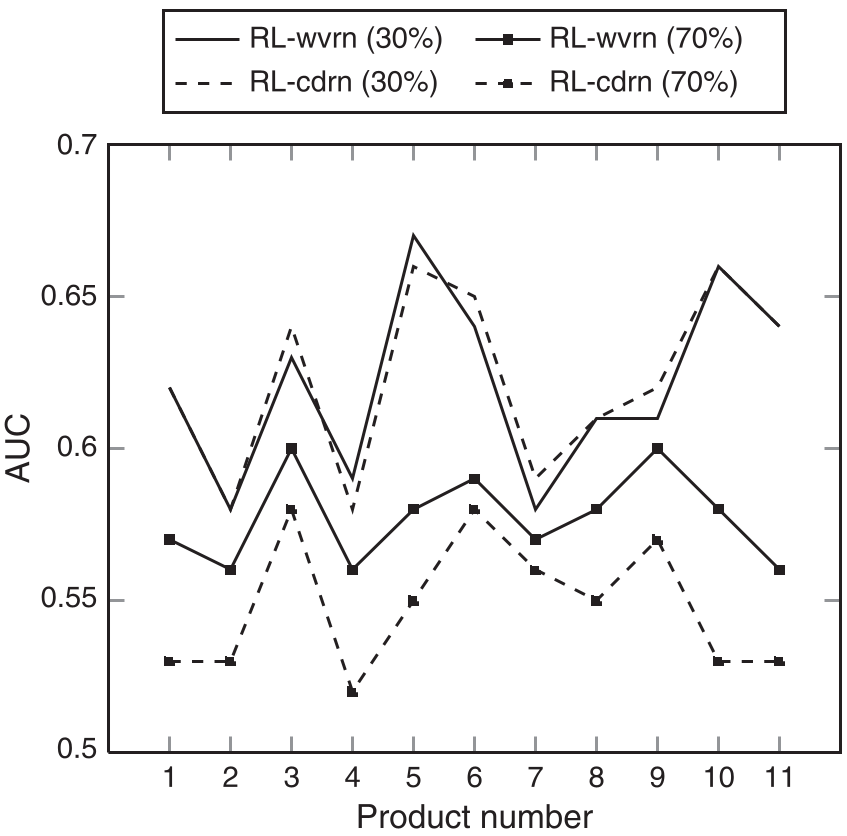
Table: Performance across Product Groups
The table below shows how the Network Model excels in specific niches compared to traditional Logistic Regression (LogReg).
Critical Analysis & Conclusion
This work serves as a powerful "Proof of Concept" for Relational Data Mining.
The Takeaway: Companies should stop obsessing over individual "cookies" and start looking at "clusters." If you are selling a high-durability item (like air conditioning) or a service with a high perceived risk, targeting the social clusters of existing online adopters is significantly more efficient than broad demographic targeting.
Limitations: The study used a student-parent sample. While statistically sound, the dynamics of a corporate network or a global social platform like X (Twitter) might introduce more noise. Furthermore, the average connection per node was low (3.24). In a denser network, we could expect even higher accuracy.
Future Outlook: As privacy regulations (like GDPR) tighten, shifting from "Who are you?" to "Who do you know?" offers a legally safer and technically robust path for the next generation of marketing AI.