
Predictive CSP: Leveraging Machine Learning for Optimal Solver Selection
Predicting Optimal Constraint Satisfaction Methods
The paper proposes a machine learning-based algorithm selection framework for Constraint Satisfaction Problems (CSPs). By utilizing a C4.5 decision tree classifier trained on problem features like constraint density and tightness, the author aims to predict the optimal solver (e.g., Forward Checking vs. Arc Consistency) to minimize solving time, outperforming any single static solver.
TL;DR
In the world of Constraint Satisfaction Problems (CSPs), there is no "Silver Bullet" solver. Different problem structures favor different heuristics. This paper explores a meta-learning approach: using a C4.5 Decision Tree to predict which CSP solver will perform best based on intrinsic problem features. The result? A predictive model that outperforms any single constituent solver and approaches the performance of a theoretical "Oracle."
The Problem: The Expert Bottleneck
Whether it's scheduling, circuit design, or software verification, CSPs are everywhere. However, the diversity of these problems is matched only by the diversity of solvers (Forward Checking, Arc Consistency, varied variable/value orderings).
The current industry standard relies on expert intuition to match a problem to a solver. A wrong choice doesn't just mean a few lost seconds; it can mean the difference between finding a solution in milliseconds or timing out after hours. The author notes that even the best average solver () is significantly slower than a theoretical "Oracle" () that always picks the best tool for the job.
Methodology: Mapping Features to Performance
The research focuses on a classification approach. The author extracted several key "structural signatures" from CSP instances:
- n: Number of variables.
- m: Domain size.
- p1 & p2: Constraint density and tightness.
- kappa (): A measure of problem constrainedness.
Using these as inputs, two solvers were compared: Forward Checking (fc) and Arc Consistency (ac).
The Oracle Gap
The author defines the performance landscape using a simple but effective comparison table:
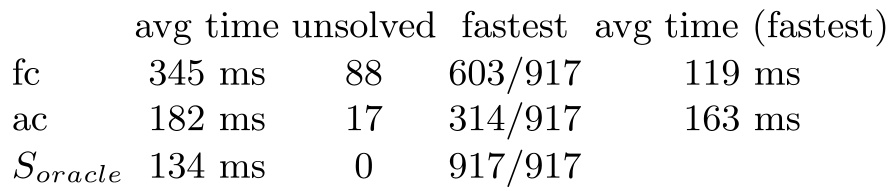
The data shows a clear opportunity: while ac is faster on average (182 ms), fc is actually the faster choice for 603 out of 917 problems. This "flip-flop" in dominance is exactly what the machine learning model aims to exploit.
Cost-Sensitive Learning
One of the paper's most critical insights is that not all mistakes are equal.
- If you choose
fcwhenacwas slightly faster, the penalty is small. - If you choose
fcfor a problem whereacwas hundreds of milliseconds faster, the penalty is severe.
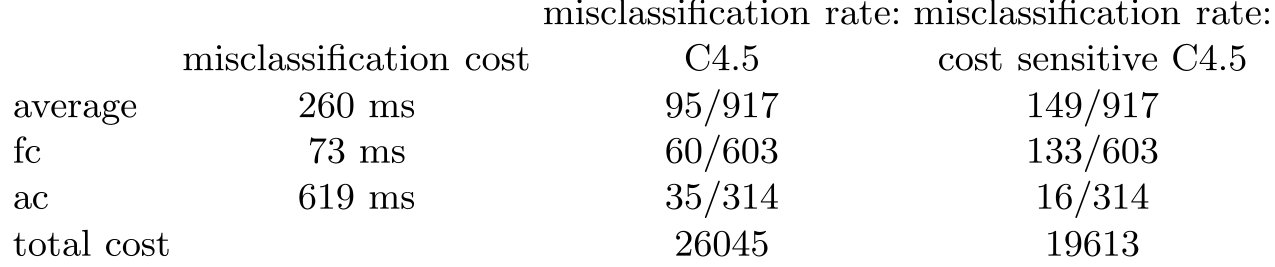
To address this, the author employed Cost-Sensitive C4.5 Decision Trees, which weight training instances based on the "Misclassification Cost" (the time difference between the chosen solver and the best solver).
Results and Insights
The experimentation yielded impressive results:
- Single Best Solver (ac): 182 ms average.
- Standard C4.5: 162 ms average.
- Cost-Sensitive C4.5: 155 ms average.
- The Oracle Baseline: 134 ms average.
The cost-sensitive model successfully bridged approximately 56% of the gap between the best static solver and the theoretical maximum performance. This confirms that even rudimentary problem features can provide enough "signal" for a decision tree to make high-value branching decisions.
Critical Analysis & Conclusion
While the results are promising, two major hurdles remain:
- Feature Overhead: The time taken to calculate and must be less than the time saved by picking a better solver. In very fast solve times (<5ms), this overhead makes ML impractical.
- Scaling to Thousands of Solvers: Moving from a binary choice (fc vs. ac) to a portfolio of thousands of parameter combinations will require more sophisticated ranking models or neural embeddings.
Takeaway: This paper serves as a foundational proof-of-concept for Algorithm Portfolios. Instead of trying to build the "perfect" solver, the future of CSP research lies in building "intelligent dispatchers" that understand the geometry of the search space.
Future Work
The author suggests moving toward mid-problem solver switching. Imagine a solver that starts with Forward Checking and, upon sensing the problem structure change during search, dynamically switches to Arc Consistency. This could potentially lead to a solver that is even faster than the current .