
From Tweets to Patents: Predicting the Economic Footprint of Research
Predicting Patent Citations to Measure Economic Impact of Scholarly Research
The paper introduces a predictive framework to determine if a research article will have a tangible economic impact by being cited in patents. Utilizing Altmetric data, the authors benchmark several classification models, with Random Forest achieving a SOTA-level accuracy of 93.9% in predicting patent-scholarly linkages.
TL;DR
Is your latest research paper just a scholarly contribution, or does it hold the keys to industrial innovation? This paper investigates the link between Altmetrics (social media/news mentions) and Patent Citations. By analyzing over 780,000 records, the authors demonstrate that machine learning—specifically Random Forest—can predict whether a paper will be cited in a patent with an impressive 93.9% accuracy.
Executive Summary
In the modern research ecosystem, "Impact" is often a buzzword. However, this study moves beyond semantic debates by framing economic impact through a concrete proxy: Patent Citations. By bridging the gap between social digital signals and formal intellectual property, the authors provide a predictive roadmap for researchers and funding bodies to identify work with high commercialization potential before it even reaches the patent office.
Problem & Motivation: The Lag in Innovation Metrics
The primary pain point in bibliometrics is the "Time-to-Impact." Traditional citation counts take years to accumulate, and patent citations take even longer. Prior work has often focused on back-tracing patents to papers, but few have attempted the inverse: predicting forward-looking economic value using real-time digital footprints.
The authors' insight is grounded in the "Global Knowledge Flow" theory. If a paper is being discussed on platforms like Twitter, Mendeley, or in Policy Documents, it signifies an active transfer of knowledge that often precedes industrial application.
Methodology: Mapping Social Signals to Patents
The research team processed a massive dataset from Altmetric.com, focusing on articles published after 2010 to ensure a rich social media presence.
The Feature Set
The models were trained on eight key predictors:
- Mass Media: News outlets and Blogs.
- Reference Tools: Mendeley and Wikipedia.
- Social Platforms: Twitter, Facebook, and Google+.
- Policy: Mentions in official policy documents.
The authors analyzed the correlation between these features (as seen below), finding that while individual social signals are relatively independent, their collective ensemble provides a powerful predictive signature for patent citation.
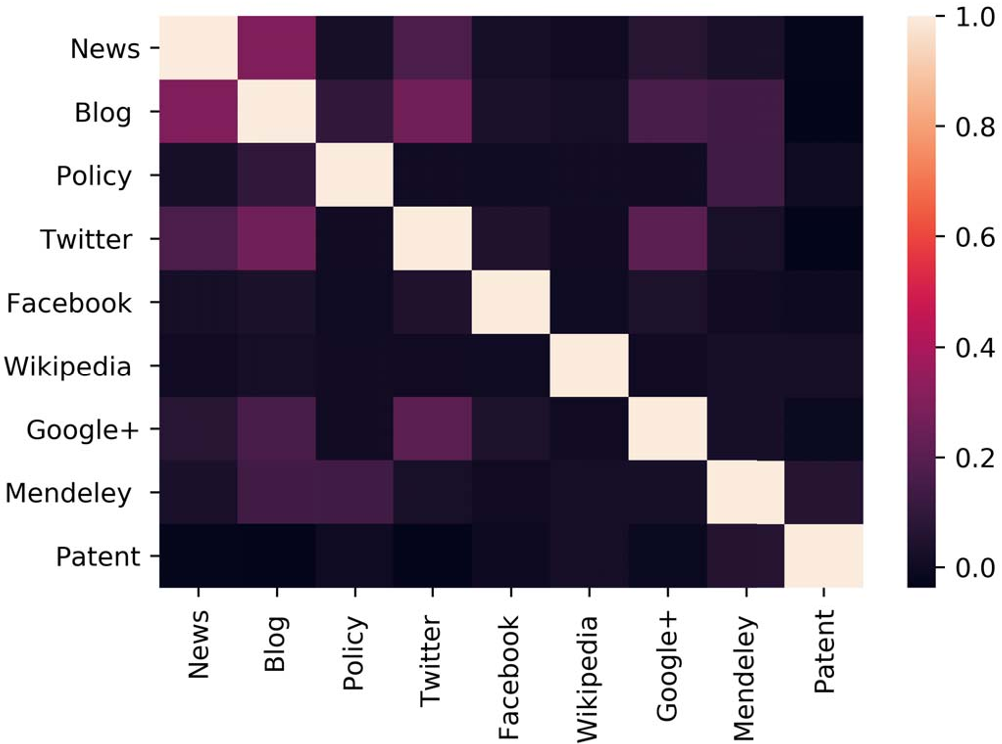 Figure 1: Low correlation between features suggests that each social signal provides a unique dimension of 'attention' to the model.
Experiments & Results: Random Forest Reigns Supreme
The authors benchmarked four classic classifiers: Logistic Regression (LR), Decision Tree (DT), Naive Bayes (NB), and Random Forest (RF).
Performance Breakdown
The results were remarkably consistent, but Random Forest emerged as the clear winner. The high Recall (94.8) of the RF model is particularly noteworthy for policy-makers, as it indicates a very low rate of "missed" innovations.
| Metric | LR | DT | NB | RF |
|---|---|---|---|---|
| Accuracy | 89.7% | 92.6% | 90.5% | 93.9% |
| F1-score | 90.3 | 93.0 | 90.4 | 94.5 |
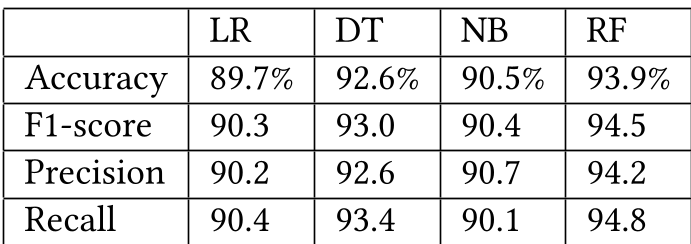 Table 1: Performance metrics across different architectures.
An additional critical finding was the Threshold of Citations: papers with more than 100 traditional scholarly citations had an 80%+ probability of being cited in a patent, suggesting that high-tier academic research and high-tier economic value are deeply intertwined.
Critical Insight & Conclusion
This work validates that scholarly "noise" (buzz) is actually "signal" (potential).
Key Takeaways:
- Altmetrics as Lead Indicators: Social media and news mentions are not just vanity metrics; they are early-warning signals for industrial interest.
- Model Reliability: The high accuracy of the Random Forest model suggests that the relationship between digital attention and patenting is not random but follows learnable patterns.
Limitations & Future Work:
While the binary prediction (Cited vs. Not Cited) is highly accurate, it doesn't yet account for the market value of the patents themselves. The authors' future roadmap involves integrating patent valuation data to create a comprehensive framework for measuring the "Dollar Value" of a research paper.
For the academic community, the message is clear: the path from a PDF to a Product is increasingly visible in the digital traces we leave behind.