
Beyond Keywords: Decoding Personality through the Lens of Social Dynamics
Predicting Personality with Social Behavior
The paper investigates the extent to which fine-grained behavioral measures on Twitter—such as social reciprocity, interaction priority, and friend homophily—can predict the "Big Five" personality traits. By introducing novel metrics like Kullback-Leibler (KL) divergence of interactions, the authors achieve prediction accuracy (Mean Absolute Error) comparable to traditional text-based psycholinguistic analysis (LIWC).
TL;DR
Can your Twitter "response time" or the way you prioritize your friends reveal more about your personality than the actual words you tweet? This paper explores the predictive power of social behavior—reciprocity, interaction intensity, and friend characteristics—to map individuals to the "Big Five" personality traits. The verdict? Behavioral patterns are just as reliable as automated text analysis, offering a non-intrusive alternative for understanding human psychology in digital spaces.
Background: The Hidden Signals in Social Action
Most social media research views personality through lexical lenses (what you say) or structural counts (how many followers you have). However, this work by Adalı and Golbeck shifts the focus to "Why" and "How" we interact. By looking at the normative behavior of our social circles and our distinctive deviations from those norms, we can uncover latent traits that words alone might mask.
Methodology: The Behavioral DNA
The researchers categorized social activity into several high-dimensional groups to capture the "rhythm" of interaction:
- Pairwise Dynamics: Measuring conversations (sequences of directed messages) rather than just total counts.
- Informativeness (KL Divergence): This measures how "differently" you treat your friends. High KL divergence indicates selective, prioritized interaction, while low divergence suggests a uniform social style.
- Homophily (FF Features): Based on the "birds of a feather" principle, the model looks at the average behavior of your friends to predict your own traits.
The Entropy of Reciprocity
A standout technical detail is the use of Shannon Entropy to calculate interaction balance. If User A sends messages and User B sends , the entropy peaks when , signaling a perfectly reciprocal relationship—a key marker for traits like Agreeableness.
Insights: Which Behavior Maps to Which Trait?
The study utilized Forward Subset Selection (FSS) to identify the "leanest" set of behavioral predictors for each trait. The findings provide fascinating psychological profiles:
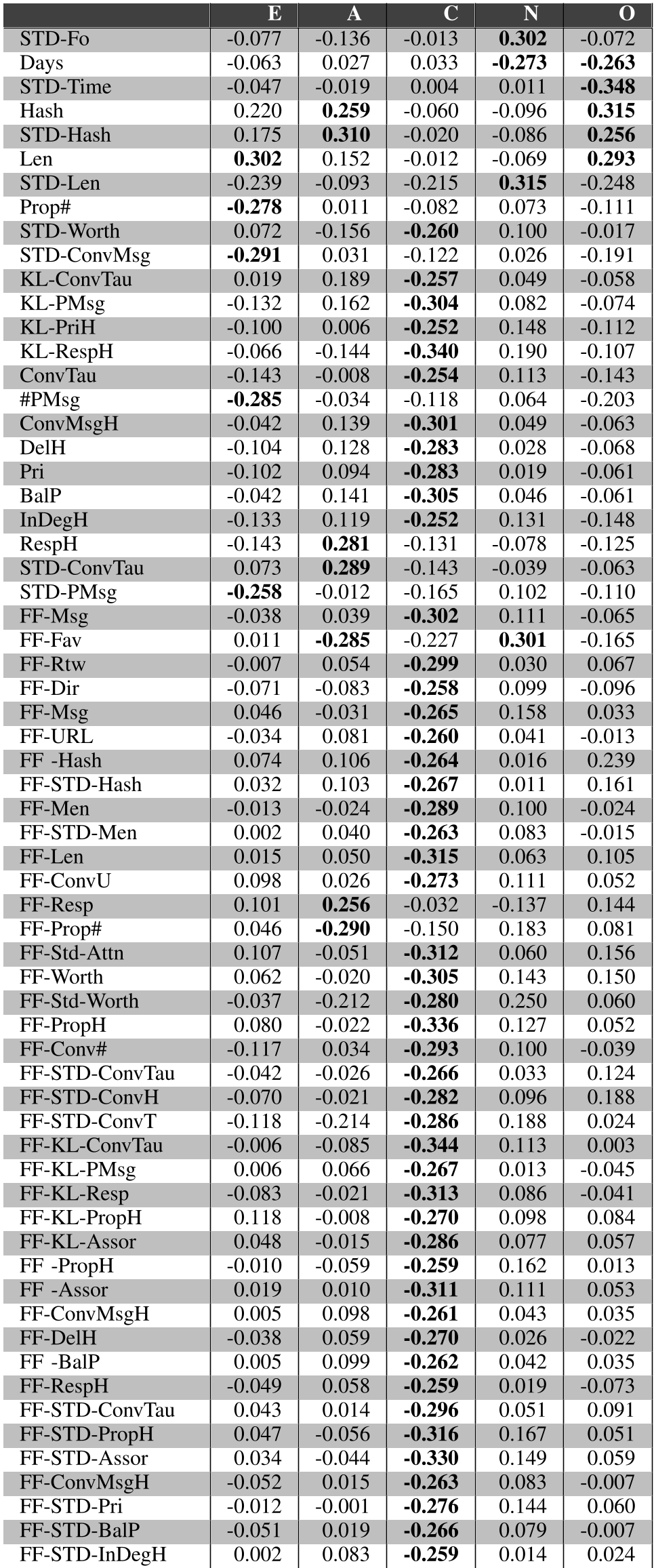
- Neuroticism: Linked to "unstable" patterns—high standard deviation in text length and response times. Neurotics also tend to have messages that are less likely to be "propagated" (retweeted) by their circle.
- Extroversion: Characterized by long text lengths (seeking expression) but, surprisingly, the research notes that extroverts' messages aren't always informative enough to be widely propagated.
- Conscientiousness: Shows highly "normative" and uniform behavior. These users are organized and reliable, treating their social circle with a consistency that results in low KL divergence across interaction metrics.
- Agreeableness: Positively correlated with "balanced" response times and the use of hashtags, suggesting an adherence to social norms and active participation in community discussions.
Experimental Validation: Behavior vs. Text
The authors compared their behavioral model (F2/F3) against the industry-standard LIWC (Linguistic Inquiry and Word Count).
The results (measured by Mean Absolute Error) showed that behavioral features achieved nearly identical performance to text-based features across all traits. For tasks like predicting Openness and Agreeableness, the error rates were remarkably low (approx. 11-12%), proving that your meta-data is as rich in signal as your data.
Critical Analysis & Conclusion
While the study provides a robust framework for behavioral analysis, it acknowledges a few hurdles:
- The Neuroticism Challenge: Traits that involve internal emotional variance remain difficult to capture through external social traces alone (higher MAE of ~18-19%).
- Situational Constraints: The "Herd Effect"—where high-risk situations (like political unrest) force everyone to behave similarly—can temporarily mask individual personality differences.
Final Takeaway
This research moves us closer to a language-agnostic understanding of personality. In an era where privacy concerns and multi-lingual datasets complicate text analysis, observing the "social pulse" of how users interact provides a powerful, scalable, and deeply human way to understand who sits behind the screen.
Future Outlook: The next frontier lies in using these behavioral signals to predict Trust, potentially revolutionizing how we build recommendation engines and community moderation tools.