
Decoding the Greek Soul: Predicting Personality via Morphosyntactic Analysis
Predicting Personality Traits from Spontaneous Modern Greek Text: Overcoming the Barriers
This paper presents a computational approach to predicting Big Five personality traits from spontaneous Modern Greek text using machine learning. The researchers developed a custom morphosyntactic and semantic annotation pipeline to handle limited resources and data, achieving classification performance comparable to SOTA English-based systems.
TL;DR
Is your writing style a mirror of your personality? While English-centric models have long answered "yes," research into other languages has lagged. This paper bridges the gap for Modern Greek, utilizing a custom-built linguistic pipeline and machine learning to predict the Big Five traits. Despite a small dataset (382 authors) and significant class imbalance, the authors show that combining SMOTE oversampling with Meta-learning allows Greek personality detection to rival established English benchmarks.
The Language Barrier: Why Greek is Different
In the world of psycholinguistics, English is the "easy mode" due to its relatively simple morphology and the existence of tools like LIWC (Linguistic Inquiry and Word Count). Modern Greek, however, is an inflected language where the verb itself encodes number and person, and there are no off-the-shelf psycholinguistic dictionaries.
The researchers faced a "triple threat":
- Limited Resources: No Greek equivalent to LIWC.
- Small Data: Only 382 essays, far fewer than the thousands typically used in English studies.
- Class Imbalance: High scores in traits like "Agreeableness" were far more common in the sample than low scores, biasing the AI.
Methodology: Building a Dictionary from Scratch
To solve the resource gap, the team developed a custom text analysis tool. They combined automated Part-of-Speech (POS) tagging (covering 14 categories) with manual semantic annotation provided by language experts.
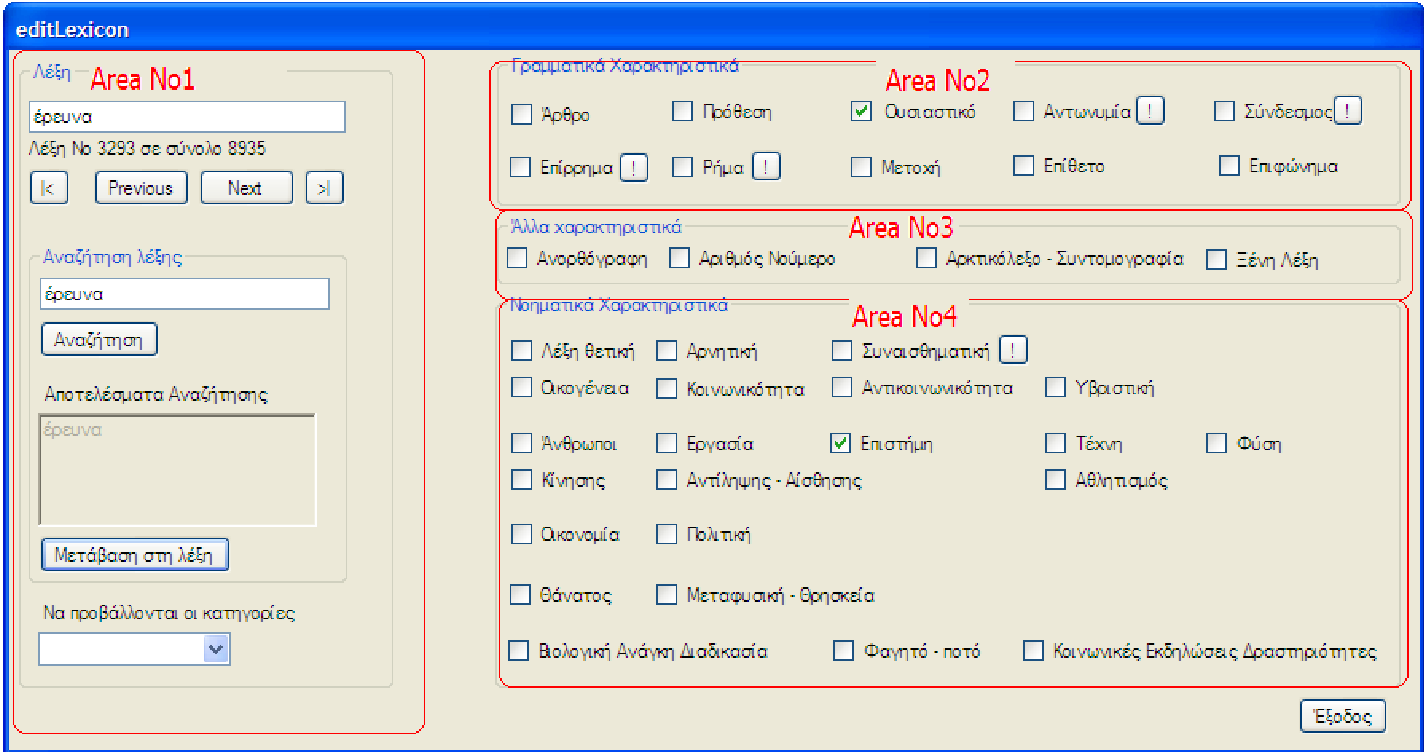
This pipeline transformed raw text into 91 distinct features, categorized into:
- Morphosyntactic Cues: Verb tenses, pronoun usage, and sentence length.
- Conceptual Categories: Words related to politics, science, religion, etc.
- Emotional Categories: Indicators of joy, anger, hope, or anxiety.
Overcoming Data Imbalance with SMOTE & Bagging
The researchers treated the task as both a Regression problem (predicting a raw score) and a Classification problem (High vs. Low trait scores).
The standout innovation was the use of SMOTE (Synthetic Minority Over-sampling Technique). In initial tests, the J48 (C4.5) classifier almost always predicted "TRUE" for traits because the "FALSE" instances were so rare. SMOTE synthetically generated minority class examples, effectively "leveling the playing field."
For regression, they utilized Bagging (Bootstrap Aggregating) with the M5P regression tree. This meta-learning approach helped the model narrow down its error rates by training on various subsets of the small dataset.
Experimental Results: Quantitative Breakthroughs
The results proved that their "Greek-optimized" approach could hold its own against much larger studies.
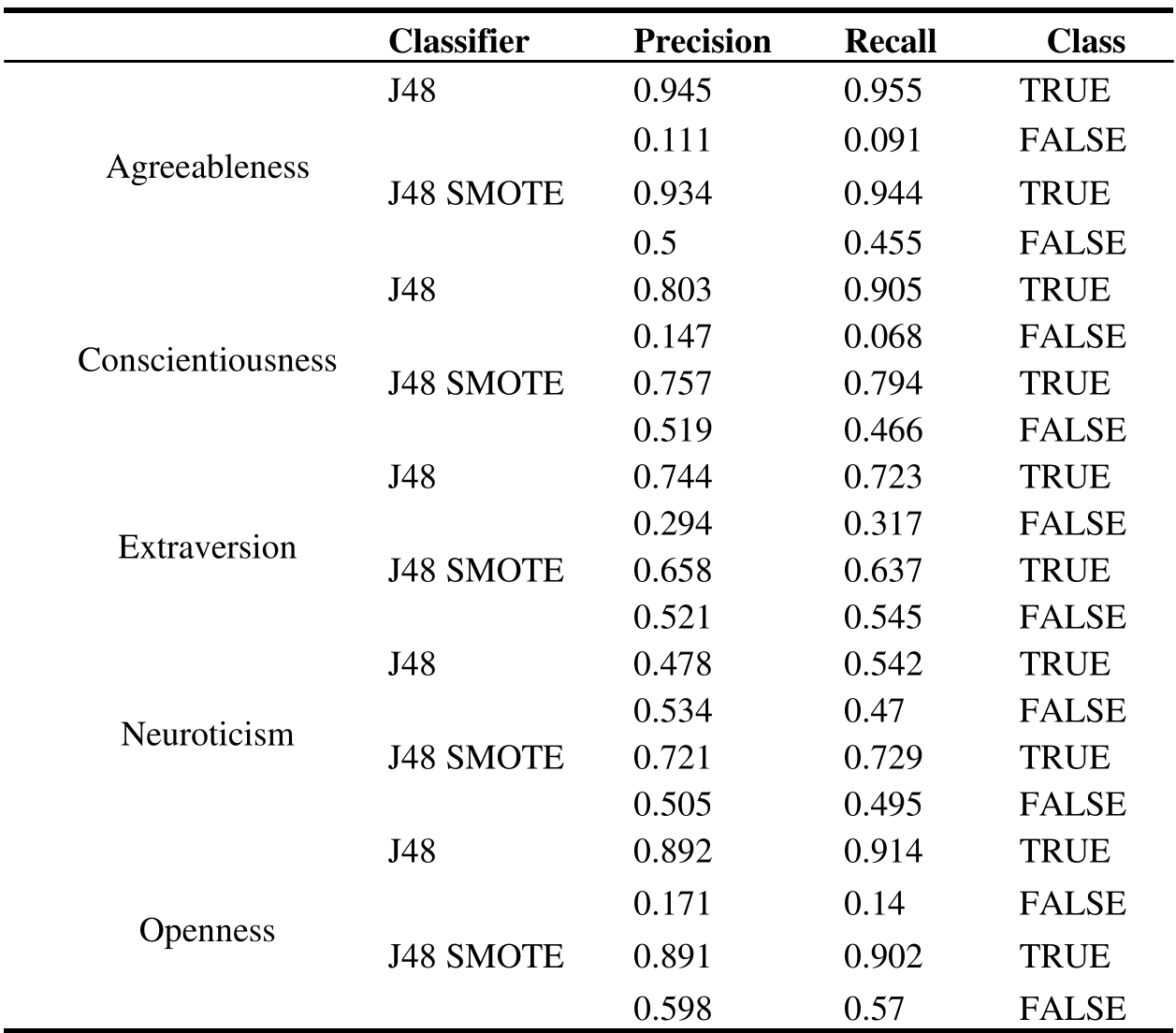
- Success of SMOTE: For the 'Openness' trait, SMOTE increased the precision of the minority class (FALSE) from a dismal 17.1% to a respectable 59.8%.
- Linguistic Insights: The decision trees revealed fascinating patterns:
- Extraversion is linked to specific participles and emotional words expressing enthusiasm.
- Conscientiousness is highly dependent on sentence length and the use of complex conjunctions.
- Neuroticism is signaled by a high frequency of adjectives and verbs related to "hope" and "anguish."
Critical Insight: The Value of Traditional NLP
In an era dominated by "Black Box" Large Language Models (LLMs), this paper serves as a reminder of the power of interpretable machine learning. By using decision trees and manual feature engineering, the authors don't just predict that a writer is an extrovert; they show which specific linguistic habits (like using participles) actually reveal that trait.
Limitations: The dataset is still small, and the regression error (RAE) remains close to the baseline, suggesting that while classification (High/Low) is robust, fine-grained scoring remains a challenge for short text samples.
Future Outlook
This work provides a blueprint for applying psycholinguistics to low-resource languages. Future iterations could integrate Deep Learning (Transformers) to capture long-range syntactic dependencies that manual POS tagging might miss, further bridging the gap between human intuition and machine prediction.