
Decoding the Digital Divide: Predicting Political Tendency on Facebook via Sentiment Analysis
Predicting Political Tendency of Posts on Facebook
This paper presents a computational framework for predicting the political orientation (Left-wing vs. Right-wing) of US-based Facebook posts. By analyzing sentiment and textual features from over 32,000 posts across 8 major political fan pages, the study demonstrates that a Decision Tree classifier using TF-IDF weighting achieves a SOTA F1-score of 0.95.
TL;DR
Is your Facebook feed a giveaway of your political leanings? This study analyzes 32,133 posts from major US political fan pages to predict whether a post is "Left-wing" or "Right-wing." By combining text mining with sentiment lexicons, the researchers found that a Decision Tree model paired with TF-IDF weighting can predict political tendency with an impressive 95% F1-score.
Executive Summary
In an era where social media serves as the digital Town Square, understanding the "pulse" of political discourse is vital. This paper occupies a key position in the field of computational social science, moving beyond simple "like" counts to analyze the actual linguistic and emotional fabric of political messaging. It proves that the way we use words—not just which ones we use—is a high-fidelity signal for partisan affiliation.
Problem & Motivation: The Challenge of Abstract Discourse
Political sentiment is notoriously difficult to categorize because it is often abstract, sarcastic, or context-dependent.
- The Limitation of Prior Work: Earlier studies often focused on "interaction features" (likes/shares) or simple adjective lists. However, these don't always capture the importance of specific terms relative to the broader political conversation.
- The Insight: The authors hypothesized that the statistical weight of words (TF-IDF) and their emotional valence (using databases like SentiWordNet) would provide a more robust feature set for machine learning classifiers than simple word counts.
Methodology: The NLP Pipeline
The researchers built a custom processing workflow to transform messy Facebook data into a structured format suitable for machine learning.
1. Data Harvesting and Cleansing
Using the Facebook Graph API, they extracted years of data from pages like Breitbart (Right) and Occupy Democrats (Left). The text underwent rigorous preprocessing:
- Stemming: Reducing words to their roots (e.g., "politicize" to "polit").
- Stopword Removal: Filtering out non-informative words like "the" or "is."
2. Feature Engineering: TF-IDF & Sentiment
The core of the methodology lies in the Term-Document Matrix (TDM).
- TF-IDF was used to highlight words that are unique to specific posts while downplaying common language.
- Two Lexical Databases (Opinion Lexicon and SentiWordNet) were used to score posts on Positivity, Negativity, and Objectivity.
 Figure 1: The systematic pipeline from data extraction to political classification.
Experiments & Results: Decision Trees Reign Supreme
The study compared legendary algorithms including Naïve Bayes, k-Nearest Neighbor (kNN), SVM, and Decision Trees (C4.5).
Key Discoveries:
- Weighting Matters: TF-IDF was the clear winner. While simple Term Frequency (TF) made many algorithms struggle, TF-IDF enabled the Decision Tree to reach a peak F1-score of 0.95.
- Linguistic Density: Interestingly, Left-wing pages are more "talkative." They used over twice as many words (333,196) compared to Right-wing pages (145,760), suggesting a different strategy in how they present arguments.
- Algorithm Sensitivity: Sentiment analysis results were highly sensitive to the choice of algorithm. For instance, Naïve Bayes worked best with SentiWordNet, while 1NN performed better with the Opinion Lexicon.
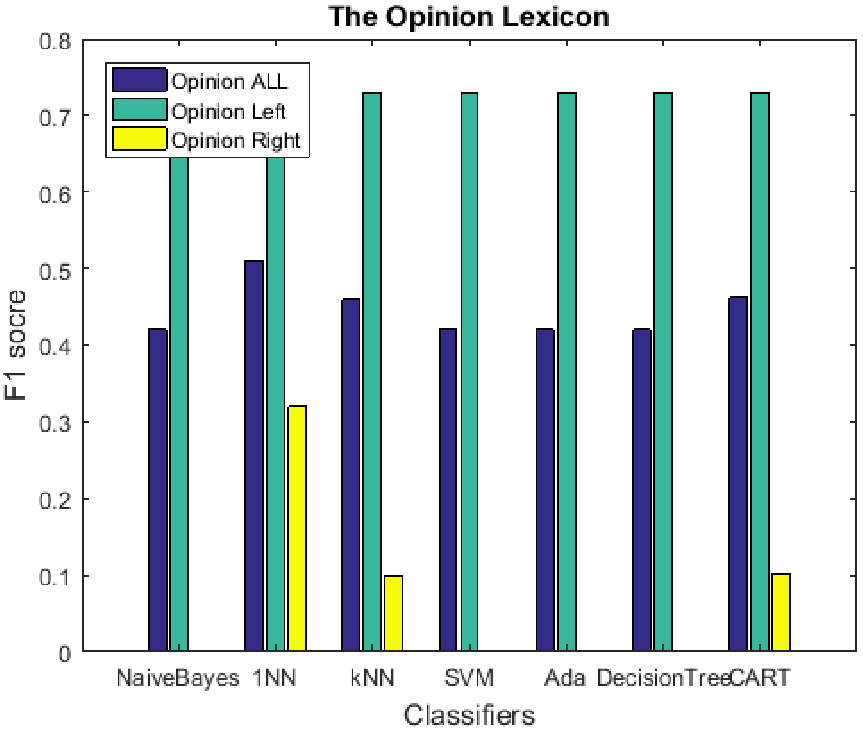 Figure 2: Performance comparison of different classifiers across various sentiment features.
Critical Analysis & Conclusion
Takeaway
The study successfully demonstrates that political leaning is encoded not just in what is said, but in the statistical uniqueness of the vocabulary used. For developers and researchers, the 0.95 F1-score suggests that classical machine learning—when paired with proper feature engineering like TF-IDF—remains incredibly potent even in the age of Deep Learning.
Limitations & Future Work
- Data Imbalance: The study noted that Left-wing posts were easier to classify, likely due to the higher volume of text available.
- Visual Content: While the study acknowledges videos and photos, the core prediction relies on text. As social media becomes more visual, integrating Image Recognition with text mining will be the next frontier.
- Objective vs. Subjective: The distinction between "Objective" and "Subjective" sentiment remains a gray area that could be further refined using modern LLMs.
Final Thought: If you want to know a post's politics, don't just look at the "Likes"—look at the TF-IDF weight of its adjectives.