
Predict Your Influence: What Makes a Foursquare Tip Go Viral?
What makes your opinion popular?: predicting the popularity of micro-reviews in foursquare
This paper introduces a predictive framework for determining the future popularity of "tips" (micro-reviews) on Foursquare, defined by the number of "likes" received. By evaluating regression and classification models, the study demonstrates that a combined feature set of user history and venue characteristics can effectively identify high-impact micro-reviews at the time of posting.
TL;DR
Researchers from the Federal University of Minas Gerais have cracked the code for predicting the popularity of Foursquare tips. In a world where reviews are getting shorter, this study proves that who you are and where you are matter significantly more than what you actually write. By using simple linear regression on user history and venue data, they achieved SOTA-level results in identifying viral tips before they actually become popular.
The "Short-Form" Dilemma
In the early 2010s, platforms like Foursquare revolutionized local discovery. Users didn't write essays; they wrote "tips"—concise, 200-character nuggets of advice.
The problem? Most prediction models at the time were built for long-form reviews (TripAdvisor, Yelp). These models relied on text density and grammatical complexity. But how do you judge the "helpfulness" of a tip that just says "Order the Spicy Tuna"? Furthermore, Foursquare's interface sorts tips by likes, creating a self-fulfilling prophecy: popular tips stay at the top, while new, potentially better advice is buried.
Methodology: Beyond the Text
The authors moved past the "Text-is-King" dogma. They analyzed over 6 million tips using three categories of features:
- User Features: Historical "likes" received, number of tips, and social circle (followers/friends).
- Venue Features: How many people check in here? What is the category of the place?
- Content Features: Sentiment analysis via SentiWordNet and basic readability.
Breaking the Class Imbalance
One major technical hurdle was the data skew: 99.5% of tips receive almost no likes (Low Popularity). To solve this, the researchers used Under-sampling on the training set to ensure the model could actually learn what a "High Popularity" tip looks like.
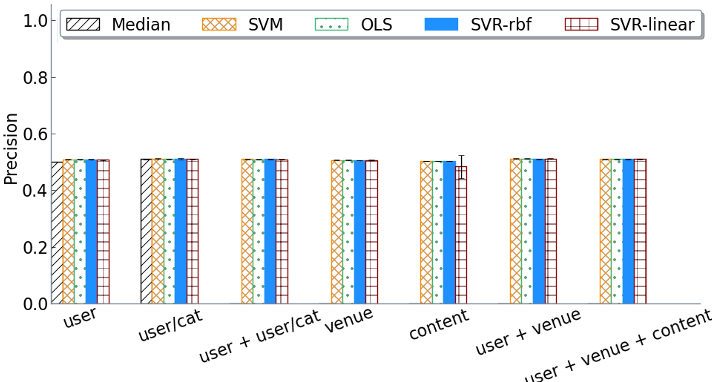 Figure 1: Comparison of Macro-Averaged Recall across different algorithms and feature sets.
Why "Context" Trumps "Content"
The results were surprising. The most sophisticated model, Support Vector Regression (SVR) with RBF kernels, wasn't significantly better than a simple Multivariate Linear Regression (OLS). In fact, OLS was 30 times faster to train and provided better precision for high-popularity tips.
The Secret Sauce:
- The Author’s Track Record: The #1 predictor is the average number of likes the user has received on previous tips.
- Venue Visibility: High check-in counts (Venue features) drastically reduced "noise" in the predictions. If you post at a busy airport, you’re more likely to get likes than at a quiet bookstore.
- Text doesn't matter (much): Adding sentiment or length data provided almost zero statistical improvement.
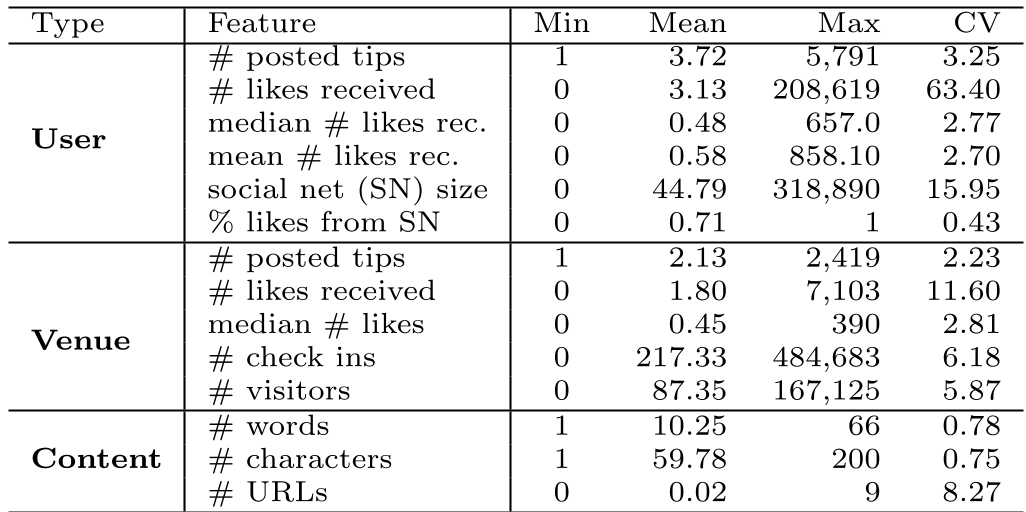 Table 1: Statistical breakdown showing the heavy-tailed distribution of likes and tips.
Critical Insight: The Social Network Effect
The study highlights that 70% of likes typically come from the user's social network. This confirms that popularity on Foursquare isn't just about the quality of the advice—it's about the reach of the person giving it.
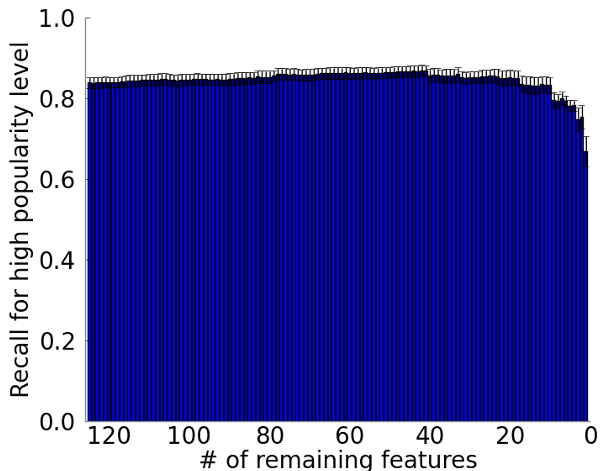 Figure 3: Impact of removing features. Note the steep drop when check-ins and social network size are removed.
Conclusion & Perspective
This work serves as a foundational piece for modern recommendation engines. It tells us that for micro-content, Metadata is the message.
While modern LLMs might have changed how we analyze text today, the core finding remains relevant: if you want to predict success on a social platform, look at the network and the intent of the location, not just the string of characters. This logic is still what drives current algorithms on platforms like X (Twitter) and Instagram today.