
TIPPPS: Cracking the Code of Corporate Upselling via Time Interleaving
15183_Predicting the product purchase patterns of corporate customers.
The paper introduces TIPPPS (Time Interleaved Product Purchase Prediction System), a machine learning framework designed to predict high-value upsell opportunities for corporate telecommunications customers. It utilizes a novel time-interleaving data concatenation method and value-weighted Support Vector Machines (SVM) to achieve a 3.7% improvement in ranking accuracy over standard techniques.
TL;DR
Predicting which corporate giant will buy a new $1M software package is vastly different from predicting if a retail customer will buy a new data plan. Data is scarce, features are numerous, and the "value" of a hit varies wildly. This paper presents TIPPPS, a system that solves the data sparsity problem through Time Interleaving and prioritizes big spenders using Value-Weighted SVMs.
Problem & Motivation: The "Corporate" Difference
Most churn and upsell models are designed for the retail market, where millions of customers provide a rich statistical playground. In the corporate segment, everything changes:
- Paucity of Data: While a telco might have millions of mobile users, it only has thousands of corporate clients.
- Extremely Low Take-up: In a given quarter, fewer than 10 customers might adopt a specific product (e.g., dedicated fiber links).
- High stakes: A single "miss" on a high-value client hurts more than thousands of misses in the consumer segment.
Existing models struggle with this Extreme Class Imbalance. If 99.9% of your data is "No Purchase," a standard algorithm achieves 99.9% accuracy by simply predicting "No" every time—a useless result for a sales team.
Methodology: Engineering the Sparse Signal
The authors introduces two primary maneuvers to make machine learning "usable" in this sparse environment.
1. Time Interleaving and Double Aggregation
Instead of looking at just one snapshot in time, the authors aggregate two billing periods. To solve the lack of examples, they use Time Interleaving. They take multiple overlapping windows of data and concatenate them into one massive training set.
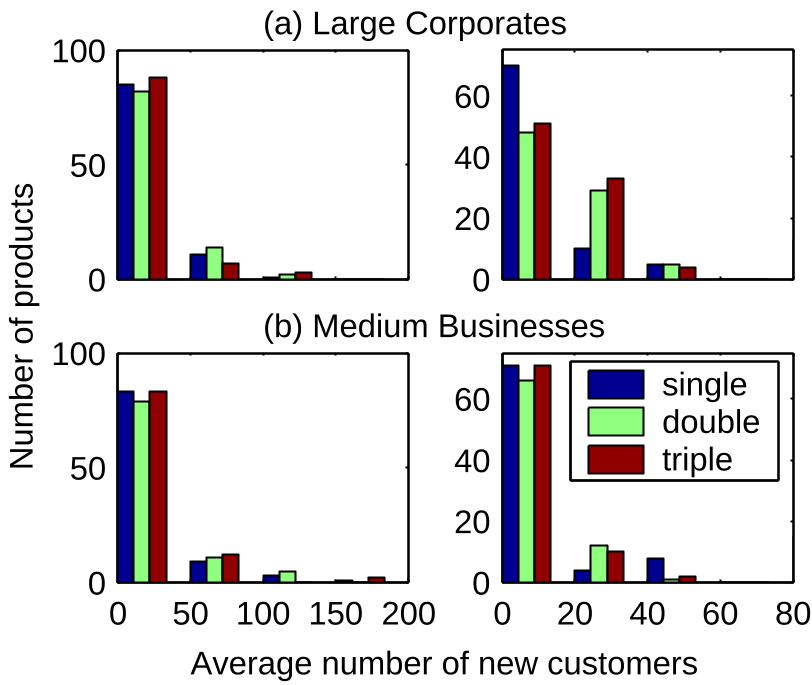
This doesn't just triple the data; it helps the model capture the transition from non-user to user by seeing the same customer at different stages of their lifecycle.
2. (Value-Weighted SVM)
A standard SVM tries to find a boundary that separates buyers from non-buyers. However, TIPPPS uses a Value-Weighted approach. The regularization constant (which tells the model how much to "care" about an error) is adjusted based on the dollar value of the purchase. If a customer spends 1,000.
Experiments & Results
The system was tested across two major segments: Large Corporates and Medium Businesses.
SOTA Comparison
The authors compared three variants: Standard SVM (), Balanced SVM (), and their Value-Weighted SVM ().
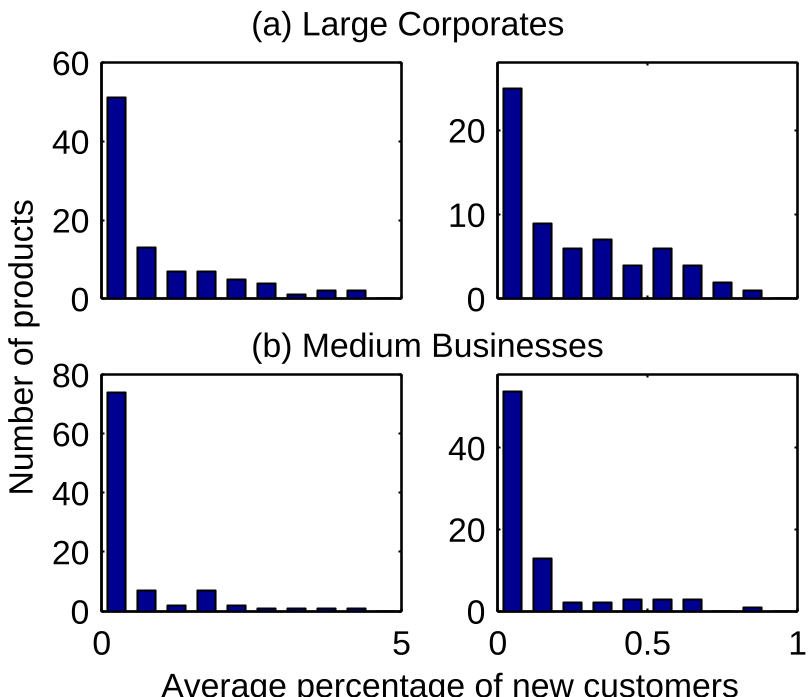
Key Findings:
- Accuracy Improvement: delivered a 3.7% improvement in AUC (ranking accuracy).
- Value Improvement: It achieved a 4.0% gain in VAUC (Value-weighted AUC), proving it is significantly better at finding the "whales."
- Stability: Time Interleaving not only increased samples but also yielded more stable models over different billing cycles compared to non-interleaved data.
Critical Analysis & Conclusion
Summary (Takeaway)
TIPPPS proves that when dealing with B2B data, how you structure your data (Interleaving) and what you optimize for (Value-Weighting) are more important than searching for a "magic" new algorithm. By framing the problem around dollar value rather than just binary labels, they created a system that sales teams actually trust.
Limitations
- Independent Assumptions: Interleaving means the same customer appears multiple times in the training set. This violates the IID (Independent and Identically Distributed) assumption of standard SVMs, which could lead to over-fitting if not carefully managed.
- Feature Complexity: The system relies heavily on binning continuous revenue data. While robust, it might miss subtle non-linear trends that modern Gradient Boosted Trees or Neural Networks might capture more easily today.
Future Outlook
The principles of TIPPPS—specifically weighting training importance by the financial impact of the instance—are highly relevant today in fields like Fraud Detection and High-Value Lead Generation. As the industry moves toward "Data-Centric AI," the temporal engineering tricks shown here remain a masterclass in making the most out of small, messy datasets.