
Predicting Project Success: Decoding the Socio-Technical DNA of Software Teams
9106_Predicting Project Outcome Leveraging Socio-Technical Network Patterns.
This paper introduces a machine learning framework to predict software project outcomes (success vs. failure) by mining discriminative socio-technical network patterns. Using a novel "rich-to-simple" graph translation approach and the LEAP algorithm on SourceForge data, the authors achieve over 90% prediction accuracy and an AUC of 0.86.
TL;DR
Is a software project destined for greatness or doomed to stall? This paper presents a machine learning approach that answers this by analyzing the "socio-technical" network of developers. By converting complex developer histories into graphs and mining for discriminative patterns, the researchers achieved a 90%+ accuracy in predicting project outcomes on SourceForge. The secret sauce? A novel graph translation method that allows standard algorithms to process "rich" multi-attributed data.
Problem & Motivation: Beyond Code and Commits
Most project management tools look at "what" is being built (loc, commits, bugs). However, this research focuses on the "who" and "with whom". The researchers observed that existing graph mining techniques were too simplistic—they couldn't handle the multi-dimensional reality of human experience. For instance, a developer isn't just a "node"; they carry a history of past successes, failures, and tenure all at once.
The core challenge was: How do we mine discriminative subgraphs when every node and edge contains a vector of features instead of a single label?
Methodology: The "Rich-to-Simple" Translation
The authors developed a framework to model software projects as Rich Graphs.
- Nodes (Developers): Labeled with Past Successful Projects (PSP), Past Failed Projects (PFP), and Length of Membership (LOM).
- Edges (Collaboration): Labeled with Past Successful Collaborations (PSC), Past Failed Collaborations (PFC), and Length of Collaboration History (LCH).
To process this, they introduced a Translation Process that replicates nodes and edges to "flatten" the rich graph into a simple graph that algorithms like LEAP can understand.
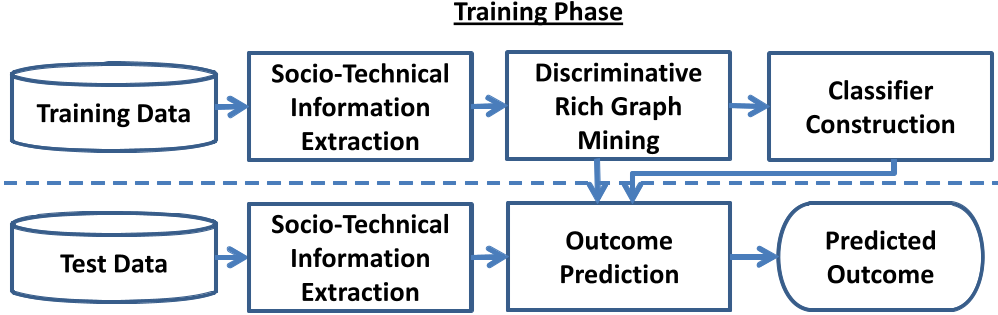 The workflow: from raw SourceForge data to socio-technical graphs, followed by discriminative pattern mining and classification.
The Translation Logic
If a node has multiple labels (e.g., a developer with both success and failure in their history), the algorithm creates NL-Replicas (Node Label Replicas). Similarly, edges with multiple labels are handled via EL-Replicas. This ensures that the structural integrity of the collaboration is preserved while making the "richness" of the data transparent to the mining engine.
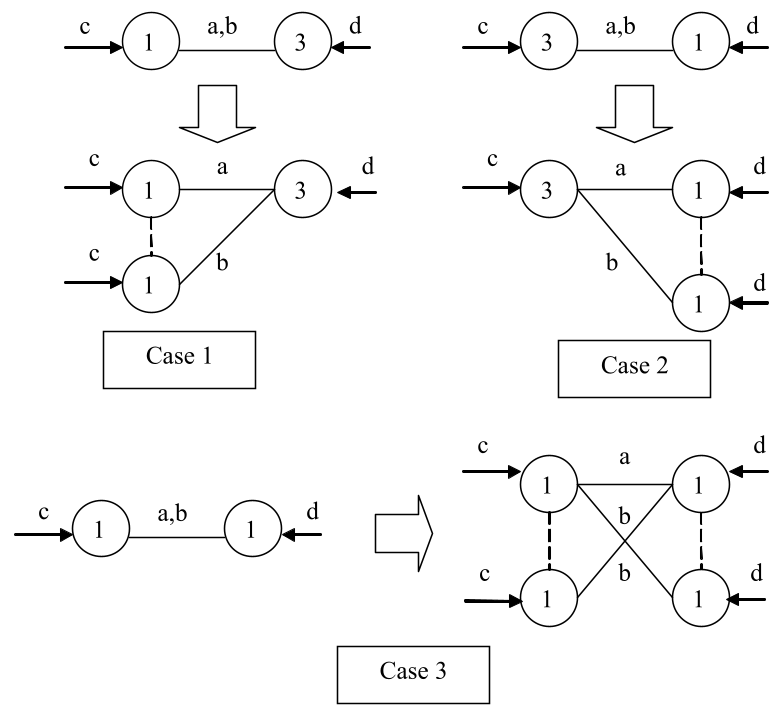 Visualizing EL-Replicas: How multi-labeled edges are split into simple graph components.
Experiments & Results: What Makes a Project Succeed?
The study analyzed over 227,000 projects from SourceForge. The results were striking:
- High Accuracy: 94.99% Accuracy and 0.86 AUC.
- Discriminative Insight: The "Top 20" patterns provided clear indicators of project health.
 Key finding: Pattern P1 (no successful history) appeared in 92% of failed projects, whereas patterns like P8 (at least one successful developer) were dominant in successful ones.
Key Takeaways from the Patterns:
- Experience Matters, But Collaboration Matters More: Having developers who have successfully worked together previously (High PSC) is one of the strongest indicators of future success.
- The "Inexperience Trap": Projects where none of the contributors have a history of success are statistically likely to fail (Pattern P1).
- Tenure is Overrated: Interestingly, "Length of Membership" (LOM) did not appear in the top discriminative patterns, suggesting that what you achieved during your time is more important than how long you've been around.
Critical Analysis & Conclusion
This work bridges the gap between social network analysis and software engineering. By treating project outcome prediction as a discriminative graph mining problem, it moves beyond simple heuristics to discover complex "motifs" of success.
Limitations:
- The study relies on SourceForge data (which trends toward older OSS projects); modern GitHub workflows (Pull Requests, Forks) might introduce different socio-technical labels.
- Success is defined by "Downloads," which might not capture the "utility" or "code quality" of a project.
Future Outlook: Integrating this analytical engine into platforms like GitHub could provide "Early Warning Systems" for project maintainers, helping them identify when a team lacks the necessary collaborative "DNA" to reach a milestone.