
Predicting Public Opinion: How Social Media Mirrors the Marijuana Legalization Wave
Predicting Public Opinion on Drug Legalization: Social Media Analysis and Consumption Trends
The paper presents a framework for state-by-state public opinion analysis on marijuana legalization using Twitter data. By employing a specialized "Drug Abuse Ontology" (DAO) and SVM-based sentiment analysis, the study measures public support and tracks consumption trends of six distinct marijuana types across the US.
TL;DR
Researchers from Wright State University have developed a system to predict public opinion on marijuana legalization by mining millions of tweets. By using a specialized "Drug Abuse Ontology" to catch slang like "dabs" and "shifters," they discovered that social media sentiment isn't just noise—it's a powerful predictor of which states will legalize marijuana next.
Background: Beyond Traditional Polling
As 25+ US states shifted their legal stances on marijuana, traditional surveys struggled to keep pace. This study positions itself as a digital alternative for public health surveillance, treating Twitter as a real-time pulse of community norms. The research is part of the NIDA-sponsored eDrugTrends project, which looks to use "Collective Social Intelligence" to monitor substance use epidemiology.
The Slang Challenge: Why Standard AI Fails
Most sentiment analysis tools are trained on formal text (news, reviews). However, drug-related discourse is inherently informal. Identifying a "joint" or "420" is easy; identifying "Cannabis Resin" from terms like "keif" or "hashish" requires domain expertise.
The authors’ core insight was that lexicons aren't enough. They built the Drug Abuse Ontology (DAO), a structured knowledge base that links informal slang to scientific categories. This allows the system to achieve much higher recall by understanding that "dabs" refers to "Marijuana Concentrates."
Methodology: The Technical Core
The system architecture follows a three-stage pipeline:
- Collection: Using the Twitris platform to filter 7.5 million tweets based on 153 keywords and geo-location.
- Processing: Applying a Support Vector Machine (SVM) classifier to determine if a tweet is Positive, Negative, or Neutral.
- Entity Mapping: Using the DAO to categorize consumption into six types: Cannabis, Oil, Resins, Edibles, Concentrates, and Synthetic.
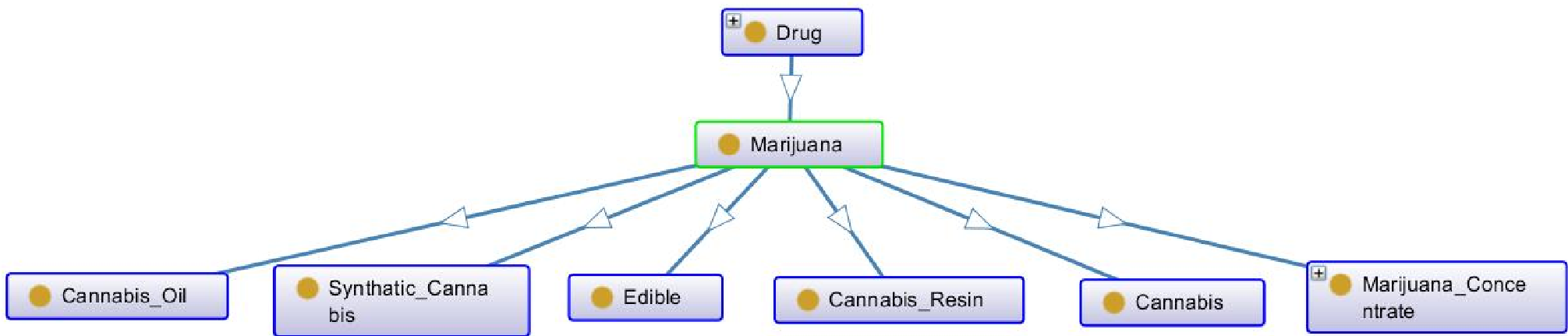 The hierarchy of the Drug Abuse Ontology used to map informal tweets to specific drug categories.
Key Insights and Results
The study analyzed data surrounding the 2015 Ohio Marijuana Legalization ballot. The results revealed a clear "happiness gap":
- The Legalization Boost: States where recreational marijuana is legal showed a positive sentiment of 67%, compared to only ~23% in states where it remains illegal.
- Leading Indicators: States with "Medical-only" status but high positive Twitter sentiment were significantly more likely to expand to recreational use in subsequent years.
- Consumption Trends: The use of "Marijuana Concentrates" and "Edibles" showed a marked increase in the "post-legalization" phase of the study, while "Resin" saw a decline.
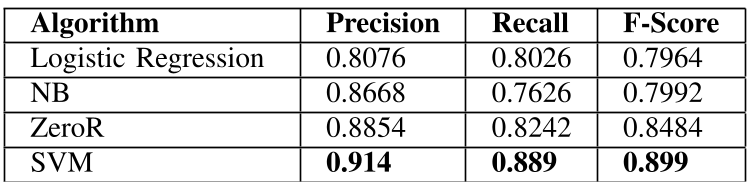 The SVM model outperformed Logistic Regression and Naive Bayes, achieving a 0.914 precision score.
Critical Analysis & Future Outlook
While the study is a breakthrough in using ontologies for social media mining, it acknowledges a major hurdle: Neutral Tweets. Roughly 65% of the data was neutral, often generated by retailers or news bots. The authors suggest that future work must use "Provenance Analysis" to separate human opinions from commercial advertisements.
Takeaway for Researchers
This paper proves that Domain-Specific Inductive Bias (in the form of the DAO ontology) is crucial for NLP in specialized fields. It opens the door for using social media not just to watch what happened, but to predict the legislative landscape of tomorrow.
Future Directions
The team plans to:
- Improve Word Sense Disambiguation (e.g., distinguishing "Spice" the drug from "Spice" the ingredient).
- Apply Network Analysis to identify influential "hubs" in the pro-legalization movement.