
Predicting Reasoning Performance: Beyond Worst-Case Complexity
Predicting Reasoning Performance Using Ontology Metrics
This paper presents a machine learning-based approach to predict the classification performance of OWL 2 DL reasoners using structural ontology metrics. By analyzing over 350 real-world ontologies across four major reasoners (FaCT++, HermiT, Pellet, and TrOWL), the authors developed a RandomForest-based model that yields up to 90% prediction accuracy.
TL;DR
While the theoretical complexity of OWL 2 reasoning is dauntingly high (2NExpTime-complete), real-world performance varies wildly. This paper bridges the gap by using Machine Learning to predict exactly how long a reasoner will take to classify an ontology based on 27 structural metrics. With an accuracy exceeding 80%, this work transforms reasoning from a "black box" into a predictable engineering task.
Background: The Limits of Theory
In the Semantic Web, reasoning is the engine of intelligence. However, the logic underlying OWL 2 DL is notoriously expensive. Historically, researchers relied on "worst-case" limits or small-scale benchmarks. But these don't help an engineer wondering why a 5MB ontology takes hours to process while a 50MB one takes seconds. The authors argue that Ontology Metrics—quantifiable structural features—hold the key to understanding this empirical hardness.
Methodology: Mapping Metrics to Time
The researchers conducted a massive sweep of 350+ ontologies and 4 state-of-the-art reasoners (FaCT++, HermiT, Pellet, and TrOWL).
1. Feature Engineering
They extracted 27 metrics categorized into:
- Ontology-level (ONT): Size of vocabulary, Cyclomatic complexity (CYC), etc.
- Class-level (CLS): Inheritance depth (DIT), number of children.
- Anonymous Class Expressions (ACE): Count of existential quantifiers, negations, etc.
- Properties (PRO): Transitivity, symmetry, and inverse properties.
2. The Predictive Pipeline
Instead of predicting exact seconds (which is noisy), they discretized time into logarithmic bins (e.g., Bin A: <1s; Bin D: >100s). This turned the problem into a multiclass classification task.
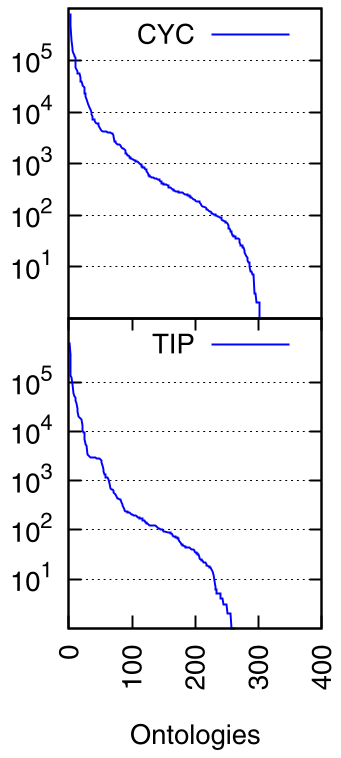 Figure 1: Distribution of key metrics across the dataset, showing the wide variance in structural complexity.
Experiments & Results: RandomForest Reigns Supreme
The study compared 9 classifiers including Bayesian Networks, Decision Trees, and Support Vector Machines.
- Top Performer: RandomForest (RF) consistently outperformed others, proving to be the most stable predictive model with the highest mean accuracy (up to 91% for the TrOWL reasoner).
- Key Insight: Not all metrics matter equally. Using feature selection (like InfoGain and Chi-Squared), they narrowed down the "Impact Factors."
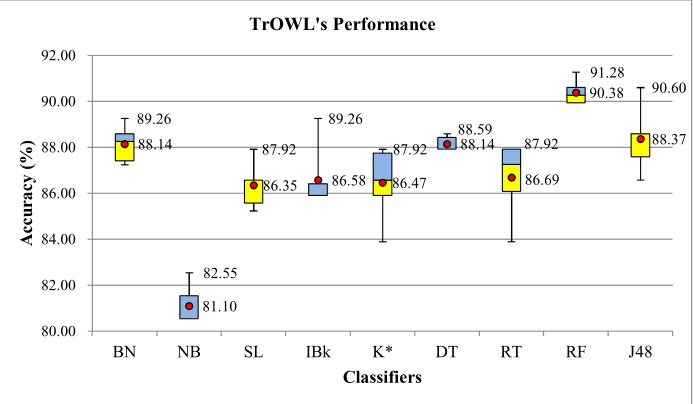 Figure 2: Accuracy boxplots across 4 reasoners. Note that RF (RandomForest) shows the highest and most consistent performance across different feature sets.
The "Impact Factor" of Ontology Design
One of the most valuable outputs for developers is the identification of Strong Impact metrics. If your ontology is slow, the culprits are likely:
- Existential Quantification (EF): High usage of
owl:someValuesFrom. - Vocabulary Size (SOV): Total number of named entities.
- Cyclomatic Complexity (CYC): The number of independent paths in the ontology graph.
- Tree Impurity (TIP): How much the inheritance structure deviates from a simple tree.
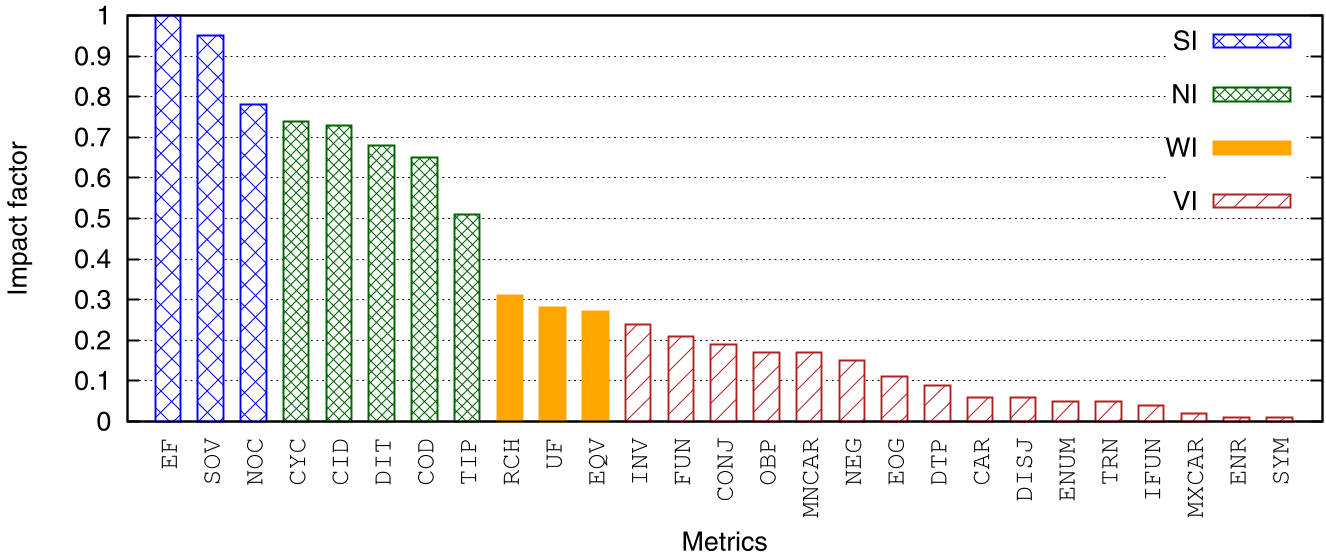 Figure 3: Impact factor ranking showing which metrics most influence reasoning time.
Deep Insight & Conclusion
This paper shifts the paradigm from theoretical logic to Empirical Software Engineering. It proves that the "hardness" of an ontology isn't a mysterious property of the logic profile alone, but a result of its structural graph properties.
Takeaway for Engineers: If a reasoner is struggling, look beyond the axioms. Simplify your inheritance tree (lower TIP), reduce class connectivity (lower CID/COD), and prune anonymous class expressions. This work provides the mathematical justification for "cleaner" ontology design as a direct path to faster reasoning.
Limitations: The study uses 2011/2012 reasoner versions. Modern optimizations (like modularity-based reasoning) might shift these metrics' weights, and the rise of EL++ reasoners may require specific sub-projections of these models.