
Beyond the First Click: Predicting Relationship Persistence in Social Networks
Prediction of the Persistence of Relationships in Social Networks, Considering Previous Reciprocity and Duration
This paper presents a predictive modeling framework to estimate the persistence and "staying power" of social network relationships using longitudinal data from a Polish blog portal. By employing classifiers like BayesNet and RandomForest, the study investigates how reciprocity and interaction frequency serve as critical predictors for relationship survival, achieving a True Positive rate of nearly 70% in high-interaction scenarios.
TL;DR
While most social network research focuses on how people meet (link prediction), this paper focuses on why they stay. By analyzing a decade's worth of blog interactions, the researchers developed a model that predicts whether a relationship will survive based on reciprocity and interaction dynamics, achieving a 70% accuracy rate for strong ties.
Background Positioning
In the landscape of Social Network Analysis (SNA), link prediction is a crowded field. However, most SOTA works focus on "Triadic Closure" (you might know my friend, so we should connect). This paper pivots from creation to survival, positioning itself as a longitudinal study on the "metabolism" of digital relationships.
The Core Motivation: Why do Links Die?
The authors noticed a flaw in existing models: they treat all edges as equal. In reality, a single comment on a blog post is vastly different from a years-long debate. The challenge lies in the imbalance of the dataset—most digital interactions are "one-hit wonders" that never repeat. To solve this, the authors shifted focus from topological features (who is next to whom) to behavioral features (how do they treat each other over time).
Methodology: The "Reciprocity" Filter
The authors suggest that the secret to a permanent link is Reciprocity. They split their data into three tiers of increasing "relationship investment":
- ALL: Any single interaction.
- 5INT1REC: At least 5 interactions, one must be mutual.
- 5INT5REC: High-intensity mutual engagement (5+ mutual interactions).
They used a set of 16 key attributes, including temporal "burstiness" (morning vs. night) and the stability of influence (indegree/outdegree ratios).
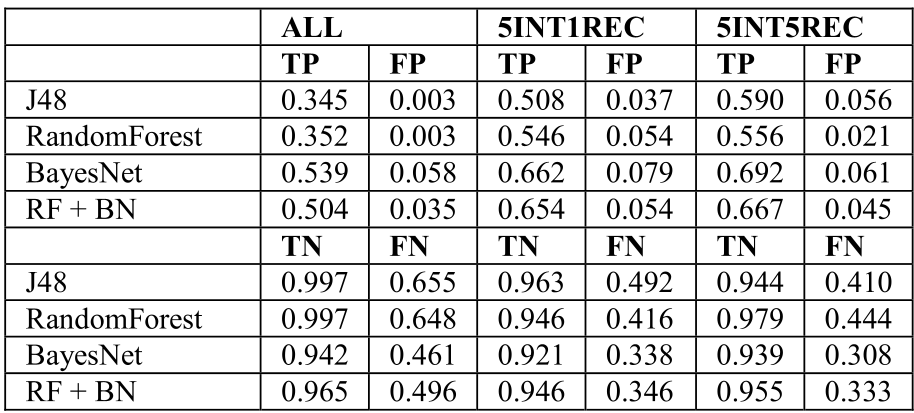 Table 1: Comparison of TP/FP/TN/FN across different relationship models, highlighting the superiority of BayesNet in the 5INT5REC tier.
Experimental Analysis: BayesNet vs. The Rest
The researchers tested J48 Decision Trees, Random Forests, and Bayes Networks.
- The Findings: Predicting relationship survival (True Positives) is significantly harder than predicting relationship death (True Negatives).
- The Breakthrough: By refining the dataset to only "strong" relationships (5INT5REC), the BayesNet classifier's effectiveness jumped. It seems that "meaningful" social signals are much easier for AI to model than the noise of random one-off comments.
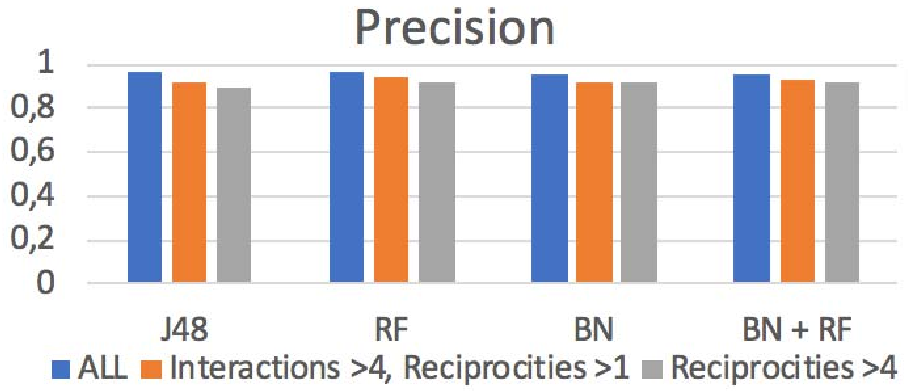 Figure 1: Precision results across models. Note how 5INT5REC narrows the dataset to the most "stable" interactions.
Critical Insight: The Root of the Tree
In the J48 decision tree analysis, the most critical attributes weren't just the "number of comments." Instead, timespan_avg (the average consistency over months) and last_interaction (how long since the link was last "fed") sat at the root of the tree. This confirms the "Use it or Lose it" nature of digital social capital.
Critical Analysis & Conclusion
Takeaway
The paper proves that reciprocity is the most reliable predictor of social link survival. If you want to know if a relationship will last 30 days from now, look at whether they responded to each other within a 15-minute window and if that behavior has been consistent over a month.
Limitations
- Domain Specificity: The data is from a 2010s-era blog portal. Modern "Short Video" or "Ephemeral" (Snapchat) dynamics might follow different decay curves.
- Content Blindness: The model looks at when and how much people talk, but not what they say (Sentiment Analysis). A heated 5-way argument might look like a "strong relationship" to this model, even if the users eventually block each other.
Future Outlook
The next frontier is combining these structural metrics with Natural Language Processing (NLP) to see if the tone of reciprocity is as important as the frequency of it.