
Identifying the Unseen: The "Empty Spot" Theory in Social Network Analysis
Predicting relevant empty spots in social interaction
The paper introduces the concept of "Empty Spots" in social interactions to identify hidden yet relevant persons in social networks. It proposes a heuristic predictor function method to detect these unobserved nodes and validates the approach through simulation experiments on homogeneous and inhomogeneous networks, achieving high precision in identifying critical hidden actors.
TL;DR
In the world of intelligence and organizational behavior, the most important people are often the ones you don't see. This paper introduces the "Empty Spot"—a hard-to-fill gap in social interaction records that hints at the existence of a hidden player. By using a specialized Heuristic Predictor Function, the authors demonstrate how to "see the invisible" in complex social networks, particularly in homogeneous structures where everyone looks the same on paper.
Problem & Motivation: The Invisible Conspirator
Whether it’s a financial supporter of a terrorist cell or a silent partner in a corporate fraud, certain actors purposefully stay off the radar. Existing surveillance methods focus on "hubs" (highly active nodes), but modern criminal organizations often adopt homogeneous structures (like the Watts-Strogatz small-world model) to avoid detection.
In such networks:
- Local invisibility: Every node has a similar number of connections (degree).
- Detection difficulty: Traditional centrality measures fail because the hidden node doesn't "look" special.
- The Problem: How do we find a person who intentionally leaves no direct digital footprint but whose influence is necessary for the network to function?
Methodology: Finding the "Hole" in the Basket
The authors treat social interactions as "Market Baskets" (), essentially groups of nodes observed together in a single event (email, meeting, etc.). To find the hidden nodes, they use a two-step process:
- Clustering & Co-occurrence: They use Jaccard’s Coefficient to measure the distance between nodes and apply k-medoid clustering to group similar nodes.
- The Predictor Function: They define a function that ranks "baskets" of communication. A high rank suggests that a specific communication record is "incomplete"—it’s missing a node that should have been there to bridge the gap.
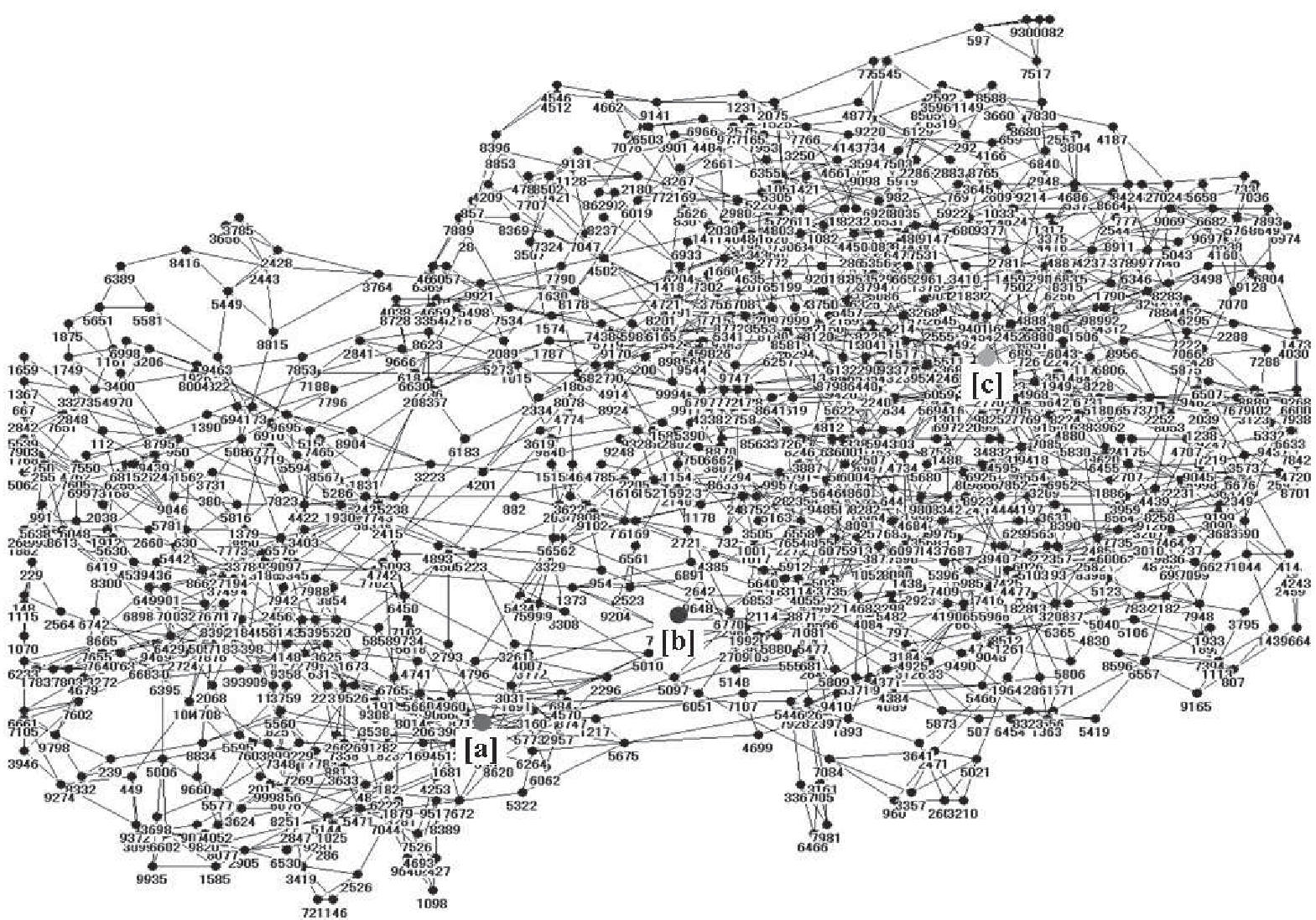 The illustration shows how node 'c' occupies a unique global position despite having a similar degree to other nodes.
Experiments: Performance in Homogeneous Networks
The researchers tested their method on a simulated 995-person network. They removed specific "key" nodes to create "empty spots" and then tried to predict which communication records were affected.
Key Findings:
- Global Position Matters: The method is exceptionally good at finding hidden nodes that serve as "gateways" or "conduits" across the network (Nodes B and C in the study).
- High Precision: For these critical nodes, the precision was nearly perfect for the top-retrieved results, meaning the predictor function correctly identified the "tampered" baskets.
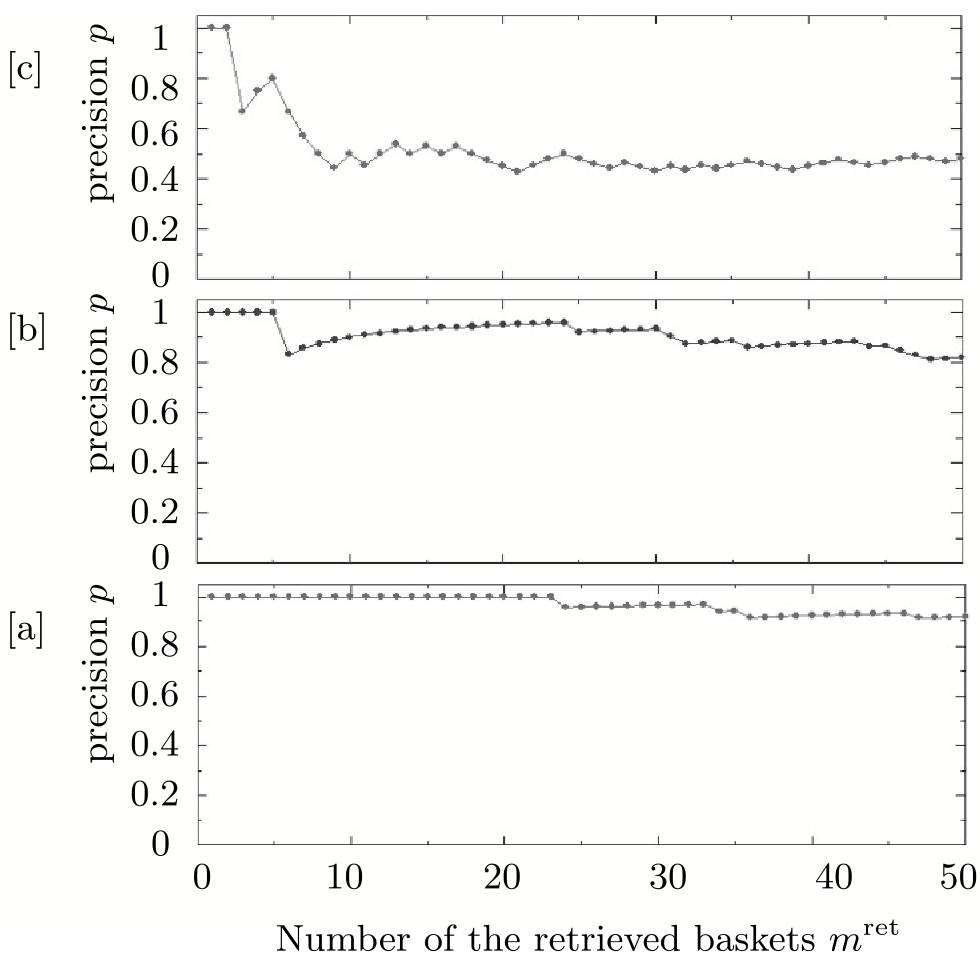 Precision-Recall curves showing the high accuracy of the predictor function for globally significant nodes (b and c).
Critical Analysis & Conclusion
Takeaway
The "Empty Spot" concept is a powerful shift in perspective. Instead of performing traditional node analysis, it performs data crystallization—looking at the surrounding context to infer what is missing. This has immediate applications in:
- Counter-terrorism: Finding the "silent" money trail.
- R&D Management: Identifying missing technical expertise in a patent database.
- Corporate Security: Detecting anomalous behavior in internal communications.
Limitations
While effective in simulations, the method's performance depends heavily on the quality of the "baskets." If the observation method is fundamentally biased or if the hidden node is truly isolated (not interacting via proxies), the empty spot may remain unfilled. Furthermore, the paper focuses on homogeneous networks; in a real-world hybrid network, the noise levels might be significantly higher.
Future Outlook
The authors suggest "Human-Interactive Annealing," a process where computers highlight these "empty spots" and human experts (investigators or engineers) use their intuition to hypothesize who or what belongs there. This synergy between algorithmic detection and human insight is likely the future of complex investigation.