
MFL Model: Using Sociological "Fatigue" to Predict Facebook Virality
Predicting the security threats on the spreading of rumor, false information of Facebook content based on the principle of sociology
The paper introduces MFL (Mainstream Fatigue Linear Model), a popularity prediction framework for Facebook content. It leverages the sociological "Mainstream Fatigue Theory" to predict the final share count of posts based on early diffusion patterns and user relationship strength.
TL;DR
Predicting which post will go viral is notoriously difficult. While most AI models look at how many people shared a post, the MFL (Mainstream Fatigue Linear) model looks at who shared it. By applying the sociological principle of "Mainstream Fatigue," researchers have discovered that if only your "super-fans" are sharing your content in the first few hours, it’s likely to die out. Real virality requires "fatiguing" the mainstream and breaking into the network of strangers. This method improves long-term prediction accuracy by roughly 13% over standard baselines.
The Problem: The Ceiling of "Super-Fans"
Why do some posts explode while others, despite a strong start, fizzle out? Existing predictive models (like the SH model or RPP) often treat every "share" as equal or focus purely on the timing of the shares.
However, the authors ground their research in Sociology. They argue that information diffusion is governed by relationship strength. If a post is only shared by a "faithful fan" base—users who interact with a page constantly—it reaches a saturation point quickly. To truly "burst," a post must engage non-mainstream nodes (weak ties). Traditional models miss this biological/sociological "fatigue" factor, leading to poor performance in long-term forecasting (7 days+).
Methodology: Identifying the "Faithful Fan" Proportion
The core innovation is the Mainstream Fatigue Parameter (). This measures the tie strength of users sharing the content.
1. The Fatigue Equation
The authors define the fatigue parameter as the ratio of a user's share frequency to the total history of the homepage.
They found a striking log-log linear correlation: as the proportion of faithful fans in the early observation period (first 3 hours) decreases, the final popularity (at 7 days) increases. In short: If strangers are sharing your post early on, you have a hit.
2. Model Architecture
The MFL model refines the linear regression approach by combining three factors:
- Early Popularity: The raw count of shares in the first hours.
- Mainstream Proportion: The percentage of regular fans vs. new audiences.
- Time Correction: Adjusting for "Relative Activity" (e.g., a post at 2 PM has more potential than one at 4 AM).
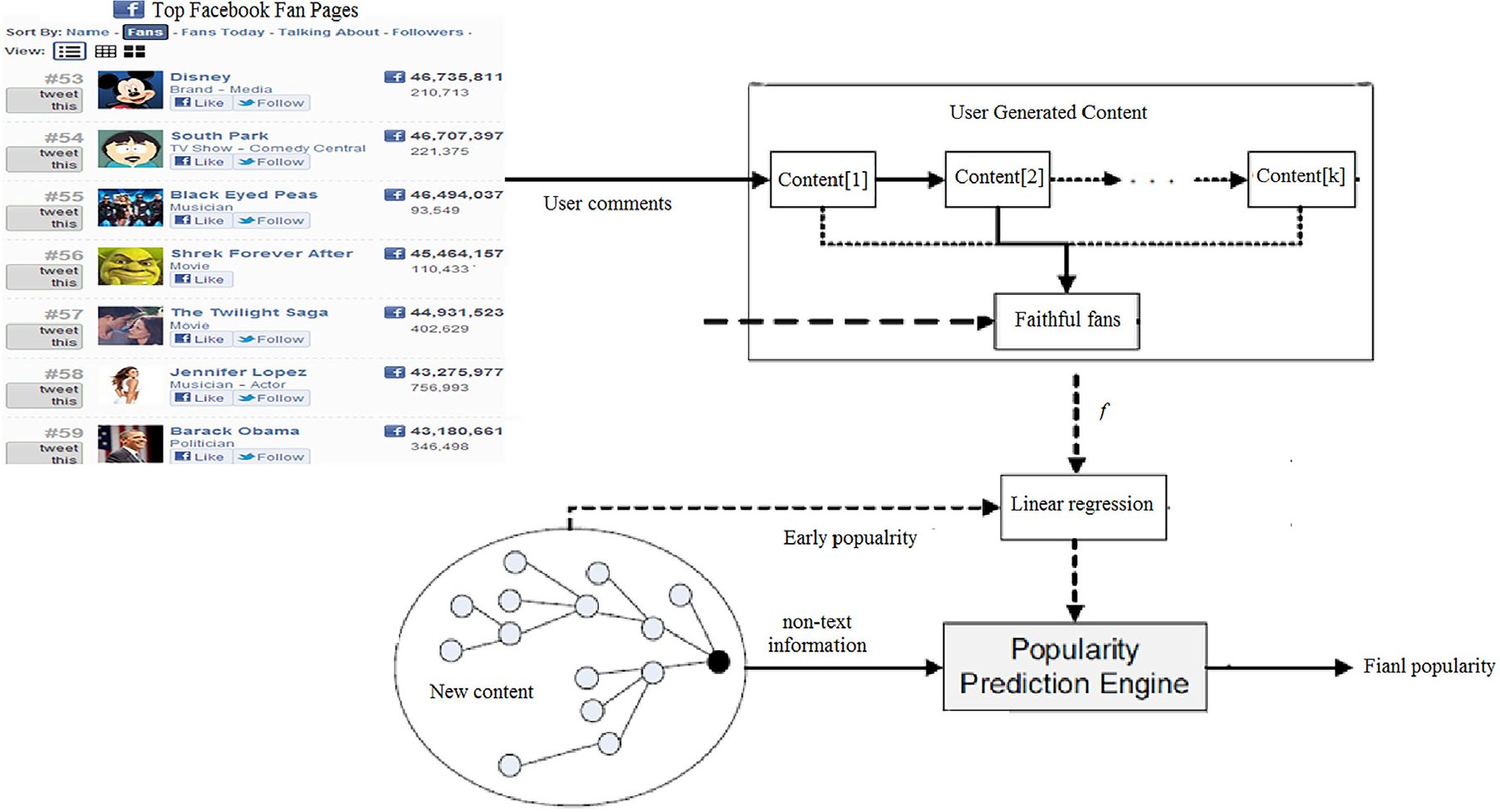 The workflow: from crawling Facebook homepages to calculating fatigue indices and performing linear regression.
Experiments & Results
The researchers tested MFL against several heavyweights: the classic SH Model, the topology-aware DSH, and the Poisson-based RPP.
Analysis of the "Sweet Spot"
The model's accuracy is sensitive to how we define a "faithful fan." The authors found that selecting the top 1.75% of most active users as the "mainstream" reference yielded the lowest RMSE (Error) and the highest Pearson correlation (~0.8).
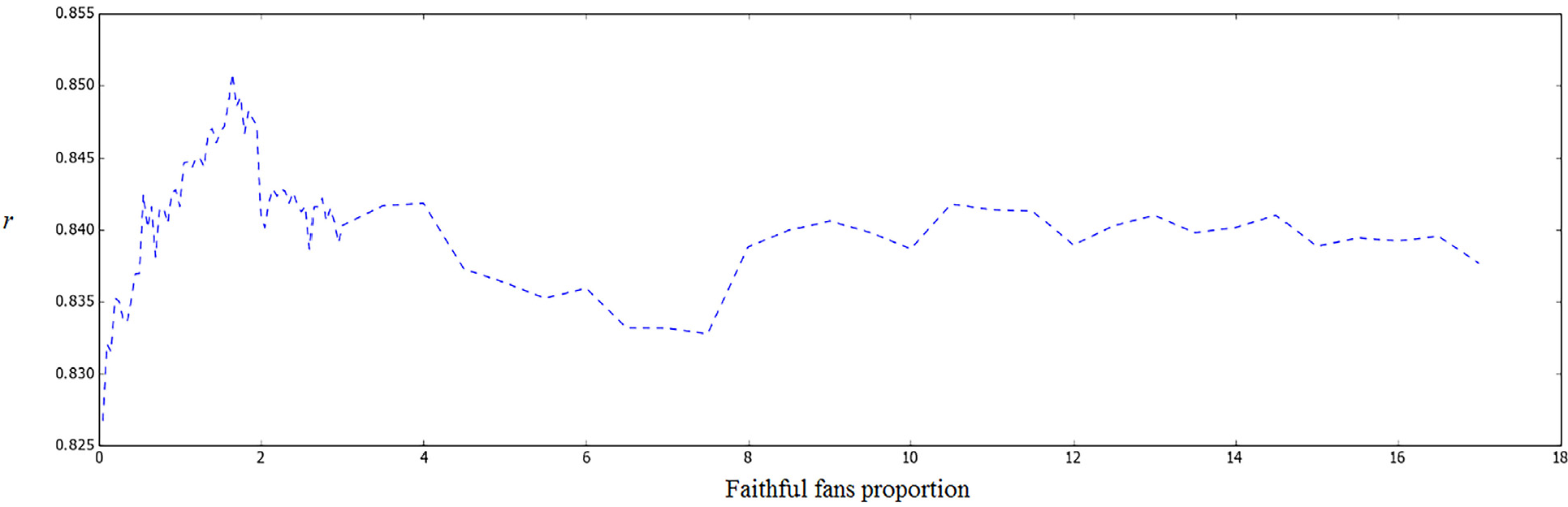
Long-Term Dominance
While models like RPP are excellent at predicting what will happen in the next hour (short-term), MFL dominates the Long-Term (4-7 days) horizon. In categories like "Entertainment" and "Interest," MFL’s MAPE (Mean Absolute Percentage Error) remains significantly lower as time progresses.
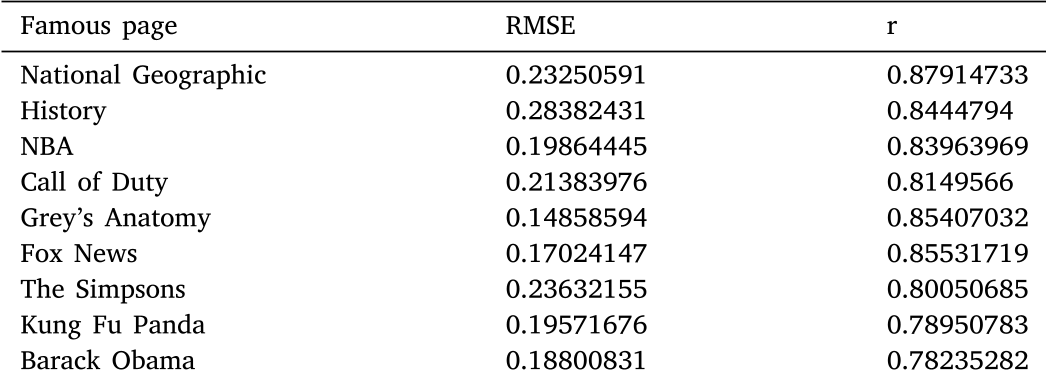 Table showing MFL achieving higher correlation (r) and lower RMSE across major pages like "Fox News" and "National Geographic" compared to the baseline.
Critical Insight & Conclusion
The MFL model proves that "Social Physics" is just as important as "Data Science." By quantifying the shift from a closed community to the open web, the model captures the essence of virality.
Limitations: The model currently uses a fixed 3% threshold for faithful fans across all homepages. However, a "celebrity" page and a "news" page might have different fan dynamics. Future iterations could benefit from dynamic thresholding based on the page's niche.
Future Outlook: This principle is a powerful tool for rumor prevention. If a suspicious post is being shared exclusively by a tight-knit, high-frequency group, it may be a niche conspiracy. But if it starts "fatiguing" that mainstream and jumping to strangers, authorities can identify a potential viral threat hours before it peaks.