
Decoding the Digital Couch: Predicting Therapy Success via Email NLP
Predicting Social Anxiety Treatment Outcome Based on Therapeutic Email Conversations
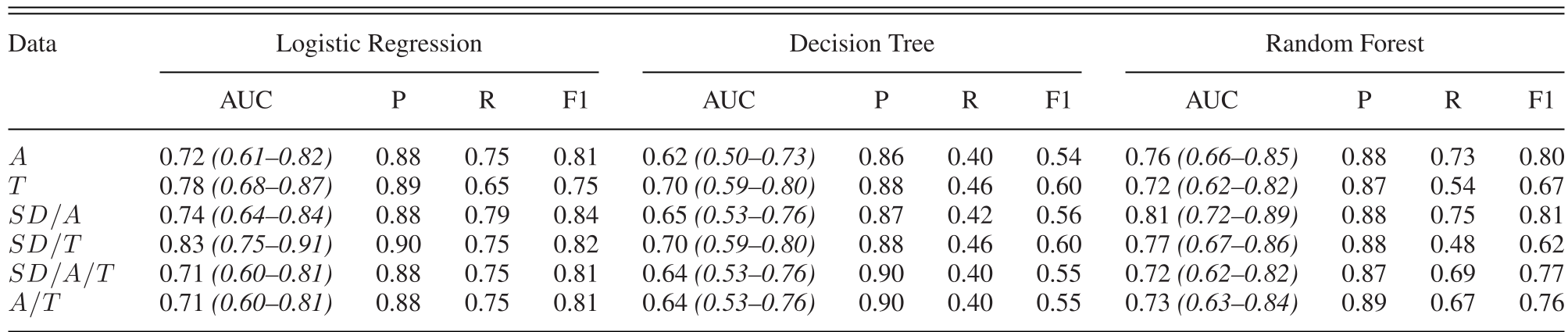
This paper presents a predictive modeling framework for therapeutic outcomes in social anxiety disorder using Natural Language Processing (NLP) on patient-therapist email conversations. By extracting features like word usage, writing style, sentiment, and topics using Latent Dirichlet Allocation (LDA), the authors achieved a SOTA-level prediction AUC of 0.83 halfway through treatment.
TL;DR
Can the way a patient writes an email predict if their therapy will work? This study analyzes 12 weeks of digital conversations from 69 social anxiety patients. By leveraging NLP to track word usage and sentiment trends, researchers built models that predict recovery outcomes with an AUC of 0.83 by the halfway point—dramatically outperforming traditional demographic records.
Background: The Hidden Signals in Text
In mental health, "Internet-based interventions" are booming. They are cheap, scalable, and generate massive amounts of text. However, therapists often struggle to monitor progress objectively. This paper positions itself as a bridge between Clinical Psychology and Machine Learning, turning unstructured email data into a "real-time" dashboard for therapeutic success.
The Core Problem: Beyond Demographics
Traditional predictors like age, gender, or marital status are notoriously poor at predicting if a specific person will get better. As shown in this study, models based only on sociodemographic data (SD) performed essentially the same as random guessing (AUC ~0.55). The real "gold" lies in the patient's own voice—the nuances of their writing.
Methodology: Engineering the Therapeutic Feature Set
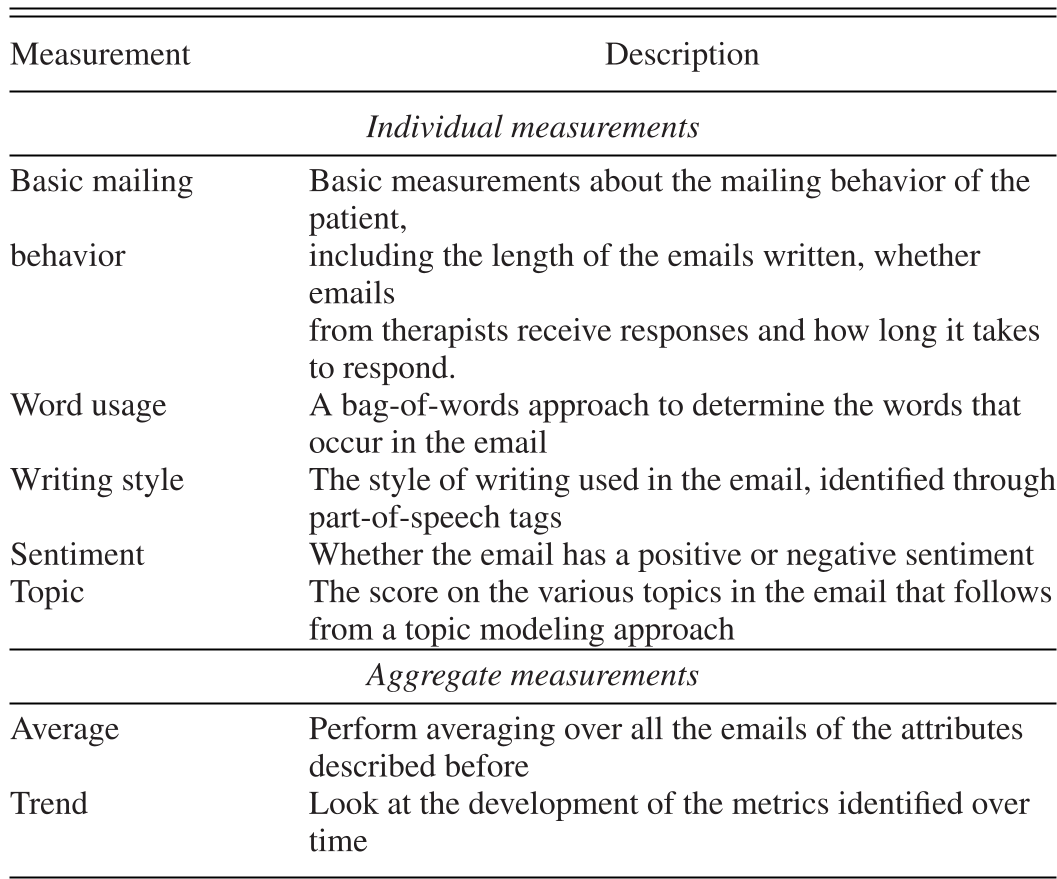
The researchers didn't just look at what was said; they looked at how it changed. They processed the German emails through five distinct lenses:
- Mailing Behavior: Response time and email length (engagement metrics).
- Word Usage: A Bag-of-Words approach focusing on stemmed German tokens.
- Writing Style: Using Part-of-Speech (POS) tags to detect shifts in complex grammar or pronoun usage.
- Sentiment Analysis: A heuristic-based approach to determine the "emotional temperature" of the message.
- Topic Modeling (LDA): High-level themes such as "fear," "gratitude," or "exercises."
The "Trend" Innovation
Instead of just taking the average score, the authors calculated Trends (T) using linear regression over time. This captures the "trajectory" of the patient—are they becoming more positive, or are they talking more about their "computer" (a sign of frustration with the digital format)?
Key Insights from Experimental Results
The findings offer fascinating "Academic Black Magic"—the ability to see patterns invisible to the naked eye:
- Negative Predictors: Frequent usage of words like "computer" (fearing the tech) and "diary" (often associated with struggle over homework) were negatively correlated with success.
- Positive Predictors: An increasing trend in using "adverbs" and words like "succeed" or "participate" strongly pointed toward recovery.
- The 6-Week Sweet Spot: The model performed better at the 6-week mark (AUC 0.83) than it did using the entire 12-week history (AUC 0.78). This suggests that early linguistic shifts are highly concentrated signals of long-term change.
Critical Analysis: Why This Matters
The most striking takeaway is the failure of sociodemographics vs. the power of trends. While the dataset is small (69 patients), it proves that "unobtrusive nonreactive data"—the natural dialogue between patient and doctor—contains the highest density of predictive information.
Limitations
- Sample Size: 69 patients is small for robust machine learning, making it prone to overfitting specific German idioms.
- Feature Complexity: The sentiment analysis used was relatively "simplistic" compared to modern Transformer-based models (like BERT or GPT-4), which could potentially push the AUC even higher.
Future Outlook: The "Automated Warning" System
The authors envision a future where therapists receive an automated "red flag" if a patient's email trends start resembling the "non-responder" profile. This would allow for Stepped Care, where non-responders are moved more quickly to intensive face-to-face therapy, preventing months of wasted effort and frustration.
Takeaway: In the future of mental health, your choice of words might be the most important vital sign a doctor ever measures.