
Graph-Based Learning: Inferring Hidden Social Attributes with Semi-Supervised Logic
Predicting the attributes of social network users using a graph-based machine learning method
The paper proposes an enhanced graph-based semi-supervised learning (SSL) framework to predict hidden user attributes (e.g., university, major, hobbies) by integrating topological social structures with known node attributes. Utilizing the "Local and Global Consistency" (LGC) algorithm on a real-world Renren network dataset, the method achieves superior performance over traditional supervised baselines by effectively leveraging unlabeled data.
TL;DR
This research addresses the "hidden profile" problem in social networks like Renren. By utilizing a Graph-Based Semi-Supervised Learning (SSL) framework, the authors prove that we can predict private user information—such as hobbies and education—more accurately than traditional AI by analyzing who your friends are and what groups you join.
Academic Positioning: This work bridges the gap between traditional social network analysis (SNA) and modern semi-supervised machine learning, specifically improving upon the "Local and Global Consistency" (LGC) framework by refining how similarity weights are calculated in heterogeneous social graphs.
The "Privacy Paradox" and Motivation
On platforms like Facebook or Renren, users often hide attributes to protect privacy. However, the Principle of Social Influence (or Homophily) suggests that "birds of a feather flock together." If your friends are all from the same university, there is a high mathematical probability you are too.
The authors identify a critical gap: supervised learning (like SVMs) requires massive labeled datasets which aren't available when 70% of users hide their data. The solution? Use the unlabeled nodes as bridges for information flow.
Methodology: The LGC Framework Evolution
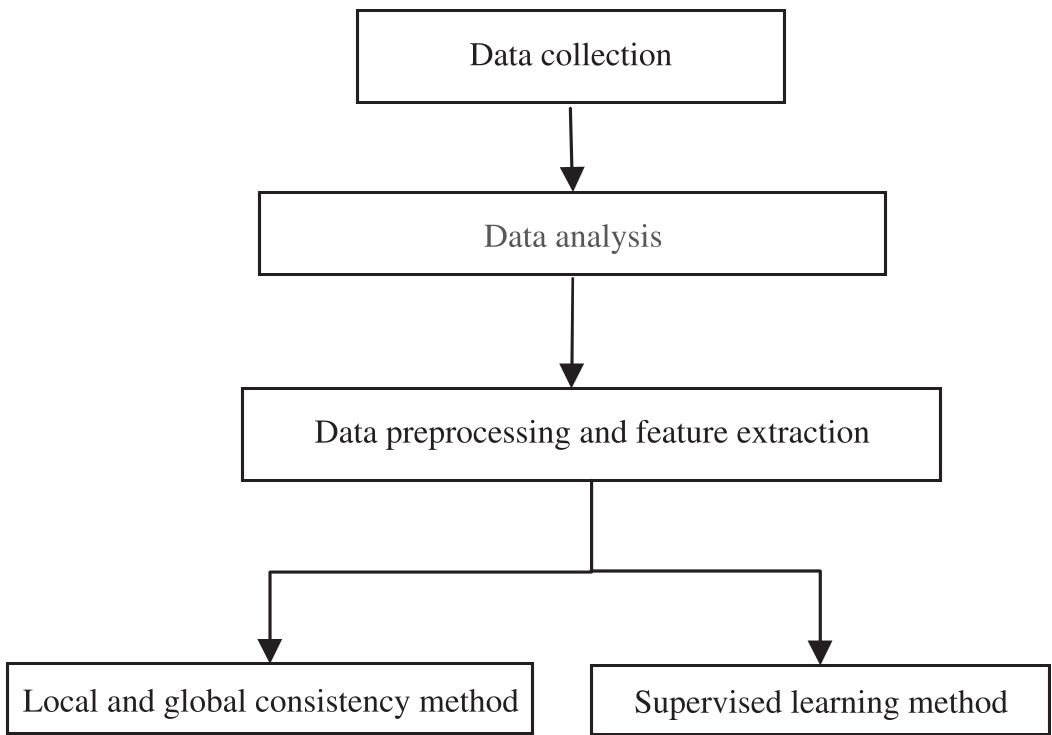
The core of the paper is the Local and Global Consistency (LGC) algorithm. The intuition is simple: a user’s attribute label should be consistent with its neighbors (Local) and the overall structure of the network (Global).
1. Multi-Relational Similarity
Instead of using a simple binary "friend or not" link, the authors define a distance using three vectors:
- Friendship Similarity: Shortest path distance between nodes.
- Group Similarity: Jaccard index based on shared public groups.
- Attribute Similarity: Cosine similarity of known profile features.
2. Adaptive Weighting Strategy
The algorithm refines the weight matrix . If two users and are labeled and share a label, . If they differ, . For unlabeled nodes, they use an RBF kernel: where is dynamically set as the average of all distances, ensuring the model remains stable across different network densities.
Experimental Insights: The Power of Affinity
The authors introduced a metric called Affinity (). It measures how much more likely users with the same attribute are to be friends compared to a random baseline.
| Attribute | Affinity |
|---|---|
| University | 11.1 |
| High School | 37.15 |
| Gender | 0.966 |
Observation: Attributes like "High School" have massive affinity, meaning they are the strongest predictors. Conversely, "Gender" has an affinity near 1.0, suggesting it has almost no influence on friend selection on this platform.
Performance Results
The LGC models consistently outperformed Supervised Learning (SVM, Decision Trees) by large margins, particularly when labeled data was limited (e.g., only 8-10% samples).

As shown in the table for University Inference, the "LGC Friend" configuration achieved 84.3% accuracy, significantly higher than the 67.1% achieved by Decision Trees.
Internal Mechanism: Why does it work?
The effectiveness of the SSL approach stems from the Smoothness Assumption. In a social graph, the "manifold" of the data is the network itself. By propagating labels through the weighted matrix , the model allows information to "leak" from confirmed users to their neighbors in a mathematically rigorous way until the system reaches a steady state.
Critical Analysis & Conclusion
Takeaways:
- Context Matters: Group relations are excellent for predicting hobbies, while friendship links are superior for predicting schools/majors.
- SSL Superiority: When dealing with social graphs, ignoring unlabeled nodes (as supervised learning does) is a waste of 90% of your available information.
Limitations: The current approach uses a static graph. In real-world scenarios, social networks are dynamic—friendships form and break, and groups evolve. Future iterations should likely incorporate Temporal Graph Networks or Graph Convolutional Networks (GCNs) to handle evolving topologies.
Final Thought: This paper proves that "privacy" in a connected world is an illusion; even if you hide your data, your network reveals you.