
Digital Inclusion Beyond Disability: What Truly Drives SNS Activity for the D/deaf?
What Predicts the Frequencies of Activities on Social Networking Sites among the D/deaf and Hard of Hearing?
This study investigates the predictors of Social Networking Site (SNS) activity frequencies among D/deaf and hard of hearing (D/HH) individuals in Germany. Using regression analysis on a sample of 199 users, the research identifies gender, education level, mobile device usage, and specific purposes (fun/work) as key drivers of online engagement.
Executive Summary
TL;DR: This study shifts the focus from "hearing loss level" to "behavioral and demographic drivers" to explain how D/deaf and hard of hearing (D/HH) individuals engage with social media. By analyzing 199 users in Germany, the researchers found that gender, education, and mobile accessibility—rather than the severity of hearing loss—are the true predictors of how often these users post, like, and share.
Academic Context: This work functions as a critical bridge between accessibility research and behavioral psychology, moving away from a purely medical model of disability to a social-technical understanding of digital engagement.
Problem & Motivation: The Myth of Hearing Loss
Historically, researchers assumed that the degree of hearing loss would directly correlate with digital exclusion or activity levels on text-based platforms. However, the linguistic reality is more complex: for many D/HH individuals, Sign Language is the first language, and written text is a second language.
The authors identified a gap: if hearing loss isn't the primary barrier, what is? They hypothesized that the "ease of use" provided by mobile devices and the specific "purposes" (like fun or schoolwork) might be more influential than the clinical measurement of decibel loss.
Methodology: Accessible Research Design
To capture authentic data, the researchers didn't just provide a text-based survey. They used a specific bilingual methodology:
- Sign Language Integration: Every question was accompanied by a video of a sign language interpreter to accommodate varying levels of written literacy.
- Comprehensive Variable Tracking: They tracked not just what people did, but on which device and for what reason.
 Figure 1: Visual representation of the study's scope (Conceptual).
The Core: What Actually Predicts Activity?
The study utilized a standard regression analysis to isolate the impact of 17 different variables.
1. The Complexity Barrier
The researchers found a clear hierarchy in activities. "Liking" was the most frequent, while "Posting Videos" was the least. This suggests that while D/HH users are highly active, they favor "low-effort" interactions that don't require complex technical or linguistic output.
2. The Predictor Matrix
The regression model revealed that 33% of the behavior could be explained by a few key factors:
- Demographics: Surprisingly, men and individuals with lower education levels showed higher frequencies of activity.
- Mobile Primacy: Accessing SNS via smartphones and tablets significantly predicted higher overall activity, highlighting the importance of "always-on" accessibility.
- The "Work-Fun" Duality: Using SNS for school or work was a powerful predictor (), suggesting these sites are not just for leisure but are essential tools for professional inclusion.
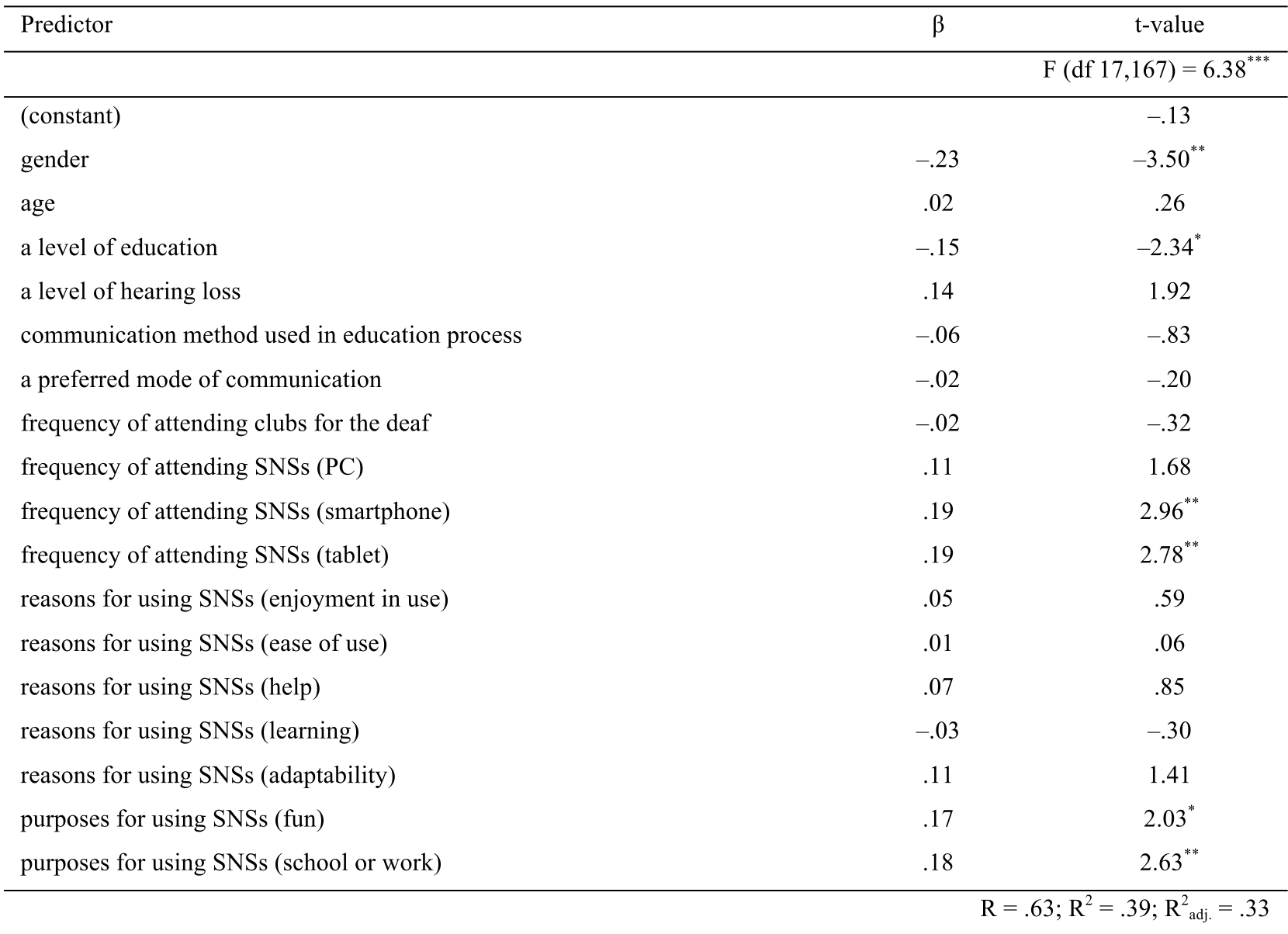 Table 1: Standardized coefficients (β) showing the weight of significant predictors like gender and mobile device usage.
Critical Analysis & Conclusion
Takeaway
The most profound insight is that motivation and access modality trump the physiological disability. If an SNS helps a D/HH person with their job or education, they will use it frequently regardless of their hearing level.
Limitations
- Self-Reporting: The study relies on participants estimating their own frequency of use, which can be prone to recall bias.
- Geographic Specificity: The results are specific to Germany; cultural differences in sign language and digital infrastructure might change the results in other regions.
Future Outlook
This paper paves the way for "Integrated Educational SNS" designs. If "school and work" are such strong drivers of activity, future accessibility tech should stop focusing on "fixing" hearing and start focusing on "optimizing" the collaborative workspaces within social platforms to be more Sign-Language friendly.