
How Are You Related? Decoding Social Roles through the Lens of Call Graphs
How Are You Related? Predicting the Type of a Social Relationship Using Call Graph Data
The paper proposes a method to predict four types of social relationships (Family, Co-worker, Service, Customer) by analyzing Call Detail Records (CDRs). Using a combination of communication behavioral features and social network topological properties, the authors achieved an 87.6% classification accuracy using a Random Forest model.
TL;DR
This research by Sprint Advanced Analytics Labs tackles the challenge of identifying whether two people are family, colleagues, or business partners based solely on their phone call patterns. By analyzing over 445,000 edges in a social graph derived from CDRs, the authors achieved an 87.6% accuracy in relationship type prediction using a Random Forest classifier.
Context & Motivation: Why Relationship Types Matter
In the world of social network analysis, we often focus on if a connection exists (Link Prediction) or who belongs to a cluster (Community Detection). However, the nature of the bond—the "Why"—remains elusive.
The authors argue that knowing the relationship type has immense commercial value. For a telco, identifying a non-customer who is a "Family" member of an existing subscriber is a prime target for a new line; identifying a "Service" relationship (like a doctor or plumber) helps in refining recommendation engines. The primary hurdle has always been Ground Truth: how do you label millions of relationships without calling everyone and asking?
Methodology: The "Account Map" Insight
The core innovation lies in the labeling strategy. Instead of surveys, the authors used Subscription Plans:
- Family: Shared small family plans (<10 members).
- Co-worker: Shared large corporate plans (>50 members).
- Service/Customer: Identified via external business listings and directed call flow.
Feature Engineering
The authors split features into two distinct buckets:
- Communication Behavior: 17 features including call duration (Mean/Med/Max), frequency, and timing (Work hours vs. Weekends).
- Social Topology: 5 features representing the local graph environment. This includes the Jaccard Coefficient (Mutual Contacts) and the Second Shortest Distance (the path length between two people if their direct link is removed).
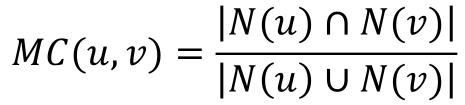 The Jaccard Coefficient formula used to measure the overlap of social circles.
The "Rhythm" of Relationships: Key Findings
The data revealed fascinating behavioral signatures for different social roles:
- The Family Pulse: Family members call each other the most frequently, but these calls are generally shorter (quick check-ins). They also share a high ratio of mutual contacts.
- The Service Bridge: Calls to businesses (Service) are infrequent but long—think of being put on hold or explaining a complex problem to a service representative.
- The Workplace Echo: Co-workers show a distinct drop in activity during weekends and higher connectivity within specific corporate clusters.
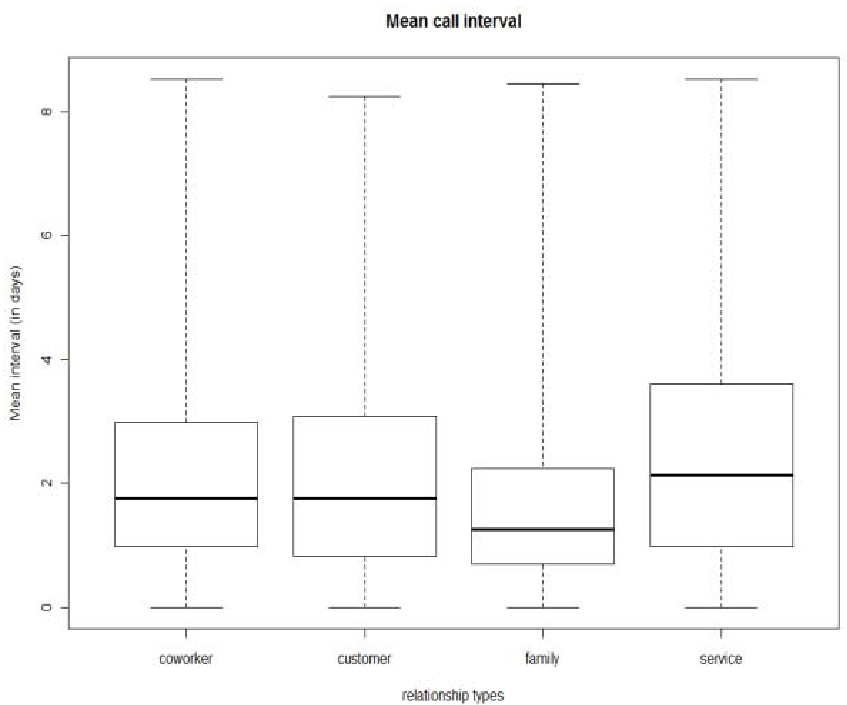 Figure 1: Distribution of call intervals. Note how Service relationships have significantly longer gaps between interactions.
Experimental Performance
The Random Forest classifier was chosen for its robustness against unbalanced datasets and high-dimensionality.
Performance Comparison
| Feature Set | Accuracy |
|---|---|
| All Features | 87.60% |
| Social Network Only | 80.82% |
| Comm. Behavior Only | 76.71% |
The result that Social Network features alone outperform Communication features alone is a profound insight. It suggests that who you both know is a stronger indicator of your relationship than how long you talk to each other.
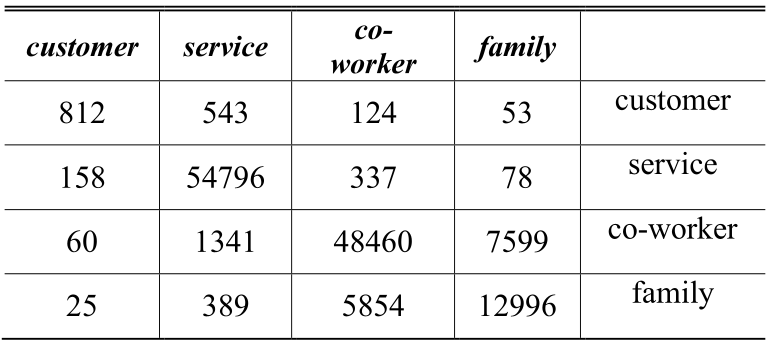 The Confusion Matrix reveals that while the model is excellent at identifying Service/Co-worker roles, it occasionally confuses Family and Co-workers, likely due to "noisy" labeling where some non-family members share family plans.
Critical Insight & Conclusion
This paper proves that our social roles are not just private labels but are etched into the metadata of our digital lives.
Takeaways for the Industry:
- Metadata is Message: You don't need to record the content of a call to understand the bond; the timing and the surrounding graph are enough.
- Scalable Ground Truth: Subscription and billing data are underutilized "Gold Mines" for training supervised models in telecommunications.
Limitations: The study relies on the assumption that billing plans accurately reflect social reality. As "Family Plans" are often extended to friends to save costs, a degree of label noise is inevitable. Future work using Graph Neural Networks (GNNs) could likely push this accuracy past the 90% threshold by capturing higher-order neighborhood structures.