
Regularizing Emotions: Improving Stock Index Prediction via Sparse Selection
Predicting the Change on Stock Market Index Using Emotions of Market Participants with Regularization Methods
This paper introduces a sentiment-based stock index prediction framework using regularization methods (LASSO and Elastic Net) for variable selection. By analyzing investor emotions from social media, it achieves superior performance in predicting the SSE Composite Index compared to traditional statistical selection methods.
TL;DR
Predicting the stock market using social media sentiment is a "high-noise" challenge. This paper demonstrates that when the number of sentiment-related keywords approaches the number of available observations, traditional variable selection fails due to overfitting. By applying LASSO and Elastic Net regularization, the authors successfully filtered emotion-driven noise, significantly enhancing the accuracy of SSE Composite Index forecasts.
Background & Motivation: The Emotional Market
Modern behavioral finance suggests that market participant emotions are not just noise—they are leading indicators. With the explosion of platforms like the Xueqiu Forum, we can now quantify "market sentiment" through keyword frequencies. However, this leads to a technical bottleneck: The Dimensionality Trap.
When we track 57 different emotion keywords over 50 days, our predictor count () is nearly equal to our sample size (). Traditional methods like Variance Inflation Factor (VIF) and t-tests tend to "over-calculate" the importance of irrelevant words, leading to models that memorize the past but fail to predict the future.
Methodology: Beyond Simple T-Tests
The core innovation lies in shifting from traditional t-tests to Penalized Likelihood Estimation.
1. The Limitation of VIF-Based T-Tests
Traditional methods calculate a t-score for each variable and filter based on VIF to avoid multicollinearity. While simple, this approach often selects too many variables, as shown in the authors' simulation where VIF-t selected nearly all 50 variables even when only 5 were truly influential.
2. The Regularization Approach
The authors implemented two primary regularization schemes within a Logistic Regression framework:
- LASSO (L1 Regularization): Forces the coefficients of less important features to exactly zero, performing automatic variable selection.
- Elastic Net: A hybrid that combines L1 and L2 penalties, which is particularly effective when variables (emotion keywords) are highly correlated.
 The penalized likelihood function used to shrink coefficients and select features.
Experimental Validation
The authors tested their hypothesis through both synthetic simulations and real-world data from the Shanghai Stock Exchange (SSE).
Simulation Insights
In controlled tests where and varied from 50 to 100, regularization methods consistently stayed closer to the "true" number of variables (5), while VIF methods consistently over-selected, reaching the maximum variable limit and introducing massive noise.
Real-World Performance (SSE Index)
Using 50 days of data and 57 keywords, the team compared five classification algorithms (KNN, LR, LDA, TREE, SVM) across different selection methods.
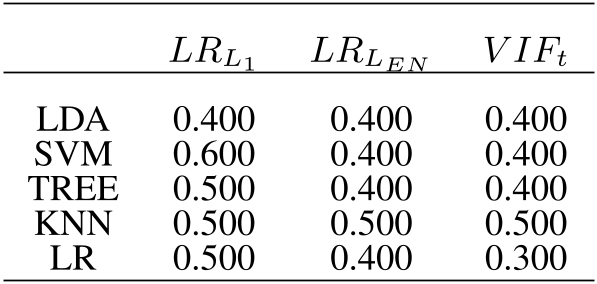 Testing Error Results: Regularization ( and ) consistently produced lower testing errors than the traditional approach.
The results were striking: while achieved 0.000 training error in most cases (a clear sign of extreme overfitting), the regularization methods provided a much more realistic and robust performance on the test set, proving their generalization capability.
Critical Analysis & Future Outlook
The paper effectively highlights a common pitfall in financial data mining: the assumption that more variables equal better predictions. However, there are limitations:
- Manual Feature Engineering: Keywords were manually selected based on a 3-day sample. Modern Text Mining and NLP (like Transformers) could automate and refine this process.
- Data Volume: 50 days is a relatively small window for financial markets. Larger datasets might reveal more complex non-linear relationships.
Takeaway for Practitioners: When working with "short and wide" datasets (where ), stop relying on simple statistical significance tests. Regularization isn't just a luxury; it’s a necessity to prevent your model from being fooled by the inherent noise of social media.
Conclusion
By treating sentiment analysis as a sparse variable selection problem rather than a simple correlation problem, this research paves the way for more reliable emotion-driven trading strategies.