
Predicting Student Emotions: Machine Learning Insights from Classroom Feedback
Predicting Students’ Emotions Using Machine Learning Techniques
This paper explores the automated detection of student emotions from real-time textual feedback (Twitter) using various machine learning techniques. It evaluates seven classifiers across different emotion sets, identifying Complement Naive Bayes (CNB) as a superior method for single-emotion detection, specifically for "Amused," "Bored," and "Excitement."
TL;DR
Understanding how students feel during a lecture is critical for engagement. This study investigates if machine learning can bypass manual monitoring by classifying student "tweets" into emotions like boredom, confusion, and excitement. Using a real-world dataset, the research identifies Complement Naive Bayes (CNB) as the most effective tool for pinpointing specifically difficult-to-catch emotions in learning environments.
Context & Motivation
Educators know that a bored student isn't a learning student. However, tracking the emotional pulse of a large lecture hall in real-time is nearly impossible. While Twitter and feedback apps offer a window into the student experience, the sheer volume of data makes manual analysis a bottleneck.
The researchers identified a gap in existing literature: while sentiment analysis (positive vs. negative) is mature, domain-specific emotion detection—recognizing states like frustration or amusement in an educational context—is still in its infancy.
Methodology: The Search for the Best Classifier
The study pipeline followed a standard NLP workflow: preprocessing, feature selection (unigrams), and classification. They benchmarked seven distinct algorithms:
- Naive Bayes (NB) and its variants (MNB, CNB)
- Support Vector Machines (SVM)
- Maximum Entropy (ME)
- Sequential Minimal Optimization (SMO)
- Random Forests (RF)
An interesting tactical choice was the comparison between High Preprocessing (stripping URLs, hashtags, mentions) and Low Preprocessing (tokenization and lowercase). Surprisingly, high-intensity cleaning did not significantly boost performance, suggesting that the informal structure of "Twitter-speak" retains emotional value even in its noisy state.
Key Results & Insights
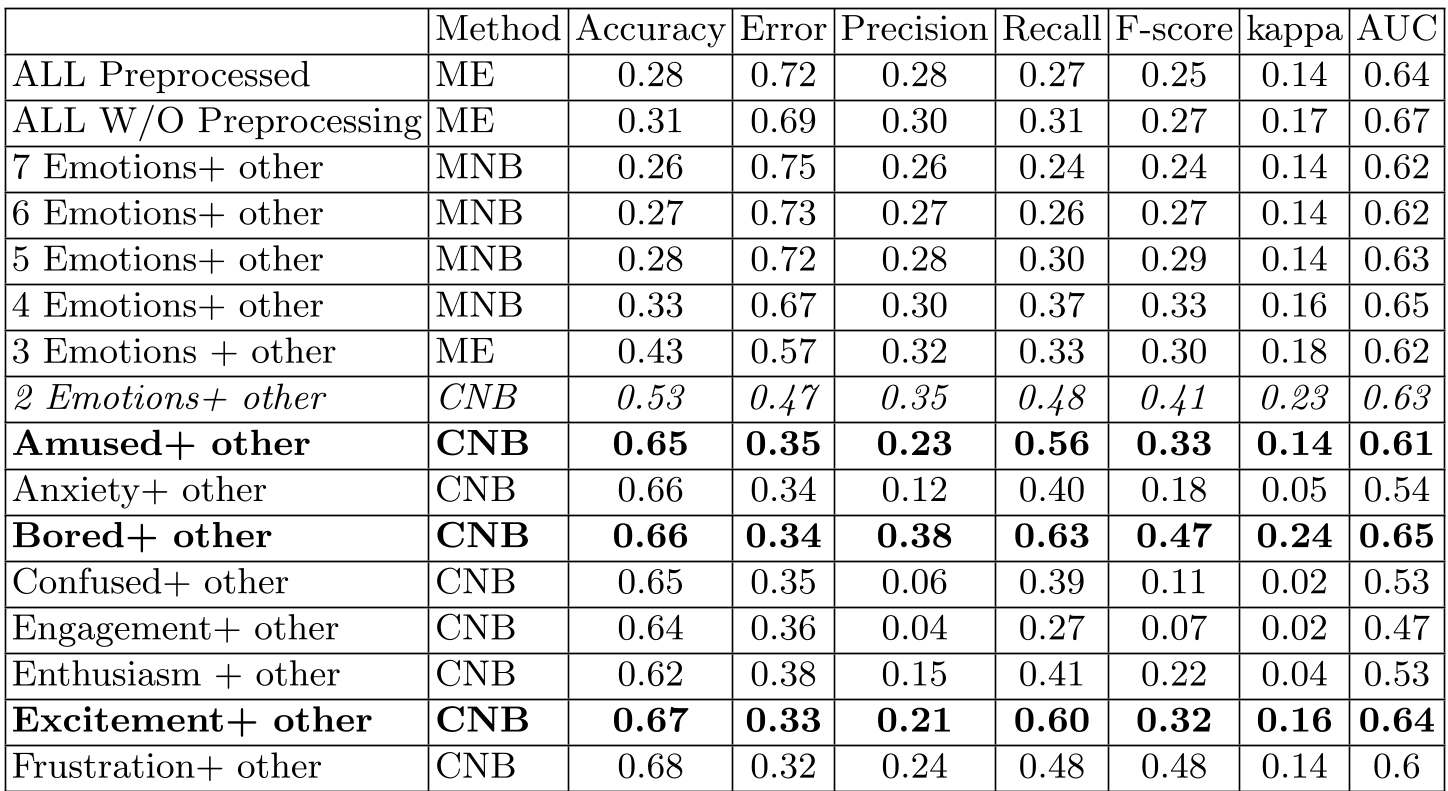
- Simplification is Key: Multi-class models (trying to distinguish between 8 emotions at once) struggled significantly. The models performed much better when framed as a binary task: detecting one specific emotion against an "other" category.
- CNB Dominance: Complement Naive Bayes (CNB) emerged as the clear winner for single-emotion detection. It was particularly effective at maximizing "Recall"—the ability of the model to actually find instances of an emotion rather than just guessing.
- Detectability Variance: Not all emotions are created equal. Emotions like Boredom (Recall 0.63) and Amused (Recall 0.56) were significantly easier for the algorithms to identify than subtle states like "Engagement."
Critical Analysis & Future Directions
The paper honestly acknowledges a major hurdle: Limited Data Performance. With AUC scores hovering around 0.60, these models are "better than chance" but not yet "human-grade." The primary challenge is the ambiguity of language—a word like "challenging" could imply healthy excitement for one student but deep frustration for another.
The Takeaway for Educators/Tech Developers: If you are building a tool to monitor classroom health, don't try to build a "universal emotion detector" yet. Instead, focus on narrow binary classifiers for high-impact states like Boredom and Exitement using CNB, as these provide the most reliable signals for intervention.
Future Work: The authors suggest moving beyond unigrams to Bigrams and Trigrams and utilizing specialized emotion lexicons tailored specifically for the education sector to improve the semantic depth of the analysis.