
Decoding Political Virality: Predicting Tweet Success via Psycho-Linguistic Intelligence
On Predicting the Success of Political Tweets Using Psycho-Linguistic Categories
The paper introduces a predictive framework for political tweet success using 12 novel psycho-linguistic categories (e.g., immigration, security, kindness) combined with context-dependent features. By analyzing a dataset of nearly 5,000 tweets from a popular Italian politician, the authors utilize Decision Tree and K-Nearest Neighbors (KNN) algorithms to achieve a classification accuracy of 76% in predicting message engagement.
TL;DR
In the high-stakes arena of digital politics, the difference between a viral manifesto and a ignored post often lies in specific linguistic "triggers." This paper moves beyond simple hashtags and timing, introducing a machine learning framework that uses 12 psycho-linguistic categories to predict tweet success with 76% accuracy. By analyzing the digital footprint of a major Italian politician, researchers discovered that thematic content—particularly around "Immigration" and "Security"—far outweighs traditional engagement metrics.
Context & Positioning
Is social media engagement purely random, or is there a hidden grammar to virality? Most social media managers rely on "best times to post" or "image vs. text" rules of thumb. However, this study treats political communication as a psychological mapping exercise. It positions itself as a transition from descriptive analytics (what happened?) to predictive linguistics (what will succeed?), specifically within the polarized context of contemporary European politics.
The Problem: The Poverty of Surface Metrics
Previous research has heavily prioritized metadata:
- Temporal factors: Does posting at lunch increase visibility?
- Structural factors: Do hashtags like #Politics actually help?
- Sentiment: Is "Happy" better than "Angry"?
The authors argue these are insufficient. A politician’s audience doesn't just respond to a "positive" sentiment; they respond to specific thematic anxieties or aspirations like "Security" or "Belonging." The core challenge is defining a methodology that captures these nuanced psycho-social categories and tests their predictive power.
Methodology: The Psycho-Linguistic Framework
The authors define Positive Engagement (PE) through a weighted formula: This acknowledges that a Retweet represents a higher cognitive investment and "endorsement" than a simple Like, while Replies can often be antagonistic.
Feature Engineering
Each tweet was processed into 16 features:
- Psycho-linguistic (12): Business, Kindness, Immigration, Security, Illegal, Politics, Social, etc.
- Context-Dependent (4): Length, Time of Day, Day of Week, and Presence of Images.
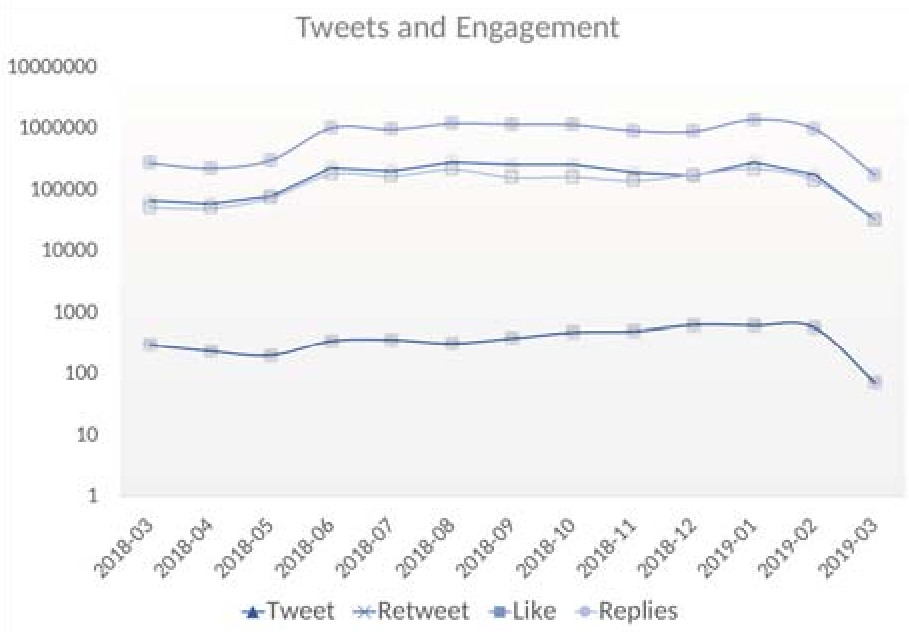 Fig 1: The sheer volume of likes vs. replies/retweets indicates that "Liking" is the most common but least committed form of engagement.
The "Why" behind the Success: Insights from the Decision Tree
The most striking find was the hierarchy of importance. Through the Gini Index, the authors found that for this specific politician, certain features were dramatically more predictive than others:
- Immigration (0.43): By far the strongest predictor.
- Image Presence (0.25): Validating the "visual turn" in social media.
- Length (0.17): Interestingly, longer tweets (over 140 chars) often performed better in specific contexts.
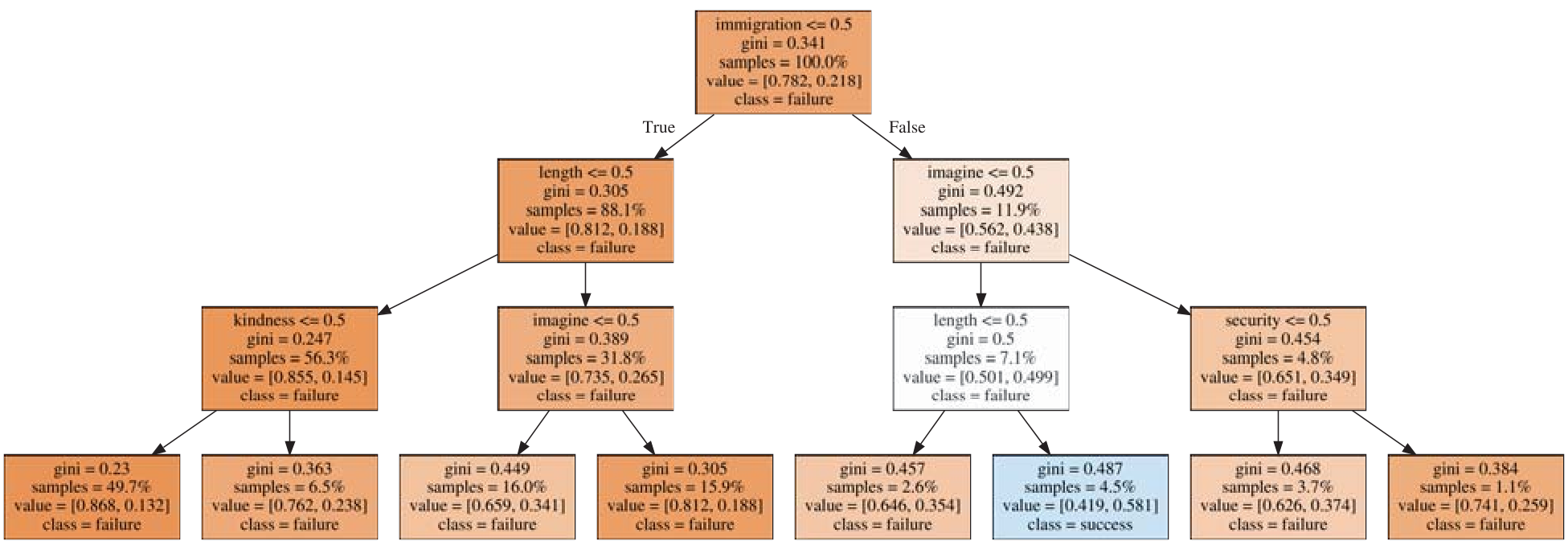 Fig 2: A simplified Decision Tree showing that tweets lacking "Immigration" themes and "Kindness" keywords have an 87% probability of failure.
Results & Performance
The study compared two primary classifiers:
- Decision Tree: Achieved 76% accuracy. It excels at identifying the "thresholds" of specific word frequencies.
- K-Nearest Neighbors (KNN): Validated with 10-fold cross-validation, it also converged at 76% accuracy with .
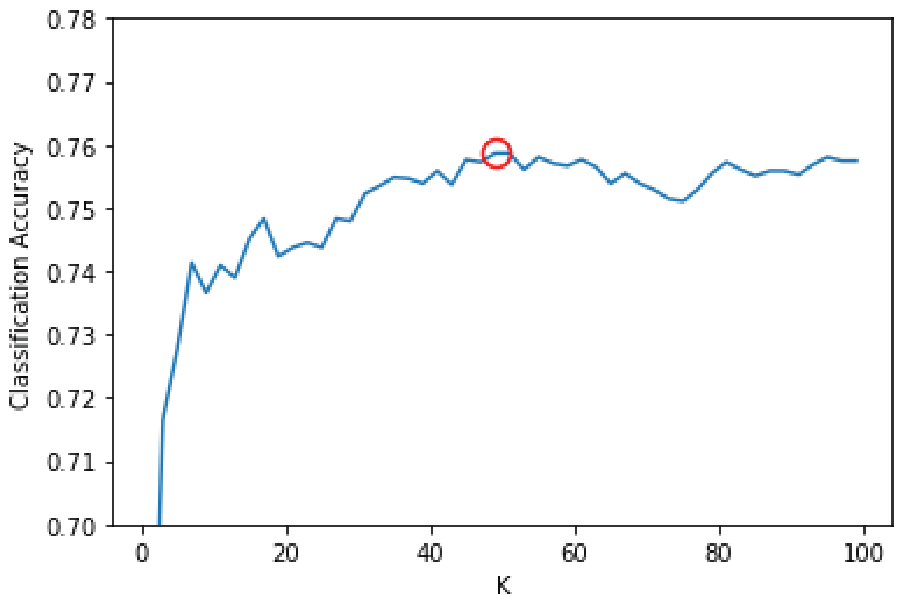 Fig 3: The KNN performance stabilizes as k increases, showing the robustness of the 16-feature space.
Critical Analysis & Future Outlook
Takeaway: The study proves that "What you say" is significantly more predictable than "When you say it." For political strategists, this suggests that the success of a message is baked into its linguistic DNA before it is even published.
Limitations:
- Generalizability: The categories were tuned for an Italian context. A left-wing politician or one from a different culture (e.g., Japan or the US) would require a different set of psycho-linguistic dictionaries.
- Sarcasm/Context: Static dictionaries struggle with irony—a staple of political Twitter.
Future Work: The authors suggest integrating more complex models like Neural Networks. However, the real value lies in the interpretable nature of the current model—politicians don't just need to know if a tweet will fail; they need to know why, so they can adjust their rhetoric.