
Precision Timing: Leveraging Cascaded Classifiers to Solve the Email Marketing Paradox
Predicting Suitable Time for Sending Marketing Emails
The paper proposes a predictive methodology for email marketing titled "Model Status-Time-Nday," aimed at optimizing the "Open Rate" by determining the ideal sending time for individual customers. By leveraging a cascaded classification approach based on the CRISP-DM framework, the authors achieved predictive accuracies of up to 93% for user engagement and over 80% for specific timing.
TL;DR
Marketing teams often treat email as a "cheap" medium, leading to suboptimal campaign timing that ignores user behavior. This paper introduces a cascaded machine learning methodology that predicts not only if a user will open an email but exactly when (day and hour) they are most likely to do so. By using a Decision Tree-based pipeline, the researchers achieved over 80% accuracy in predicting the specific hour of engagement, a massive leap over baseline heuristics.
The Problem: The Paradox of Cheap Communication
Email marketing is a victim of its own efficiency. Because it costs almost nothing to send a message, many organizations neglect the fine-tuning of delivery parameters. However, "Open Rate" is the lifeblood of digital marketing. Prior research on "best time to send" is often contradictory—some say Tuesday mornings, others say weekends.
The authors argue that the issue is population heterogeneity: every email list is a unique subset of human behavior. Thus, a static global rule is useless. The goal is to move from "General Best Practices" to "Individual Behavioral Prediction."
Methodology: The Cascaded Approach
The core of this research is a three-stage classification process built on the CRISP-DM (Cross-Industry Standard Process for Data Mining) framework. Instead of one complex model, the authors split the logic into a cascade.
1. The Model Architecture
The workflow functions like a selective gatekeeper:
- Model Status: A binary classifier (Open vs. Non-Open). If a user is predicted as "Non-Open," the system aborts—saving the user from spam and the sender from poor metrics.
- Model Time: Predicts the hour (0-23).
- Model Nday: Predicts the day of the week (1-7).
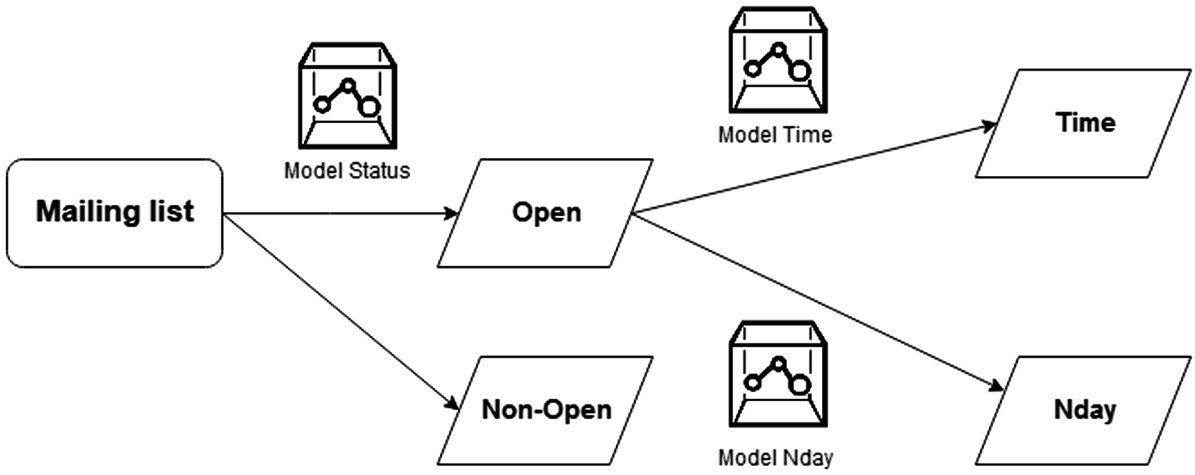 Figure: The cascaded workflow for status, time, and day prediction.
2. Feature Engineering & Selection
The authors started with 164 attributes (demographics, historical interaction, etc.). To manage this high-dimensional space, they employed Sequential Feature Algorithms (SFA)—a greedy search method that iteratively adds or removes features to find the optimal k-dimensional subspace. This ensures the model remains computationally efficient for real-time deployment.
Experiments & Results
The study utilized a massive real-world dataset, leaving 1,253,763 records strictly for final validation. They compared Naive Bayes, Random Forests, and Decision Trees against a "Baseline" (which simply predicts the most frequent class).
Performance Gains
The Decision Tree emerged as the champion across all categories:
| Target Attribute | Baseline Accuracy | Best Model (Decision Tree) |
|---|---|---|
| Status (Binary) | 90.52% | 93.01% |
| Time (Hour) | 35.91% | 80.54% |
| Nday (Day) | 56.33% | 88.68% |
The most striking improvement is in Time prediction, where the model became twice as accurate as the heuristic baseline.
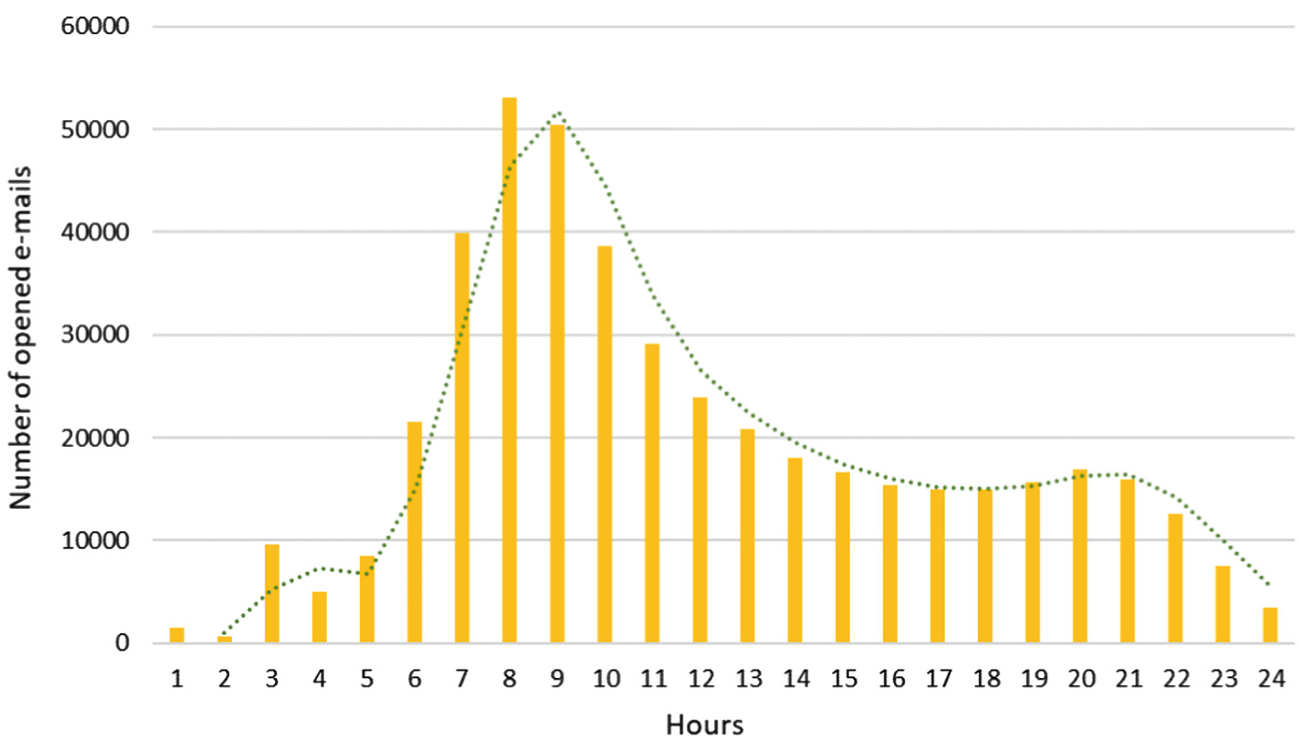 Figure: Data analysis showing peak activity times—Morning peaks (work starts) vs. Weekend peaks (personal tasks).
Critical Insight: Why Decision Trees?
While oftern overshadowed by Deep Learning in modern literature, Decision Trees proved highly effective here because marketing data often contains categorical variables and sharp logical boundaries (e.g., "Is it a Weekend?" or "Is the user in a specific timezone?"). The tree structure mirrors the human-like logic of "If [User Type] and [Campaign Type] Then [Specific Window]," providing both high accuracy and relative interpretability.
Summary & Future Outlook
This work demonstrates that "Send Time Optimization" is not a mystery but a data mining problem. By filtering non-responsive users first, the system focuses its predictive power only on active segments.
Takeaways for the Industry:
- Stop Global Scheduling: Your weekend customers and weekday customers are different people; treat them as different data points.
- Cascade your Logic: Filtering out "noise" (non-active users) before applying complex timing logic improves the accuracy of the final prediction.
- Validate on Scale: Using million-record validation sets is the only way to ensure these models survive the transition from the lab to a live production environment.